Appraisal catalogue · 30 September 2026

Bronze & Brass

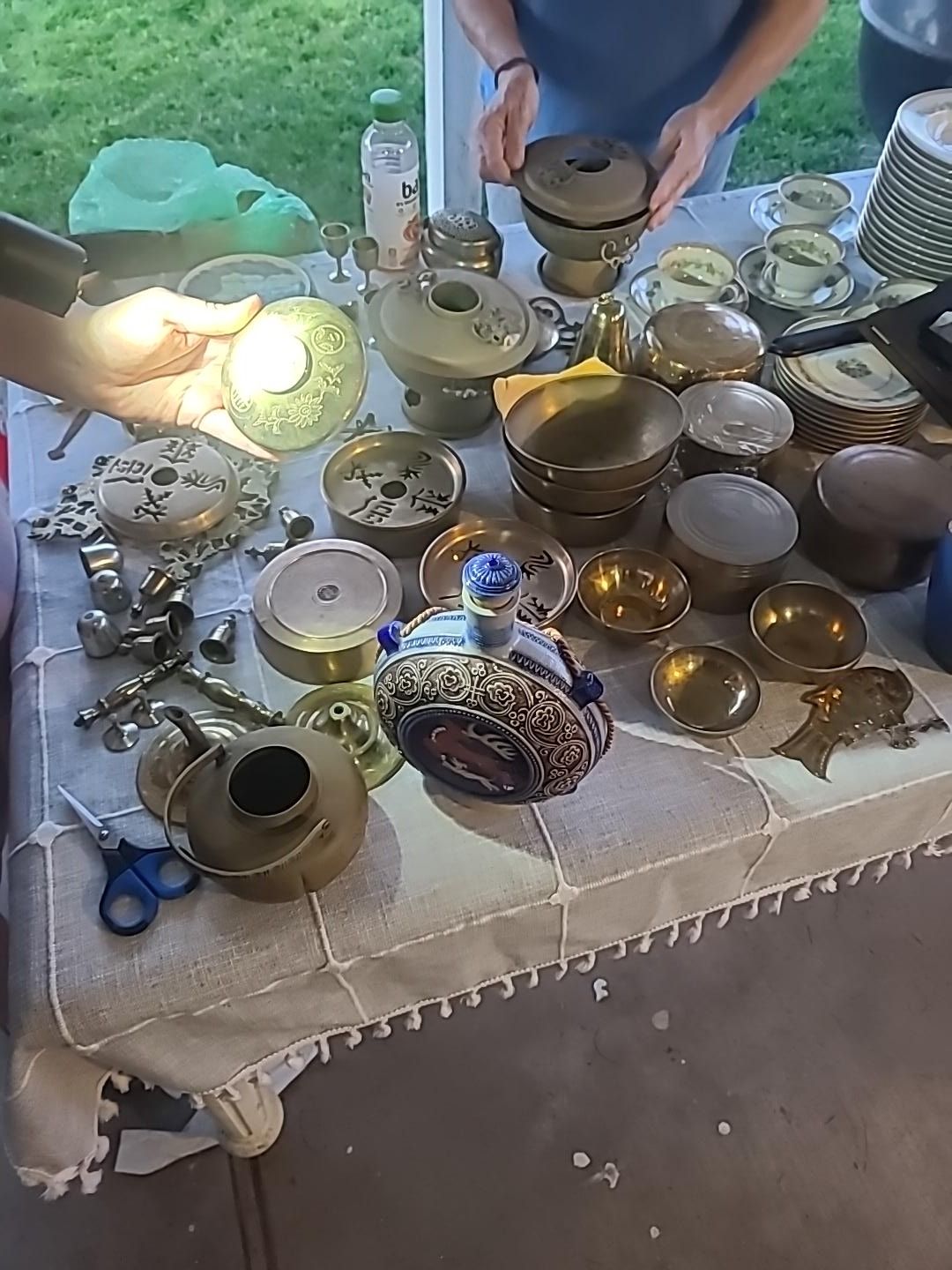
An estate group of Japanese bronze, Chinese cloisonné and Korean brass, with the china, stoneware and sterling that came with it. Every piece is identified as far as photographs allow and set against real market comparables. Where the evidence runs out, we say what we think it is anyway, and what would prove us wrong.

20lots
$2,415 – $6,170fair market value
65photographs
66cited comparables

Summary of values

LotObjectConfidenceRange
Japanese bronze$775 – $2,100
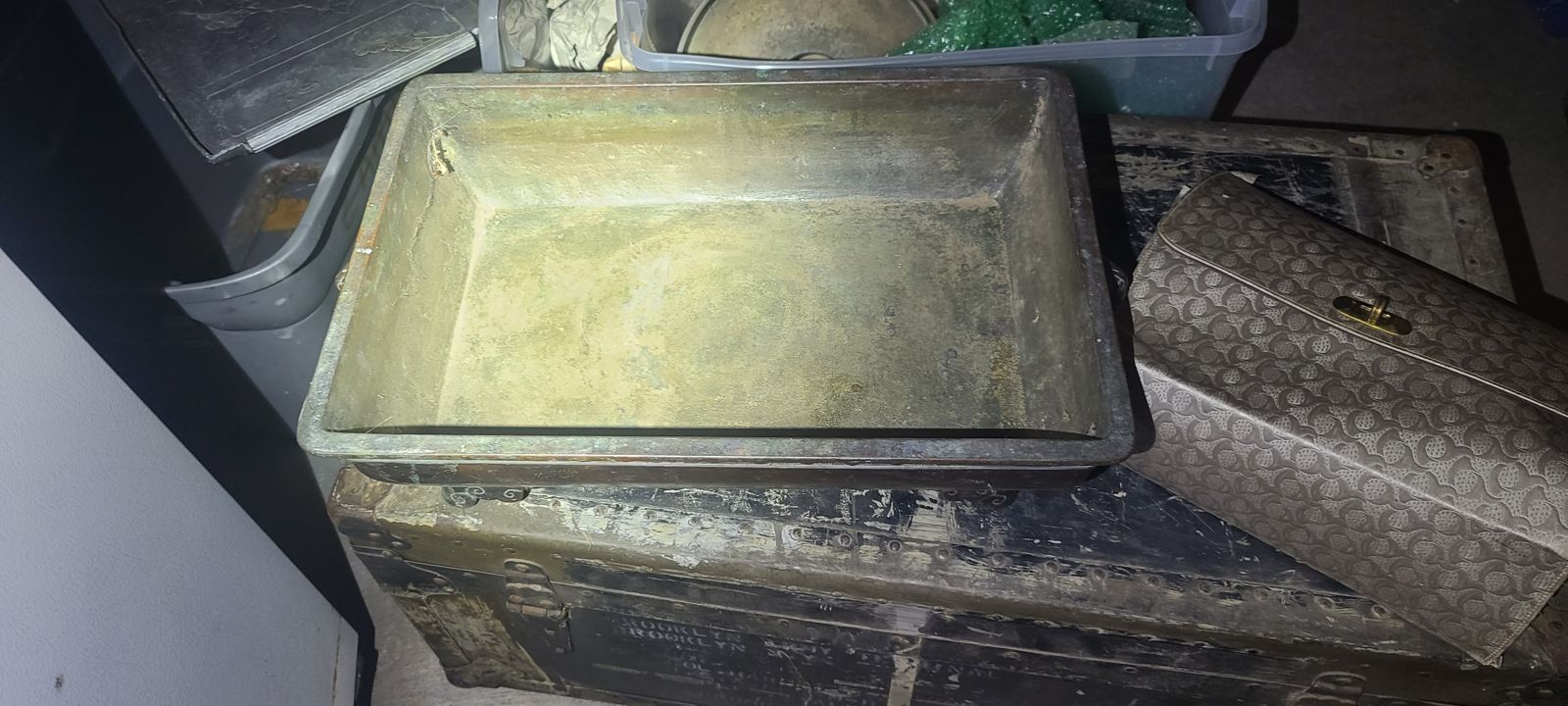
1Large rectangular bronze bonsai basin (suiban) with boss-band rim, scroll handles and cast seal markProbable$400 – $1,100
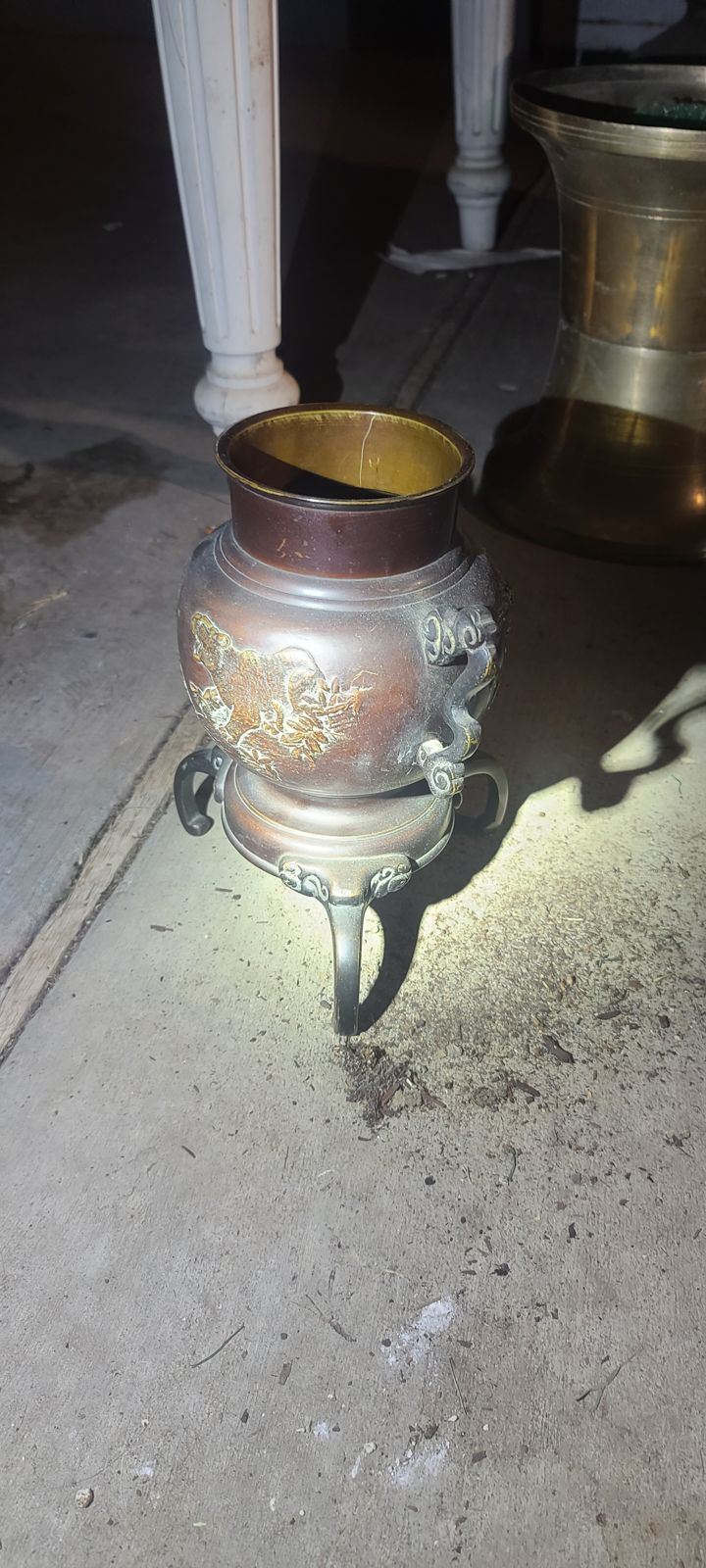
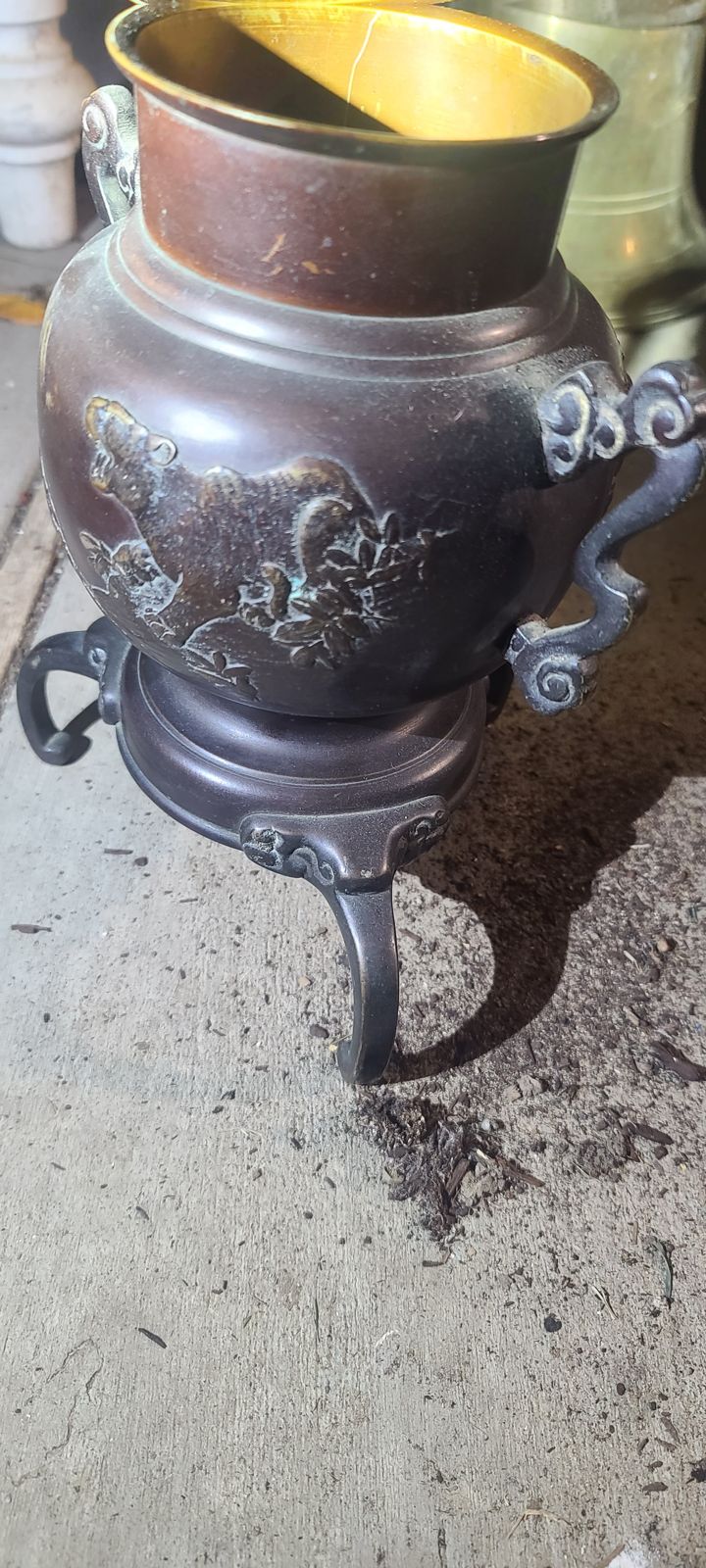
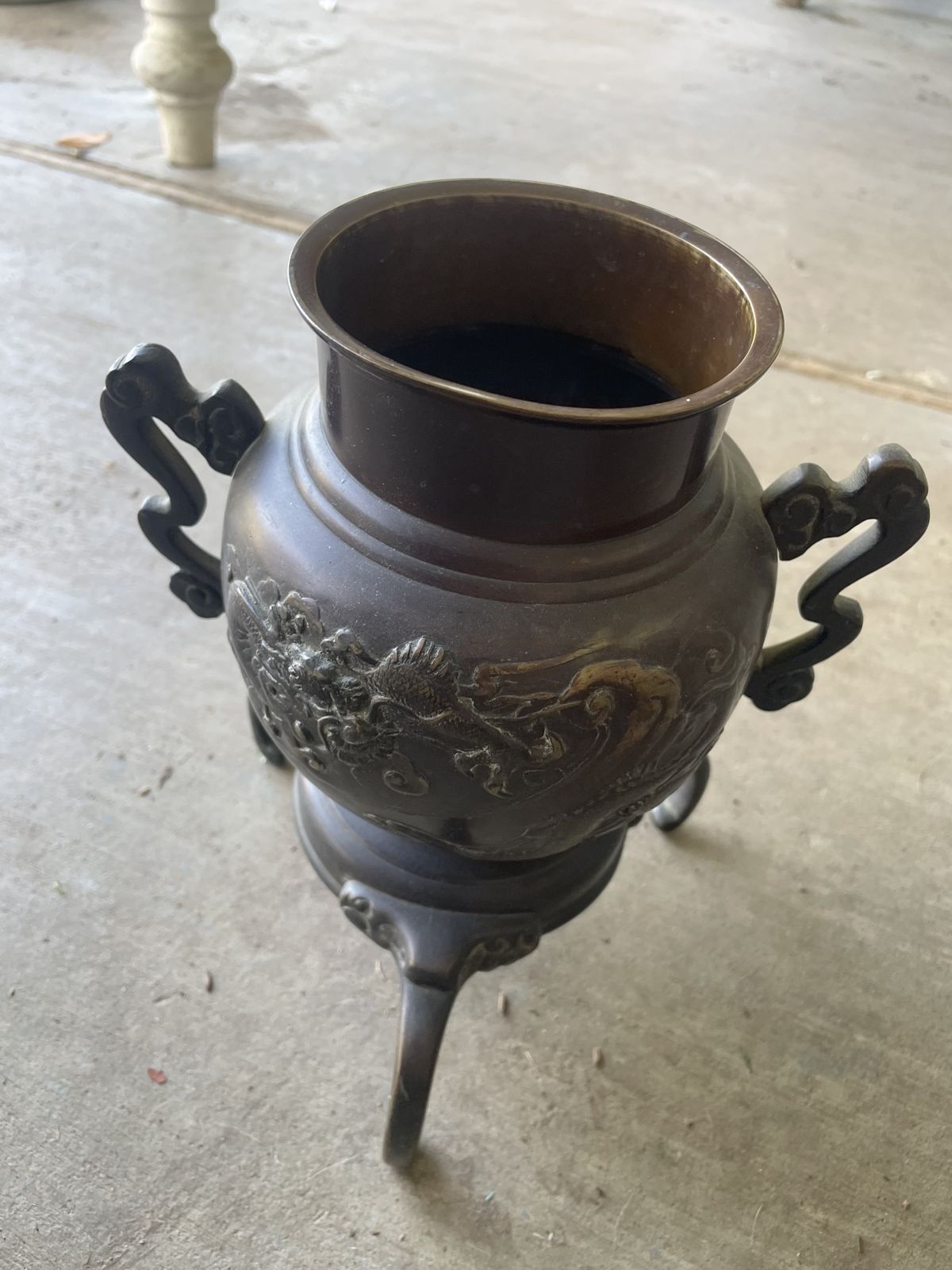
2Bronze "tiger and dragon" (ryūko) vase on detachable tripod standConfident$200 – $500
3Archaistic bronze jar with phoenix and kui-dragon band (in the manner of a Shang ritual lei)Probable$175 – $500
Chinese cloisonné$475 – $1,325
4Large cloisonné covered box: five-clawed dragon on the lid, shou characters and butterflies on the baseConfident$400 – $1,100
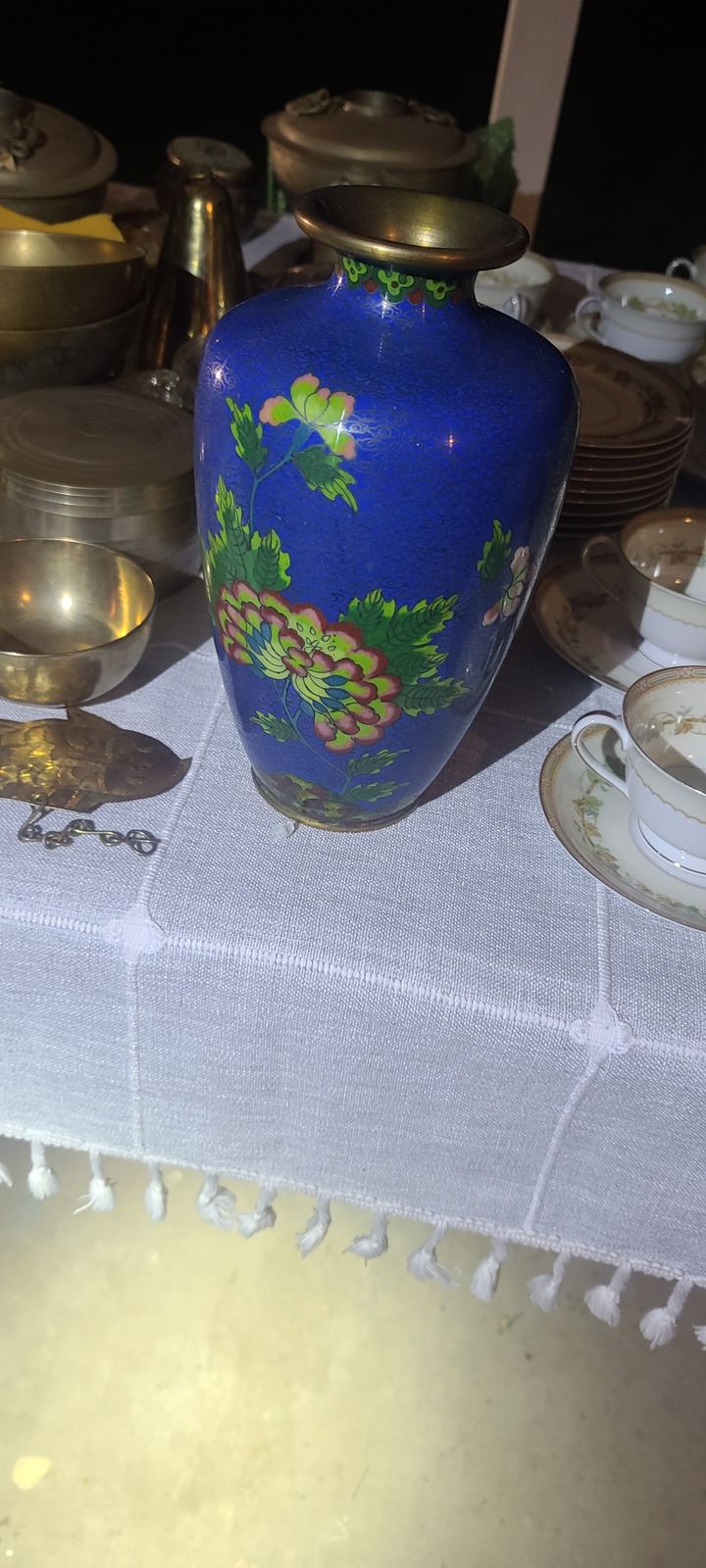
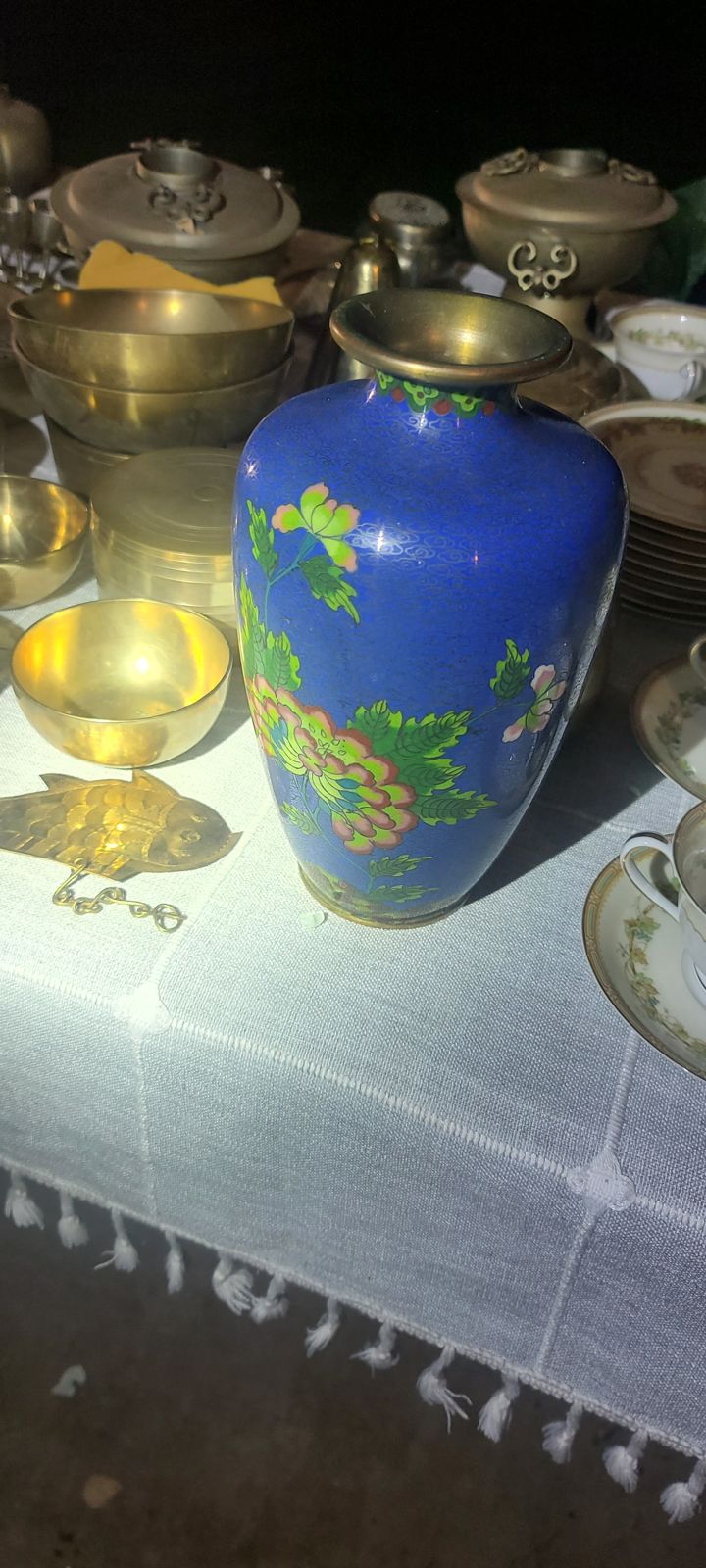
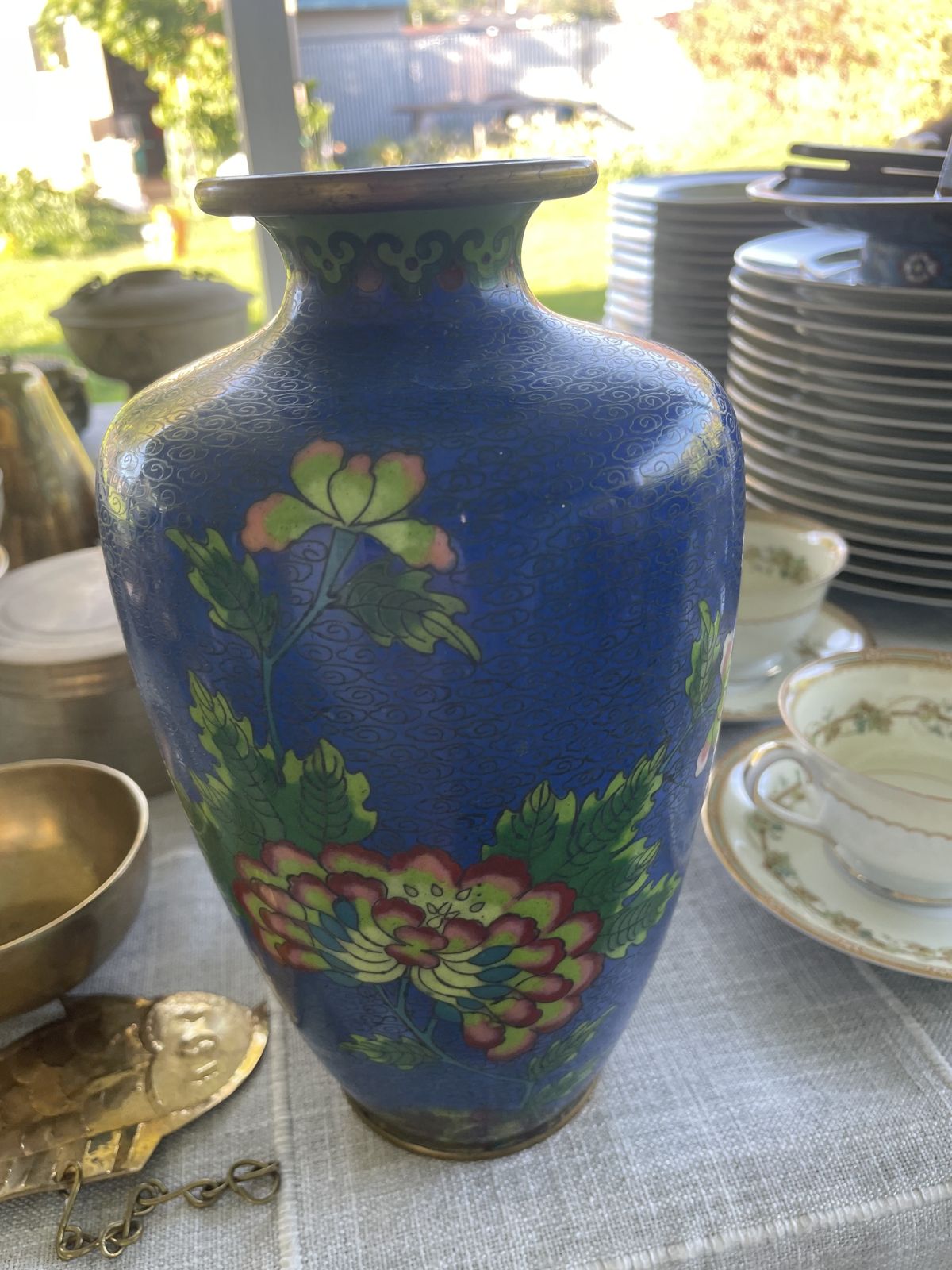
5Cobalt cloisonné baluster vase with peony spraysConfident$75 – $225
Korean & Asian brass$425 – $1,025
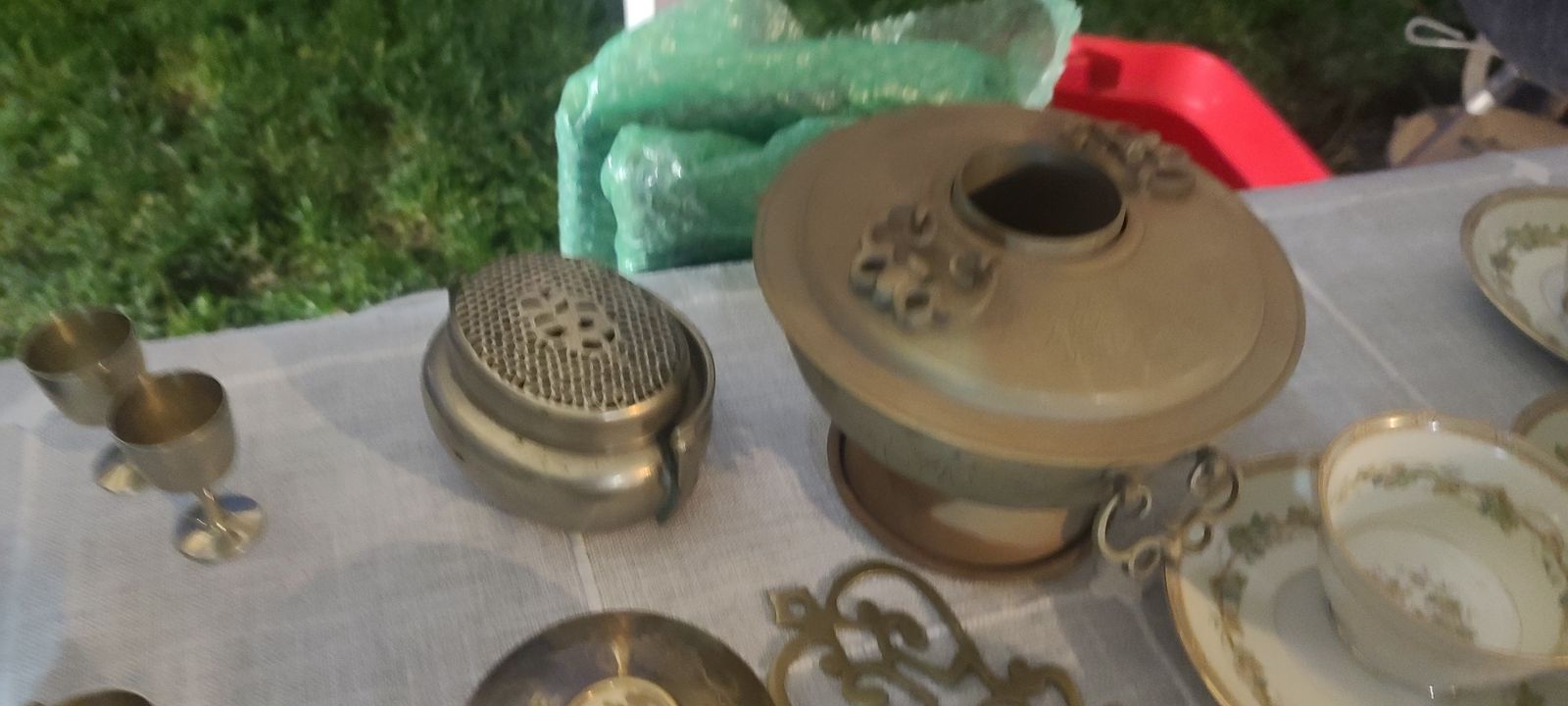
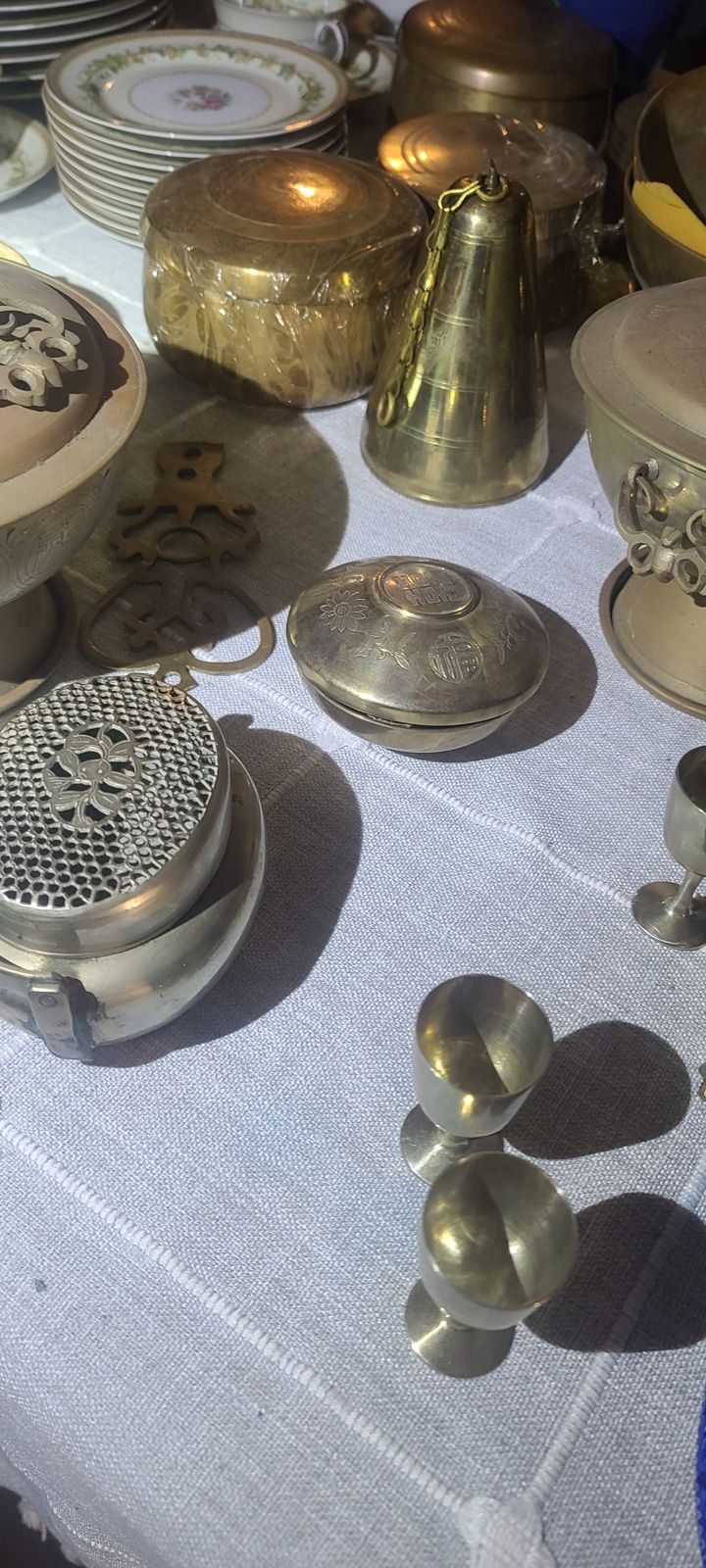
6Pair of brass sinseollo — Korean royal-court charcoal hot potsConfident$90 – $220
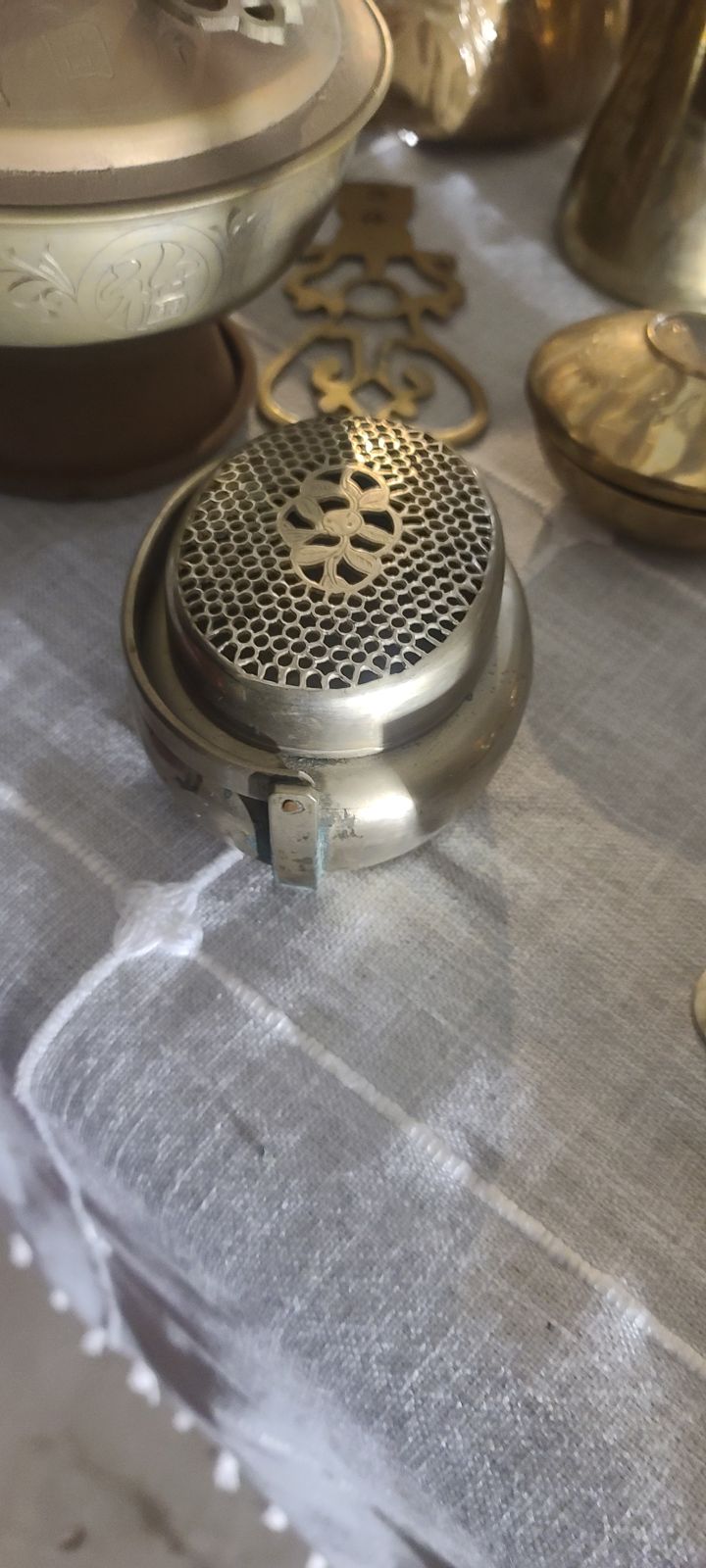
7Oval hand warmer (shǒulú 手爐) with honeycomb-pierced lidProbable$60 – $150
8Yugi brass rice bowls, including a lidded "double happiness" wedding bowlProbable$80 – $200
9Four lidded brass boxes with lids pierced in archaic-style characters (probably covered ashtrays)Speculative$60 – $140
10Brass drinking set: nine small cups, stemmed goblets, footed bowls and drip pansProbable$40 – $100
11Pair of openwork cast-brass dragon plaques / trivets and a small scroll ornamentConfident$30 – $60
12Brass bells, tall chained cone, candlesticks and two domed engraved basesSpeculative$35 – $80
13Copper cake server with crane handle, and an engraved brass trayProbable$20 – $45
14Stamped brass fish wall hanging with chainProbable$10 – $30
Other metal & stoneware$190 – $610
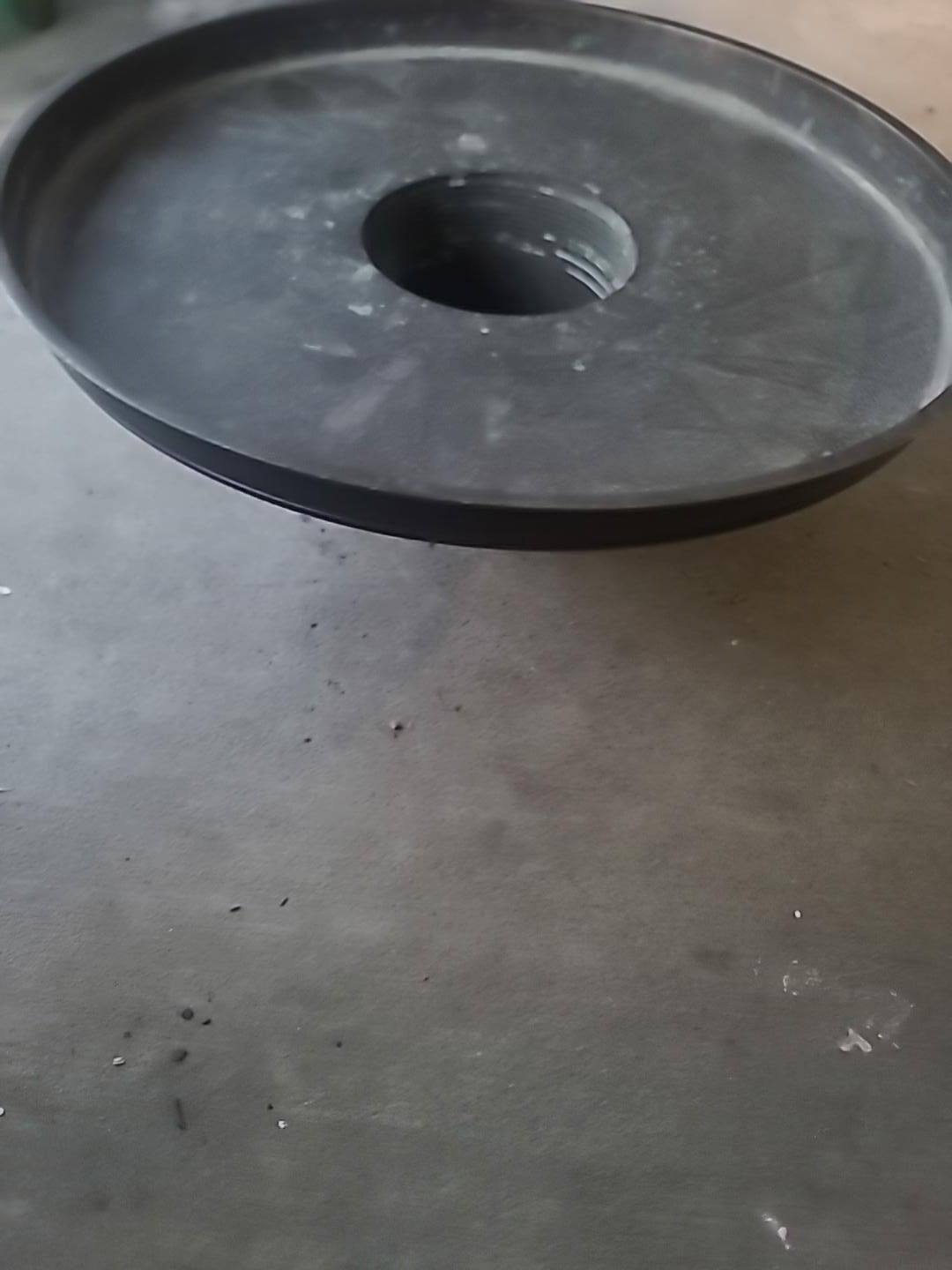
15Heavy round bronze pedestal bases, black patina, threaded centre socketSpeculative$150 – $500
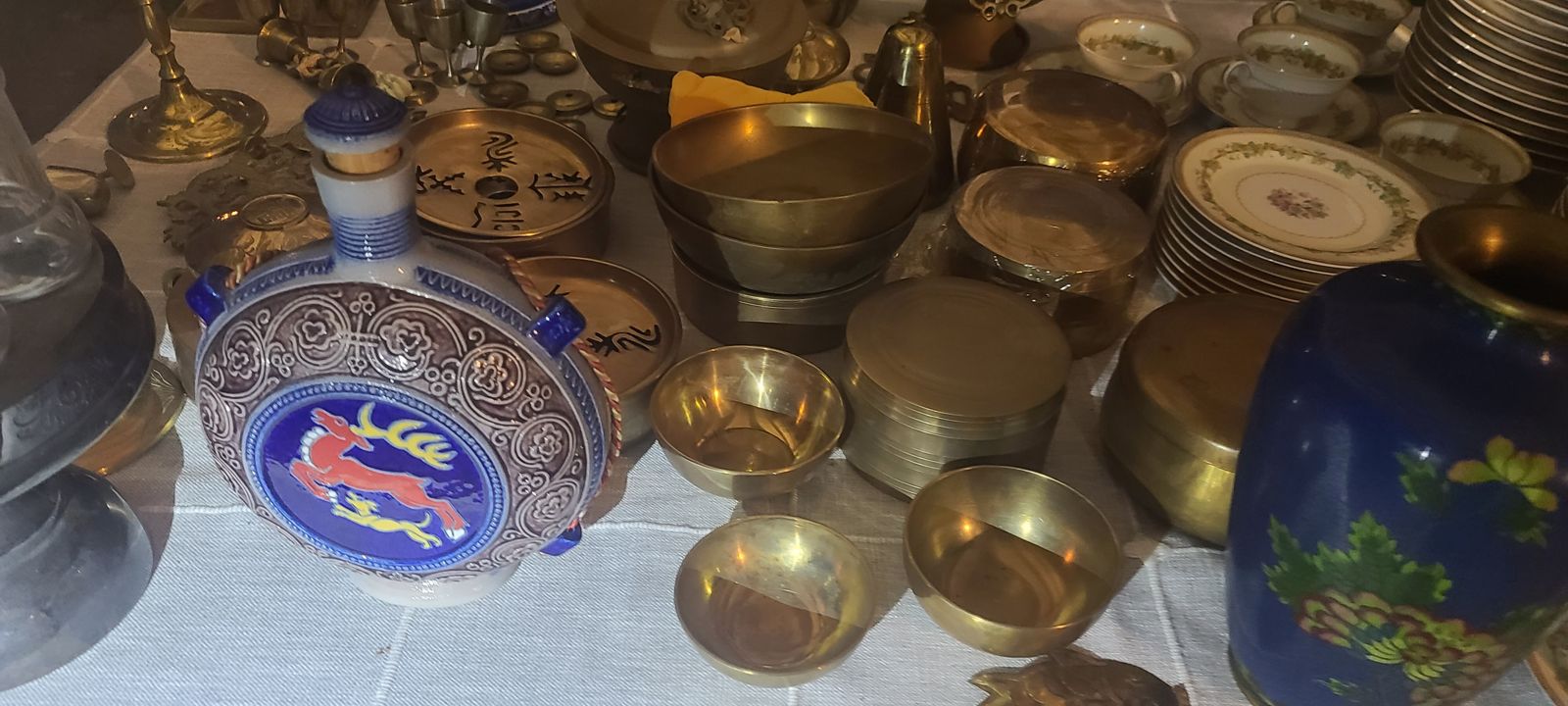
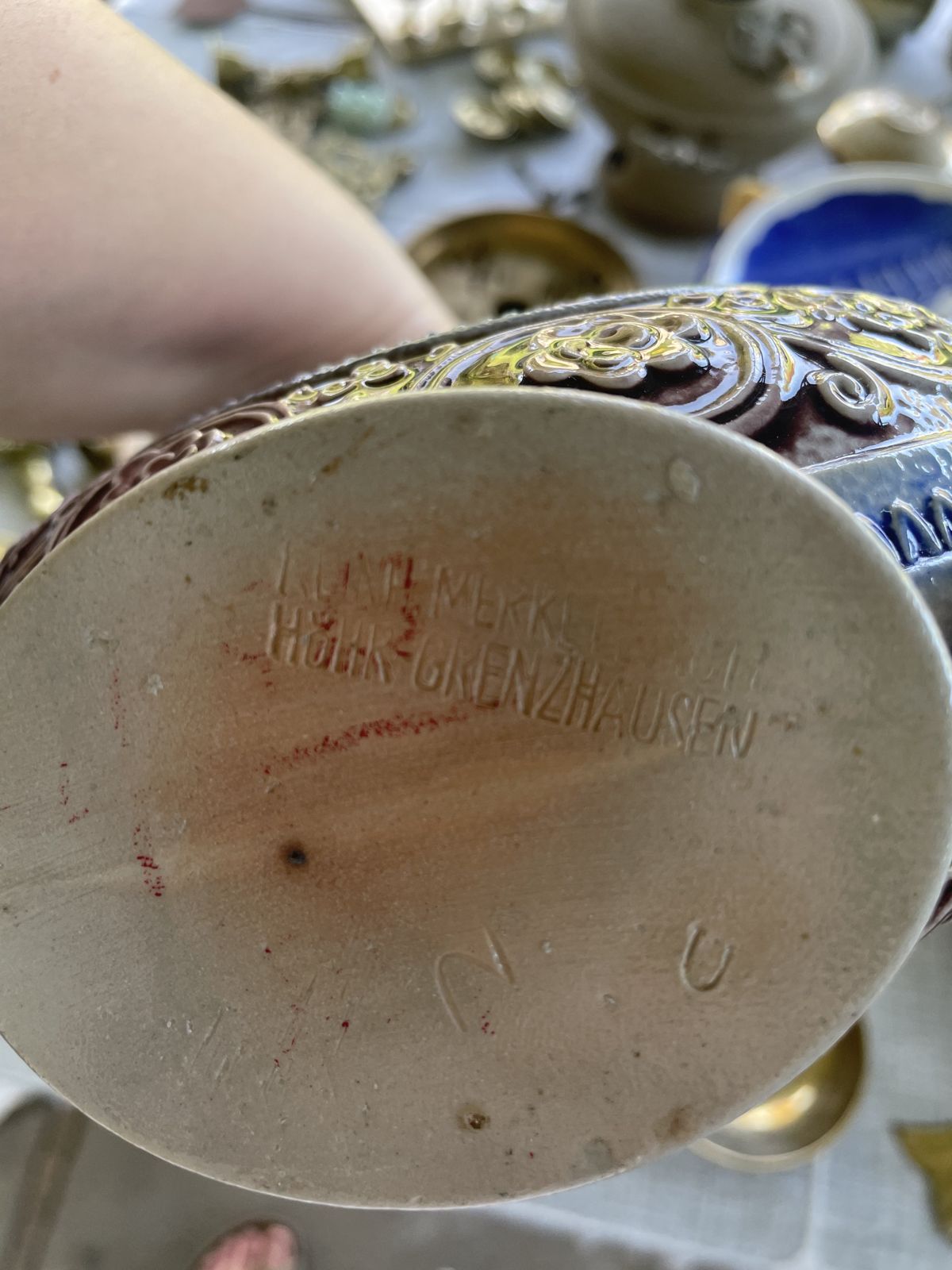
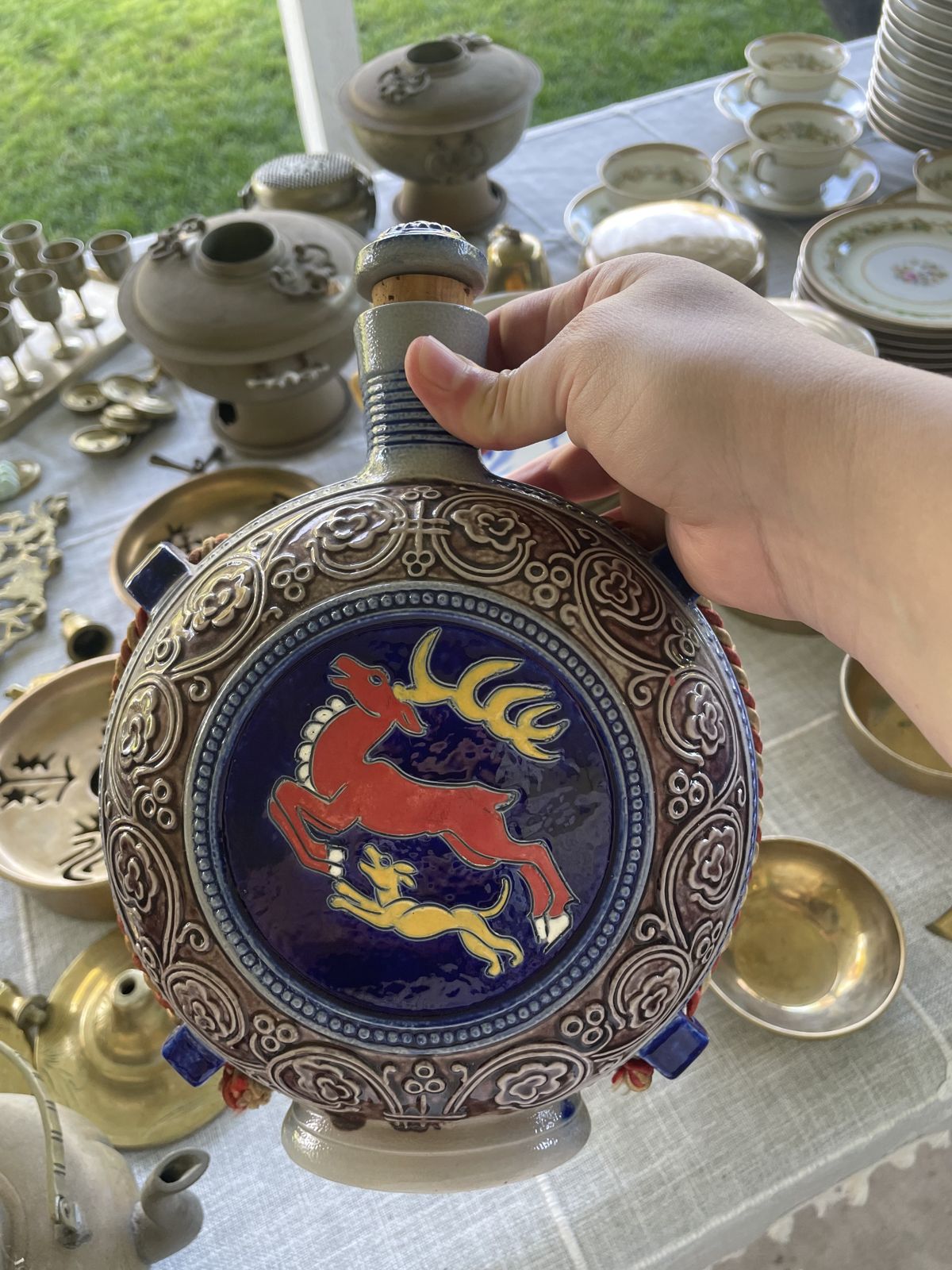
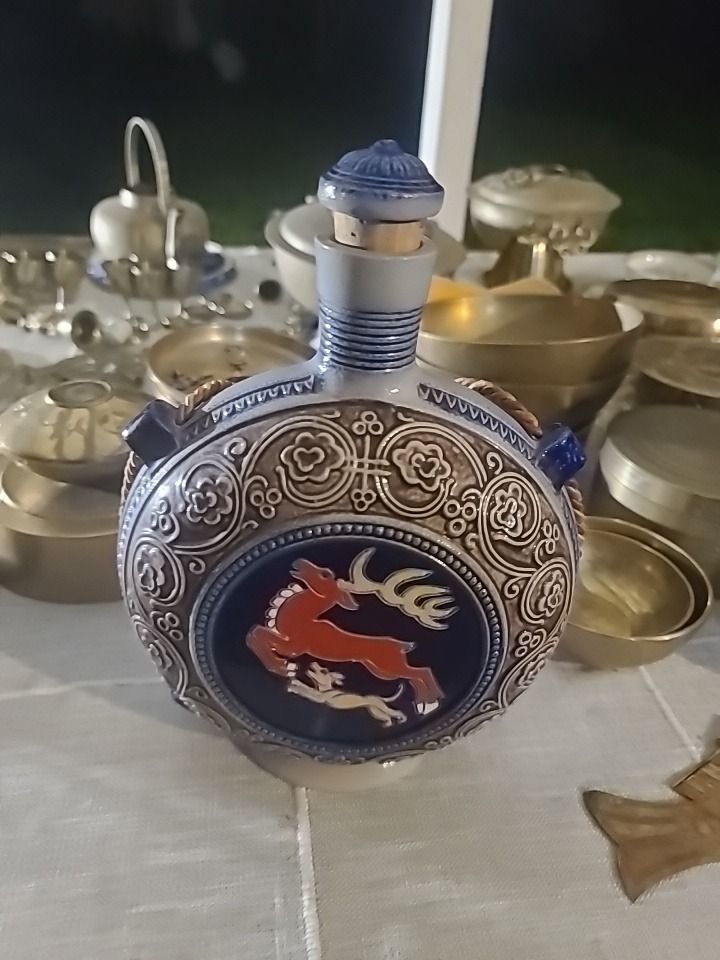
16West German salt-glazed stoneware pilgrim flask: stag and houndProbable$40 – $100
17Small white hardware plate stamped "PERMATIC / PAT. PEND."Speculative$0 – $10
China & silver$550 – $1,110
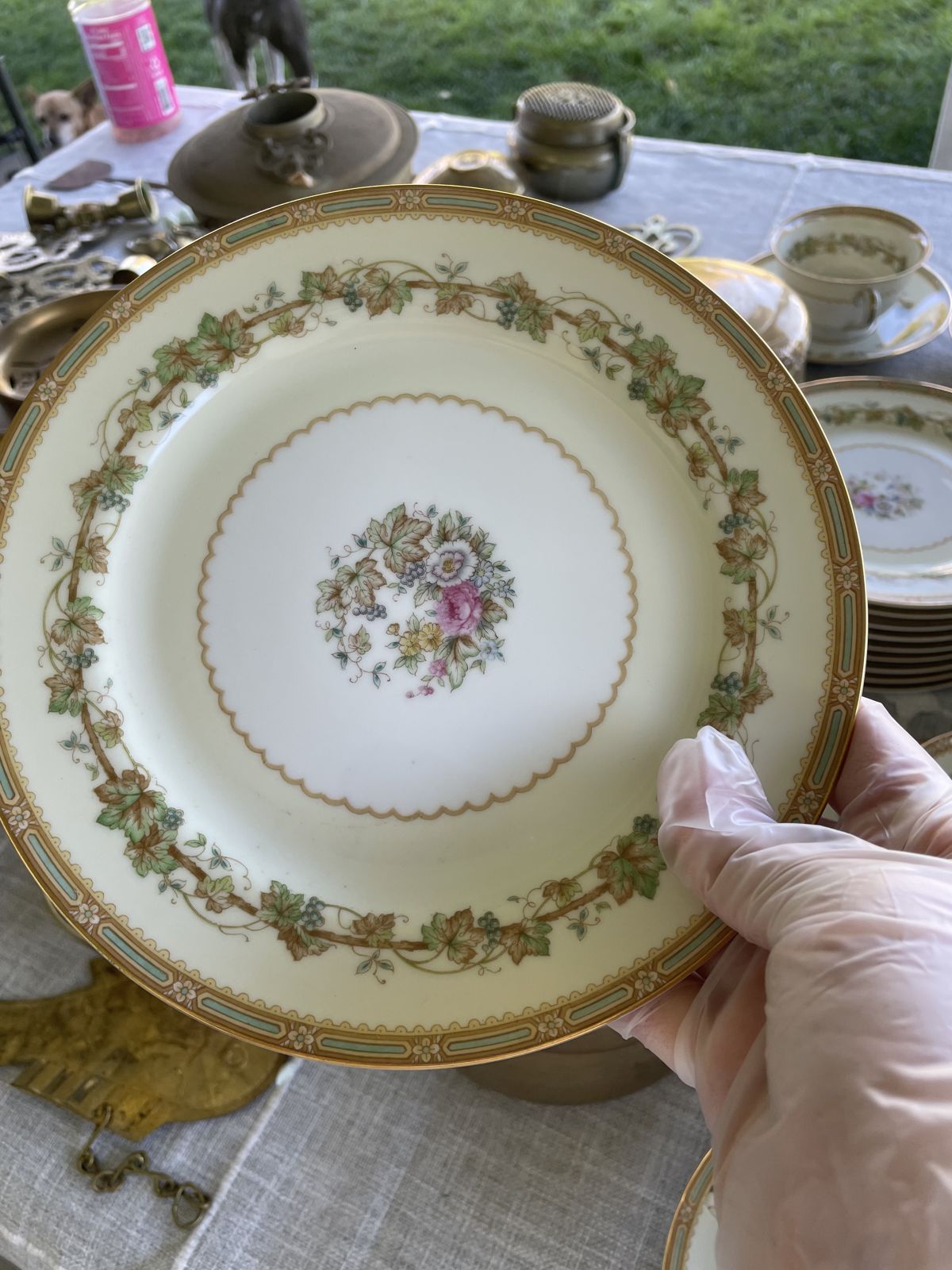
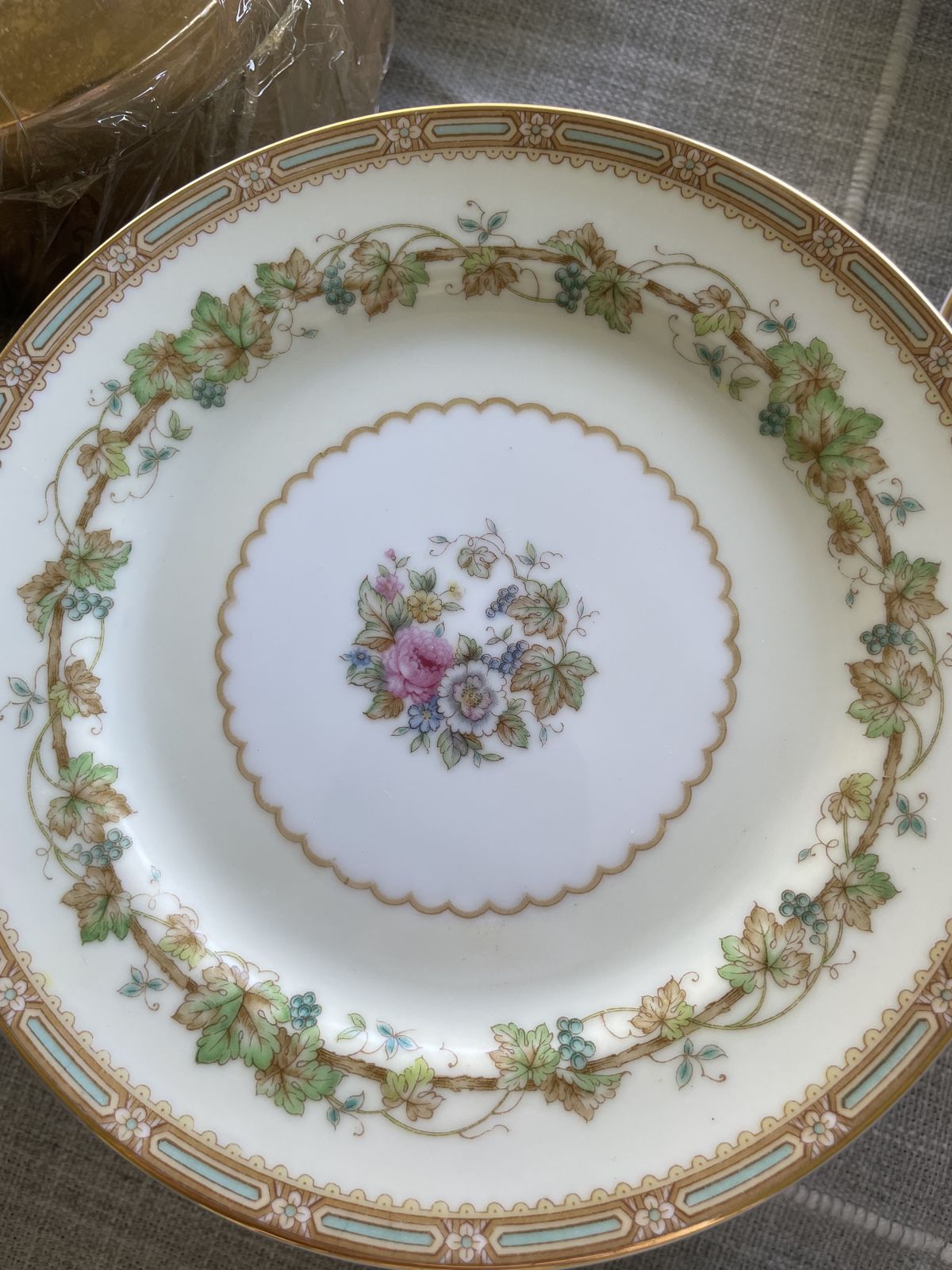
18Noritake "Concord" (pattern 4915) dinner service, probably service for 12 or moreConfident$400 – $800
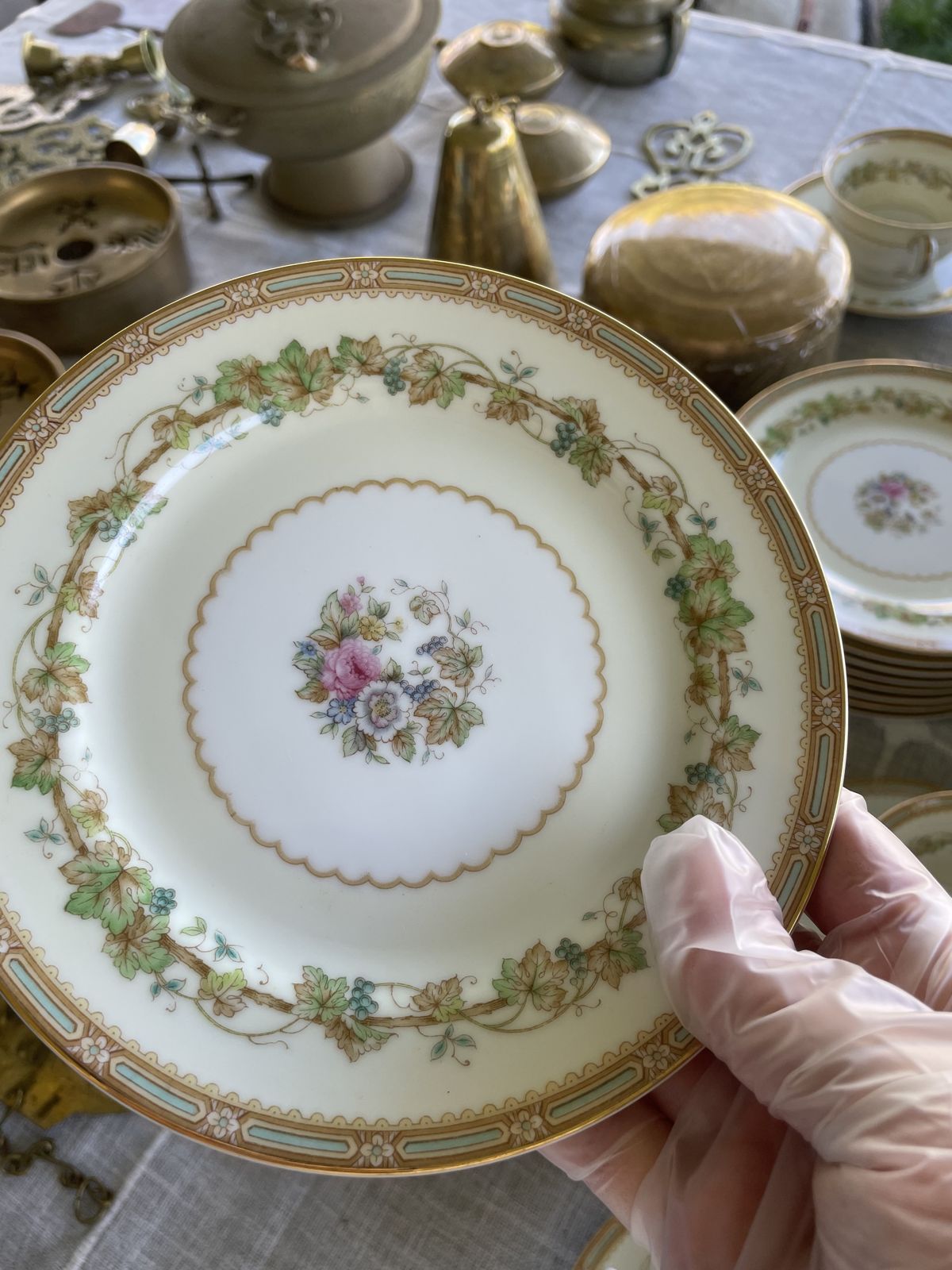
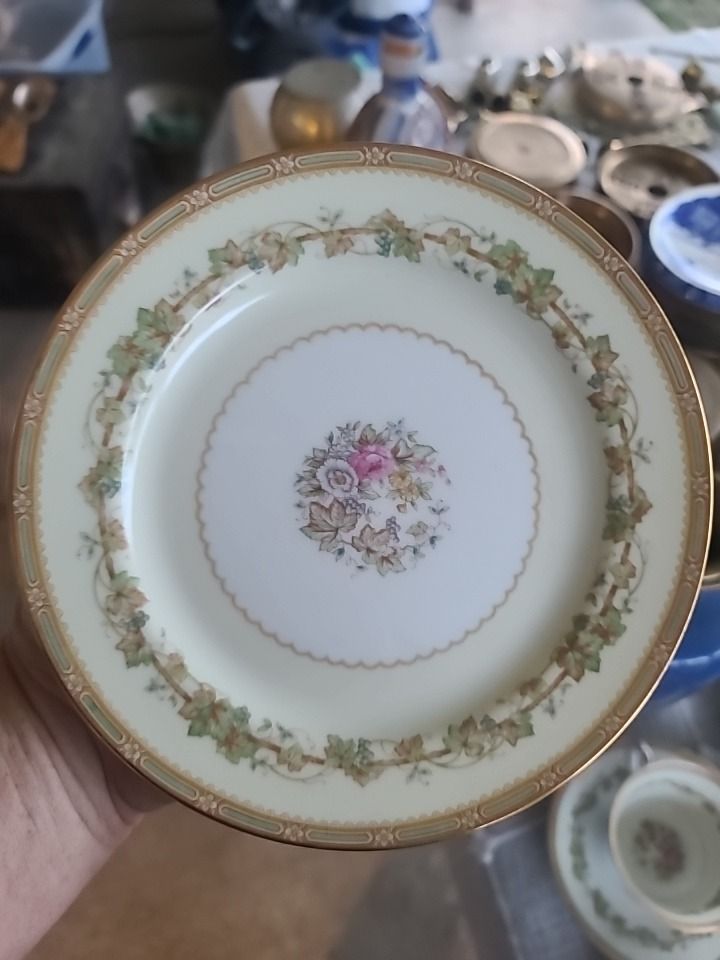
19Sango "Nancy" fine chinaProbable$40 – $150
20Westmorland sterling flatware: "George & Martha Washington" patternConfident$110 – $160
Total, all lots$2,415 – $6,170

How to read this

This catalogue was compiled from 65 photographs on 30 September 2026, without handling the objects. Each lot gives a best identification, the other things it could reasonably be, the visual evidence behind the call, and a short checklist of what to look at in person. Most of these checks take seconds with a magnet, a tape measure and a flashlight, and they settle the open questions.

The confidence tag on each lot is deliberately blunt. Confident means the photographs settle it. Probable means the identification is our best reading, but a mark or a measurement could still change it. Speculative means an educated guess offered to start the conversation, not to end it.

Values are fair market value, the price a willing buyer and willing seller would reach in an open sale such as a regional auction, eBay or a dealer's shop, in today's market, in the condition shown. They are not insurance replacement values, which typically run one and a half to two times higher. Every lot cites comparable sales or listings, with links. Asking prices are labelled as asking, because they run well above what things actually sell for. The ranges lean toward realised prices.

A note on the word "bronze": in the trade it is used loosely for any brown copper alloy. Most of the yellow metal here is brass (copper and zinc). The heavy brown and grey-green vessels in Section I are true bronze (copper and tin). A magnet won't pick up either; if it sticks, the piece is iron or spelter with a bronze finish.

Section I

Japanese bronze

These are the heavy pieces, and the ones most people would call "Chinese bronze". On close study they read as Japanese. Japan's bronze foundries, above all those at Takaoka in Toyama prefecture, spent the Meiji, Taisho and early Showa eras (roughly 1868–1945) turning out huge numbers of vessels in Chinese archaic taste for the export trade and for domestic flower-arranging. The tell-tales are an even, applied chocolate or grey-green patina, very crisp but slightly mechanical casting, separate tripod stands, and decoration (tigers, dragons, boss bands, taotie masks) borrowed from Chinese ritual bronzes but drawn with a Japanese hand.

None of this is ancient, and none of it is a fake. It is honest decorative bronze, a century old more or less, and it sells steadily to bonsai and ikebana people as well as to Asian-art buyers. Don't polish any of it: the patina is a large part of what a buyer pays for.

Source frames: P04, P05, P09, P10, P11, P12, P13, P14

Lot 1Probable

Large rectangular bronze bonsai basin (suiban) with boss-band rim, scroll handles and cast seal mark

Origin
Japan (probably Takaoka), alt. China
Period
c.1880–1940, most likely Taisho to early Showa
Material
Cast bronze, chocolate-brown exterior patina; golden interior with verdigris
Quantity
1

Fair market value$400 – $1,100

Mid-point of Japanese suiban auction results ($250–$750) and current retail asking ($845). The weight, the dark even patina and the cast seal push it toward the upper half. The value is open-ended upward only if a specialist reads the mark as a genuine early Chinese foundry seal.

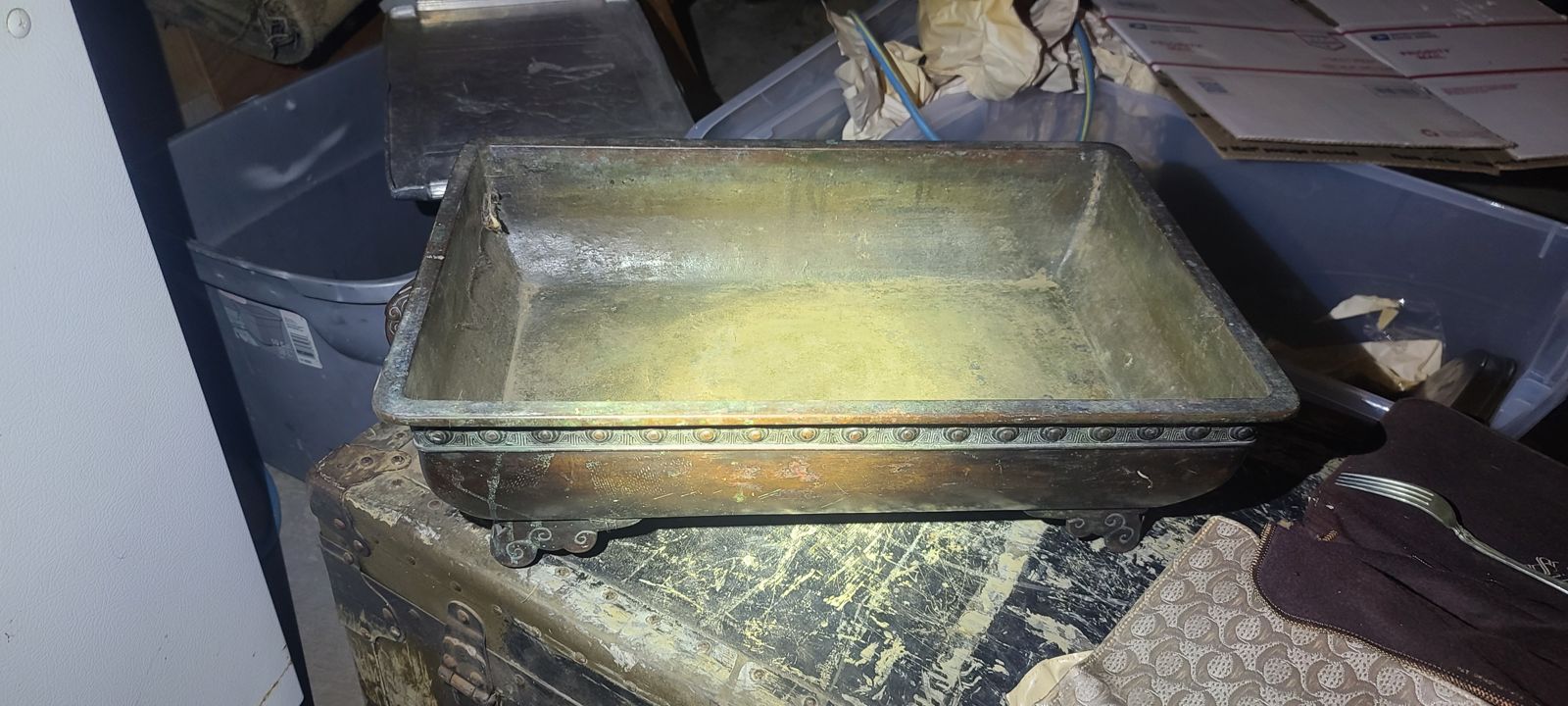
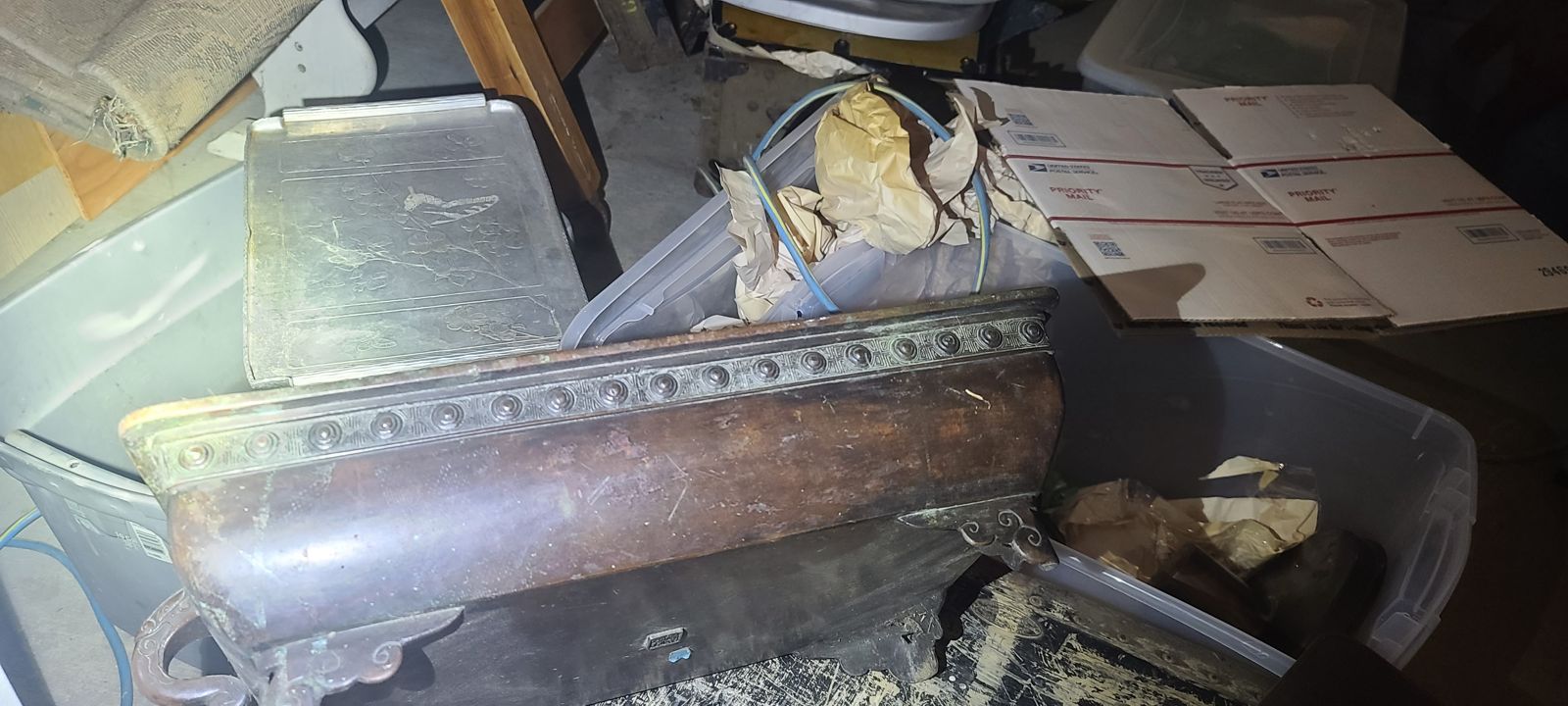
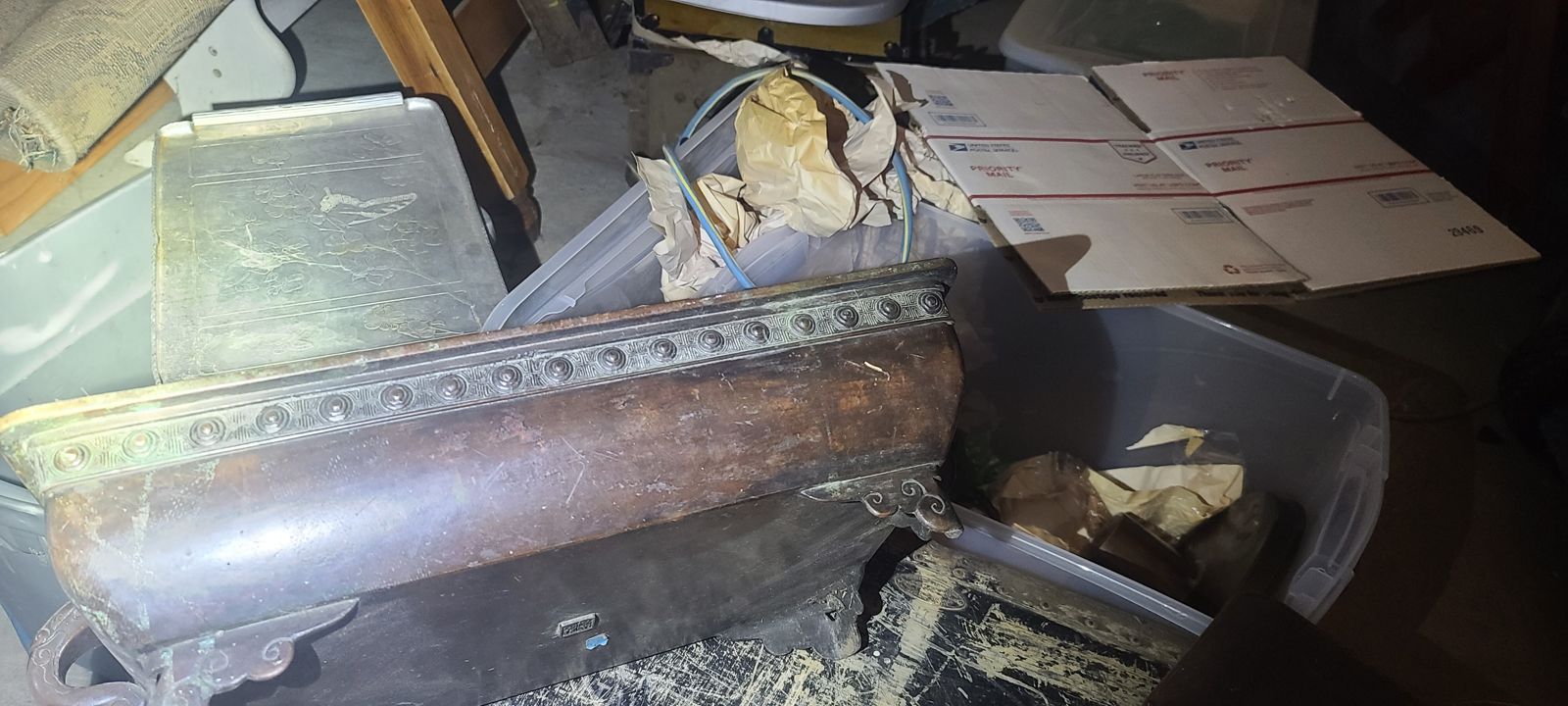
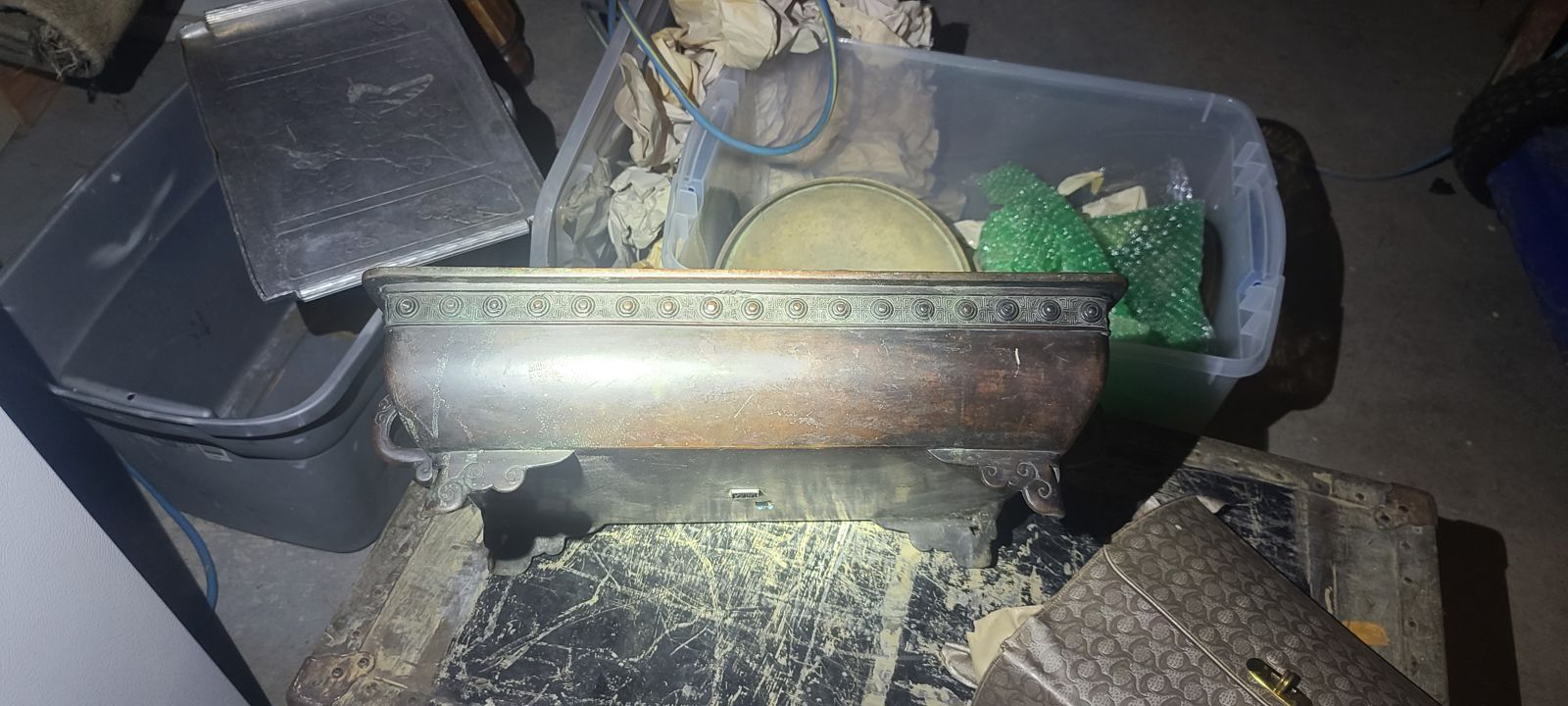
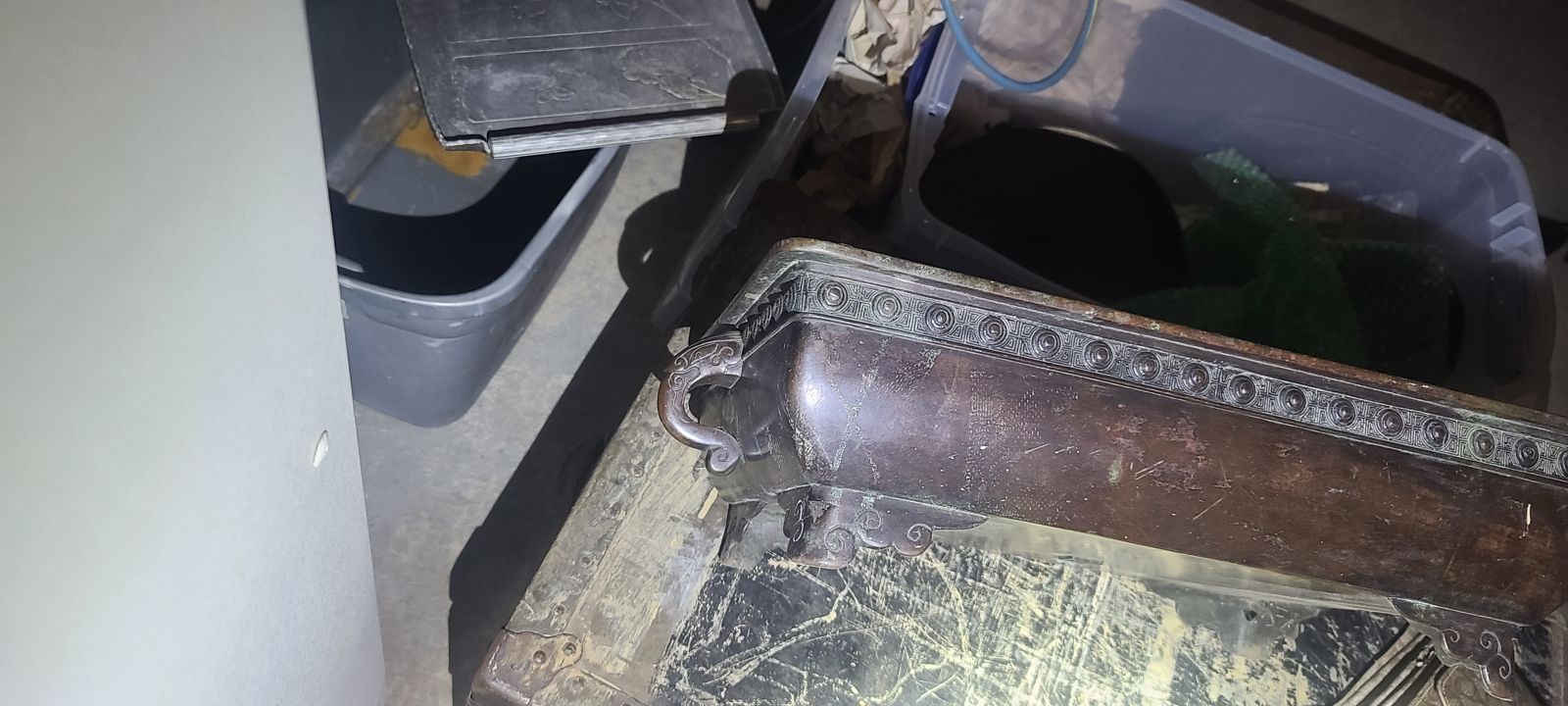
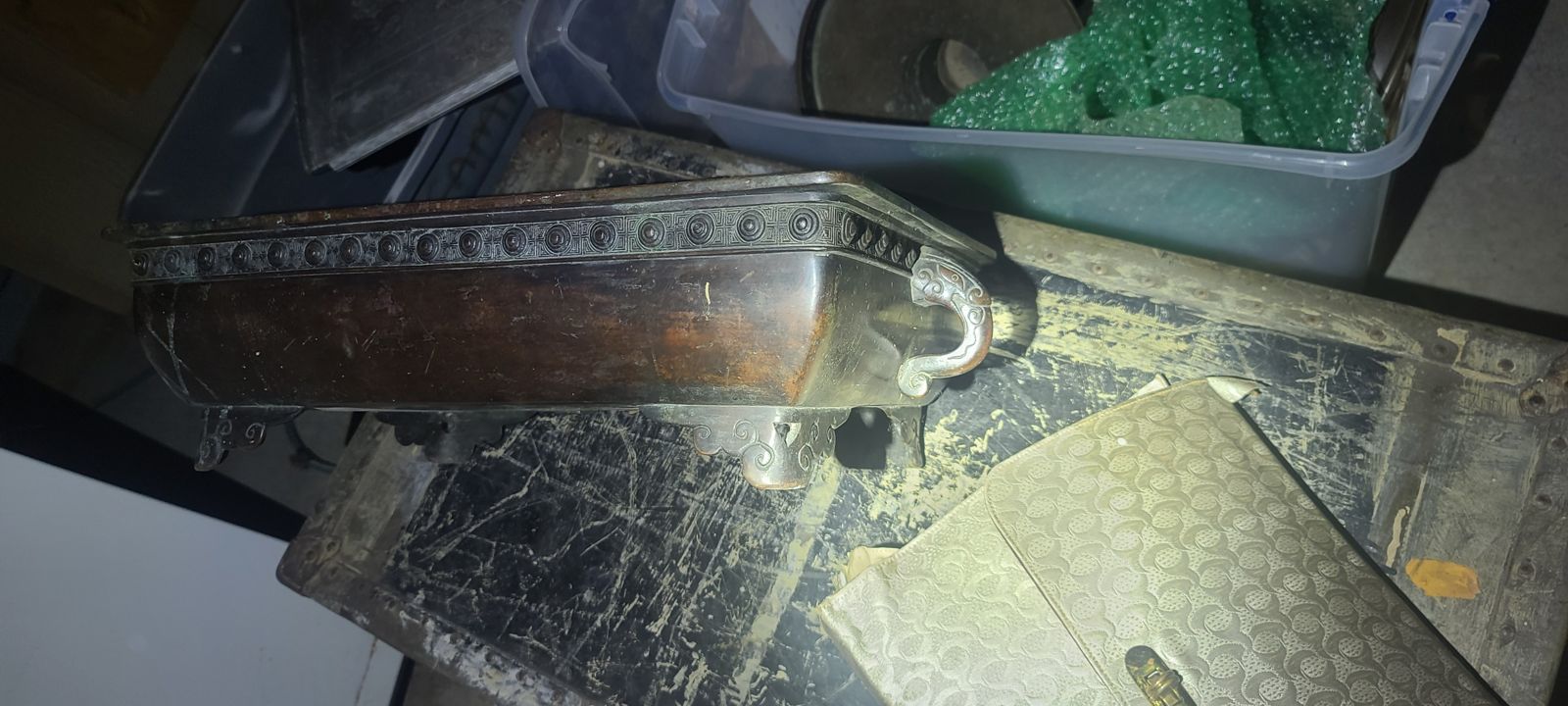
This is the biggest and heaviest piece in the collection, and the "big heavy bronze base". It isn't a base, though: it's a vessel. It is a long, shallow rectangular basin with straight sides. A rolled, slightly everted lip sits over a band of about twenty raised round bosses (stud or "rice-grain" ornament) on a finely diapered ground. The ends carry stylised kui-dragon C-scroll handles, and it stands on four bracket feet shaped like ruyi clouds.

Outside, the patina is smooth chocolate-brown, darker on the high spots, the kind Japanese founders applied chemically and then waxed. Inside, the surface is paler and golden with green verdigris where water has stood (P05, P14). That is a good sign: the basin was actually used for flowers or bonsai.

In Japan a vessel of this shape is a suiban (水盤) or doban (銅盤). It is a water basin for ikebana in the moribana style, where flowers stand in a pin-holder in shallow water. It is equally a display tray for bonsai or suiseki (viewing stones). Westerners have always called them "jardinières" or "planters", and in the trade they sell as "bonsai pots". The boss band and the dragon handles copy Chinese Ming-dynasty bronze censers, and Japanese buyers of the period prized that Chinese literati look.

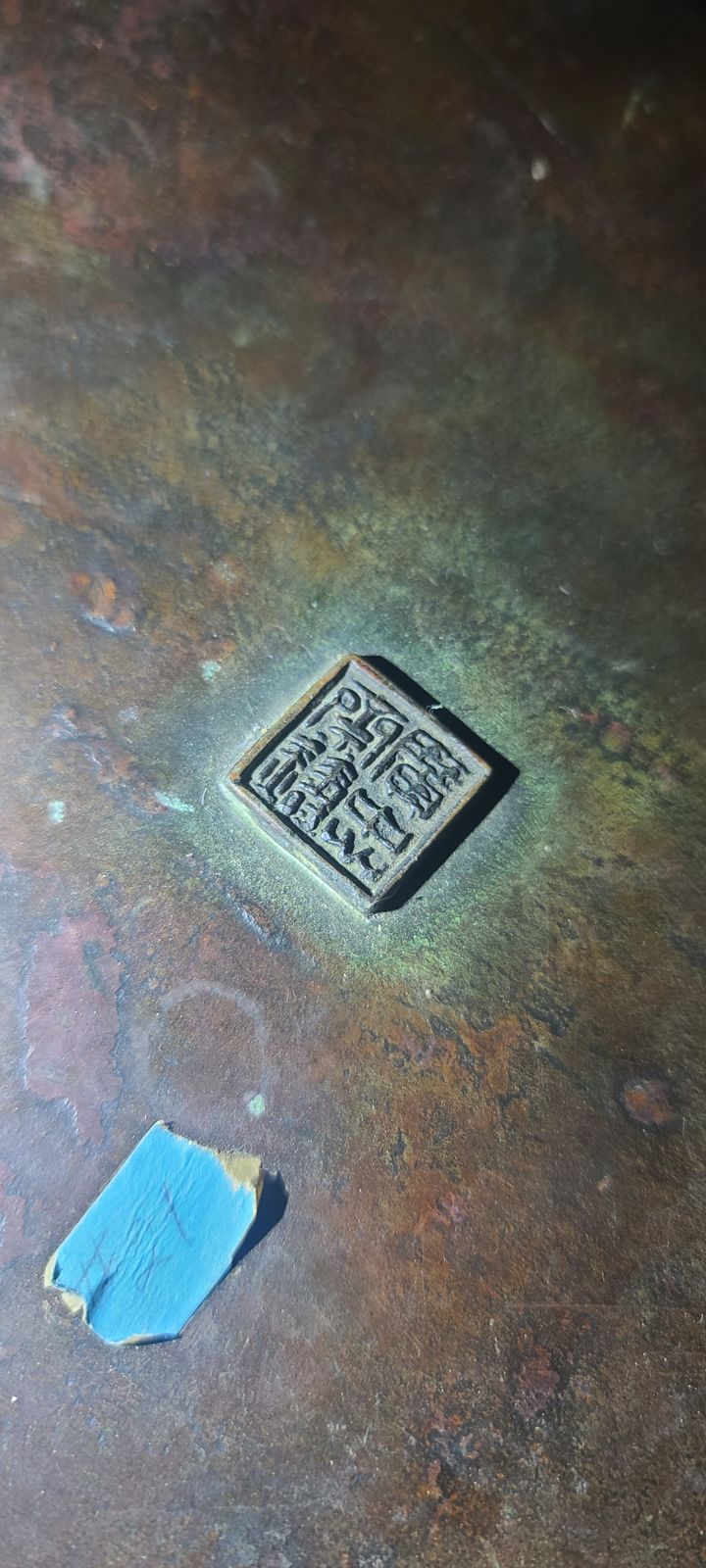
The important feature is underneath. Cast into the base is a raised square seal of four characters in seal script, in two columns (P04, shown enlarged in the second and third images). Turned and enlarged, the right-hand column reads best as 宣 over 德 and the left as 年 over 製. That gives 宣德年製, "made in the Xuande reign". The Xuande emperor (reigned 1426–1435) is legendary for the bronze censers cast in his reign, and Chinese and Japanese founders put his mark on bronzes for the next five hundred years as homage. A Xuande mark on a vessel like this is almost never a date; it is a statement of style. It is an "apocryphal" mark, honest by the conventions of the time, and should be catalogued as "Xuande mark, later". The reading itself is only medium-confidence.

Why we lean Japanese rather than Chinese: the casting is very even and sharp, the exterior patina is uniform and applied rather than accumulated, the seal plaque is flat and crisp, and the proportions (long, low, with small separate feet) are typical of Takaoka export suiban that borrowed a Chinese reign mark. A Chinese late-Qing censer of this form would more likely be squarer, deeper and heavier-walled. A small paper or foil label shows on the side in the night photographs. Keep it, because old dealer labels add provenance.

Other things it could be

  • Chinese late-Qing or Republic rectangular censer or jardinière with an apocryphal Xuande mark, copying a Ming fangding
  • The seal may be a Japanese foundry seal in a square cartouche (e.g. a Takaoka maker) rather than a reign mark
  • Mid-20th-century Japanese export copy, worth about half as much

What points that way

  • Rolled rim over a boss band on a diaper ground
  • C-scroll kui-dragon end handles; four ruyi-cloud bracket feet
  • Four-character seal-script mark in a raised square, cast on the base
  • Smooth applied brown patina outside; water staining and verdigris inside
  • Very heavy for its size, so cast bronze rather than spelter

Check in person

  • Photograph the base mark straight down in raking light, and ask a Chinese reader or an Asian-art auction house to confirm 宣德年製
  • Measure length × width × height and weigh it; serious suiban of 18–24 in weigh 15–30 lb
  • Check whether the seal is cast in one with the base or set in as a separate plaque
  • Do not polish or scrub; the patina is the value

Source frames: P18, P19, P20, P38, P50

Lot 2Confident

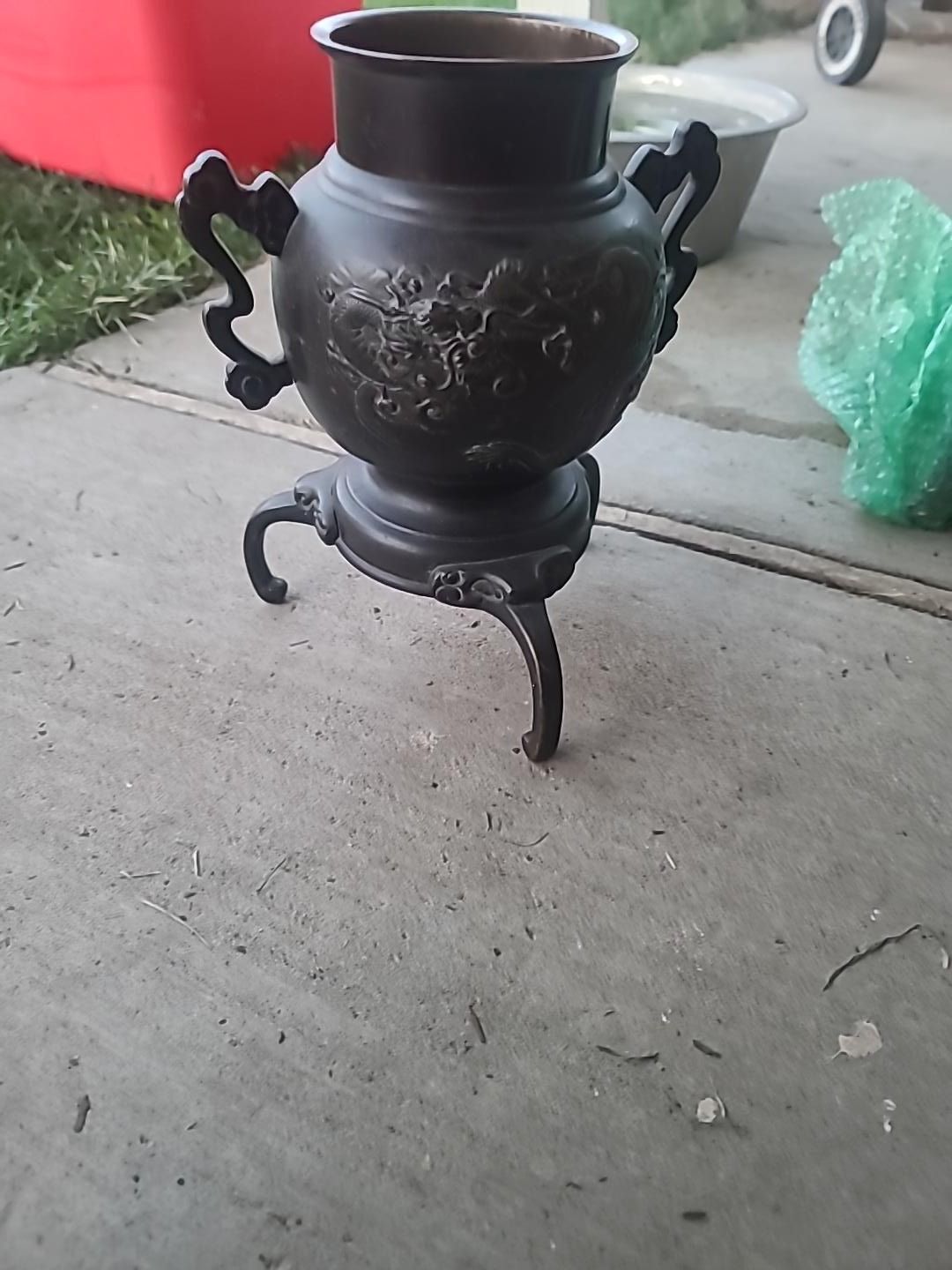
Bronze "tiger and dragon" (ryūko) vase on detachable tripod stand

Origin
Japan
Period
Late Meiji to Showa, c.1900–1960
Material
Cast bronze, dark patina, gilt-brass lined interior
Quantity
1 (vase + stand), probably not a pair

Fair market value$200 – $500

Between a Meiji vase-on-stand that sold at Bonhams (~$210) and a modern tiger-and-dragon usubata asking $529. Deduct 30–50% if the rim line turns out to be a crack.

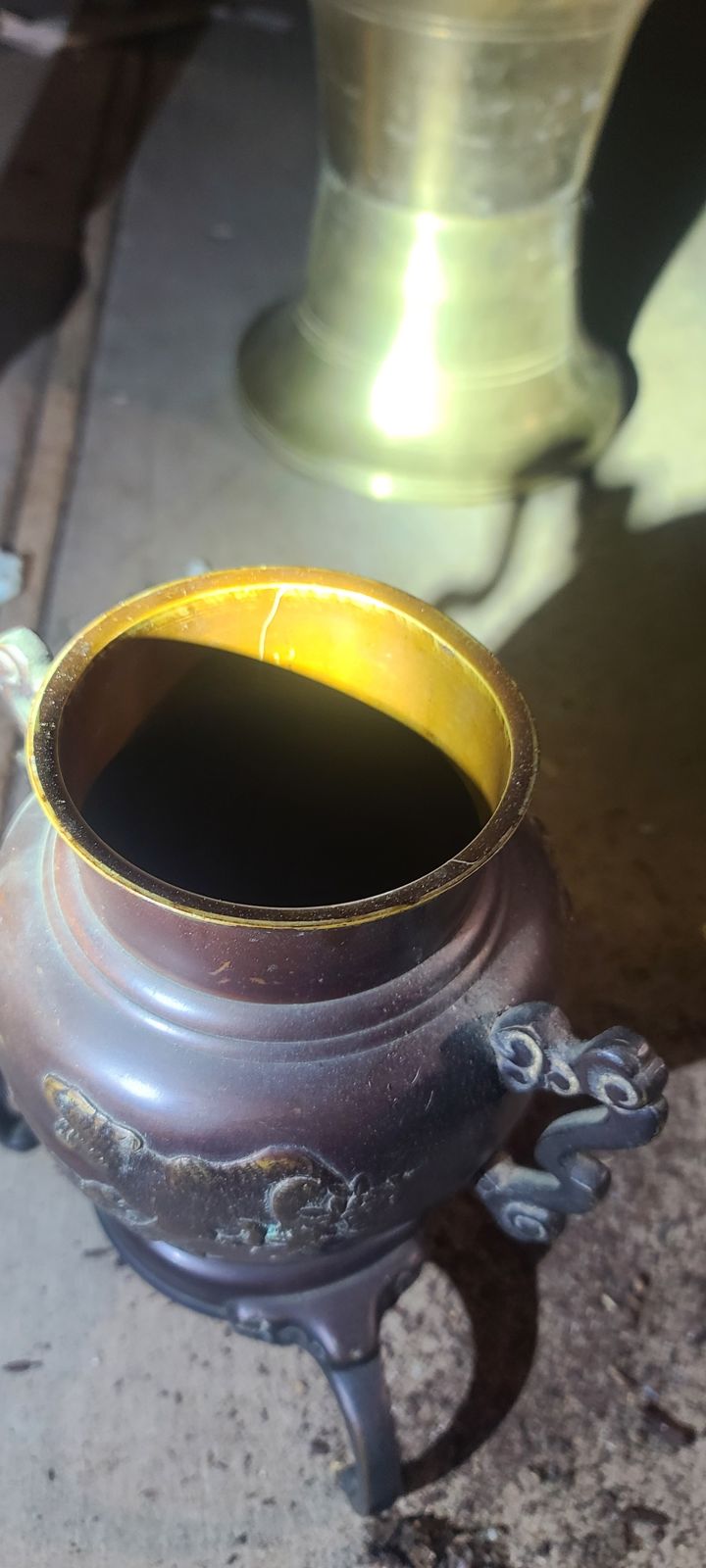
This is a baluster vase with a ringed shoulder and a tall cylindrical neck. It has two ruyi-scroll handles and sits in a separate dished ring on three scrolled legs. The body has a high-relief band in darker bronze picked out with gilding. Photographed under a flashlight at night (P18–P20) it shows a tiger among bamboo and rocks. In daylight (P38, P50) it shows a coiling dragon among clouds.

The handles, stand, neck rings and proportions are identical in all five photographs. So this is almost certainly one vase photographed from opposite sides rather than a pair. Tiger on one face and dragon on the other is the classic Japanese ryūko (龍虎) pairing. The dragon of the clouds and the tiger of the bamboo grove stand for heaven and earth, yang and yin, and the image recurs in Japanese painting, sword fittings and temple carving. Vases like this were made for the tokonoma alcove and for export, often as a usubata or kodai-style flower vessel. The bright brass liner inside the neck (P19, P20) let it hold water for arrangements.

The flashlight shots show a fine line inside the rim. It could be a scratch in the liner or a hairline crack in the bronze, and that difference matters to value.

Other things it could be

  • Two near-identical vases, one tiger and one dragon, sold as a pair (turn it around to check)
  • Chinese export copy of the Japanese form (less likely given the stand and colouring)
  • Censer (koro) used as a vase; the tall open neck argues against it

What points that way

  • Separate scroll-leg tripod stand, a very Japanese presentation
  • Tiger and dragon motifs on a single vessel, the ryūko pairing
  • Gilt highlights on the relief; gilt-brass liner

Check in person

  • Rotate it: tiger on one side and dragon on the other confirms a single vase
  • Lift the vase off the stand: check for seals under both parts and that the stand's patina matches
  • Inspect the inner-rim line with a loupe: liner scratch or a crack through the bronze?
  • Measure the overall height (the comps run 27–50 cm)

Comparables

ComparablePriceVenue
Bronze usubata ikebana vase with dragon and tiger, Japan, 27 cm, tripod feet$529 askingPamono
A bronze vase on stand, Meiji era, 49.5 cm, dragon handles£162.50 sold incl. premiumBonhams Edinburgh · Dec 2017
Antique Japanese Meiji period bronze dragon vasesee results pageLiveAuctioneers

Source frames: P08, P43, P49

Lot 3Probable

Archaistic bronze jar with phoenix and kui-dragon band (in the manner of a Shang ritual lei)

Origin
Japan (Takaoka), alt. China
Period
c.1900–1950
Material
Cast bronze, applied grey-green "excavated" patina
Quantity
1

Fair market value$175 – $500

Archaistic bronze vases of this quality typically make $100–500 at general auction. Japanese signed examples go higher at specialist sales.

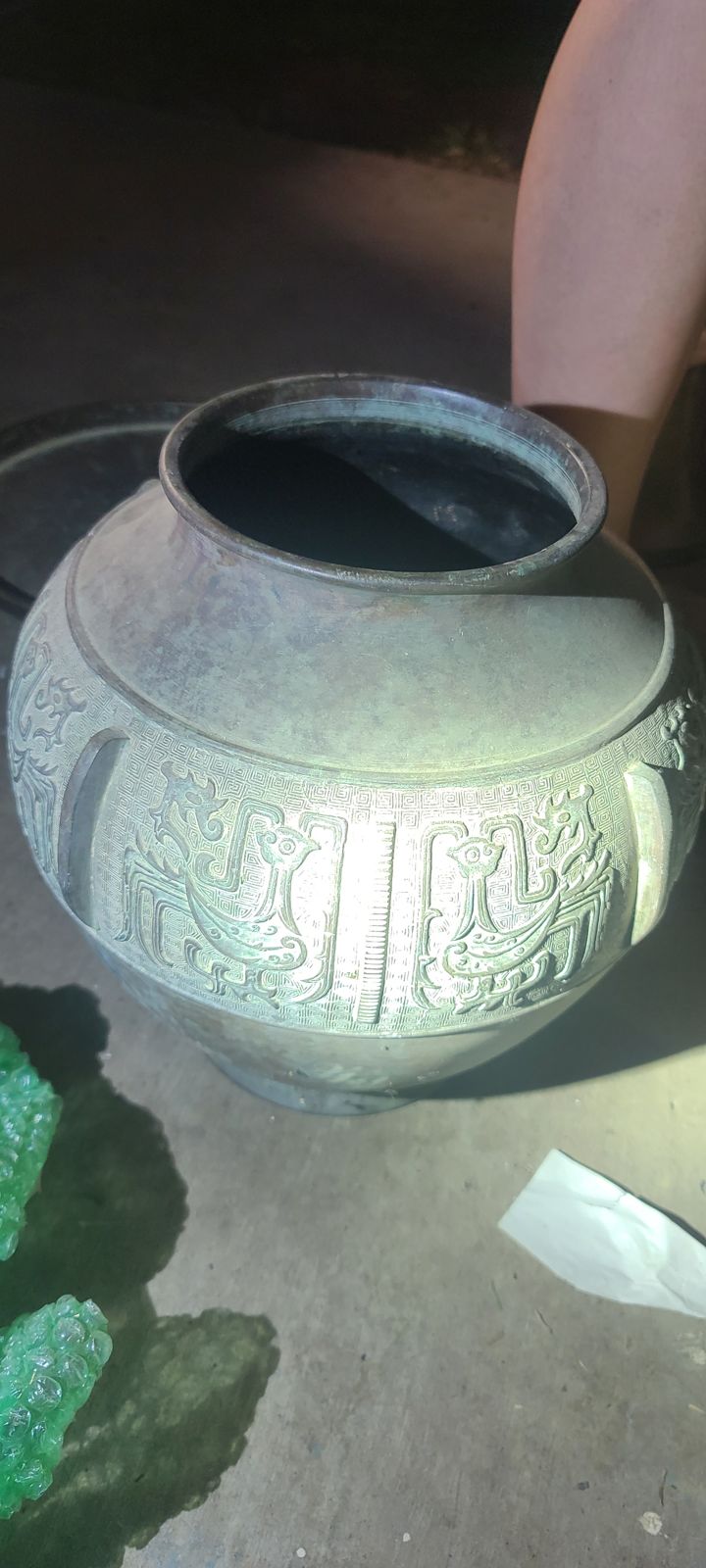
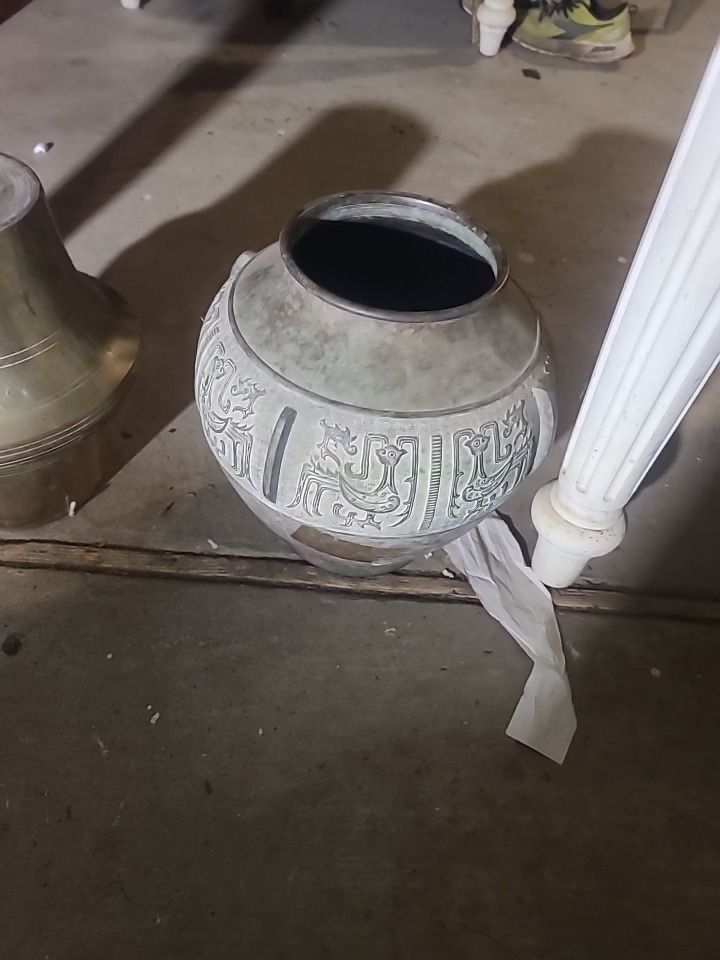
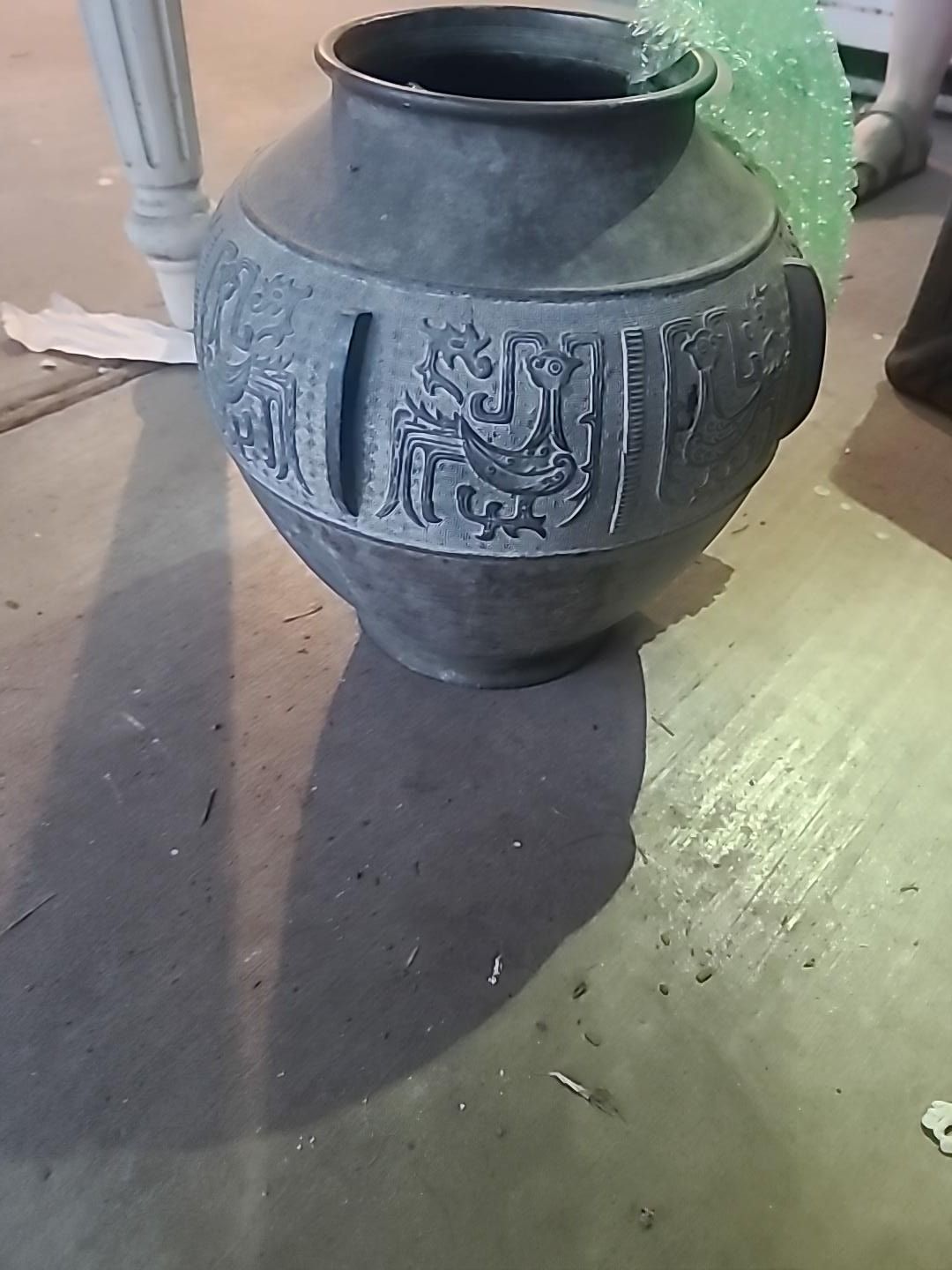
This is a broad, squat ovoid jar with a short neck. A wide frieze around the shoulder carries pairs of confronting crested birds (feng phoenixes) and kui dragons on a fine leiwen ("thunder pattern") spiral ground. The frieze is divided by notched vertical flanges, and there are small lug handles. Above and below, the surface is plain with a single raised fillet.

The design deliberately quotes the bronze ritual wine and water vessels of China's Shang and Western Zhou dynasties (about 1600–771 BC), the archaic bronzes that every later Chinese and Japanese connoisseur collected and imitated. The grey-green, faintly silvery skin is a chemically applied "excavated" patina meant to suggest burial. Under strong light it looks almost white (P08, P43); in shade it looks slate-green (P49).

The line-work is clean, even and slightly flat, and the birds are drawn with a stylised elegance. That is characteristic of Japanese Takaoka archaistic production of the early twentieth century, when such pieces were very fashionable. Chinese Republic-period souvenir copies tend to have muddier ground patterns and rougher casting. To be absolutely clear: this is a twentieth-century decorative bronze in archaic style, not an ancient vessel.

Other things it could be

  • Chinese Republic-period (1912–49) archaistic copy
  • Later (1960s–80s) Chinese or Taiwanese reproduction, worth $50–150

What points that way

  • Confronting phoenix and kui-dragon frieze on a leiwen ground, with notched flanges
  • Even, applied grey-green patina rather than true crusty corrosion
  • Crisp, regular casting

Check in person

  • Look under the base for a small square or oval seal (Japanese makers such as Eisei-dō often signed)
  • Rub a hidden spot gently: a thin wash revealing yellow bronze is normal for these
  • Measure its height (likely 9–12 in)

Section II

Chinese cloisonné

Cloisonné (jingtailan, 景泰藍) is enamel fired into cells made of fine brass or copper wire soldered to a metal body. Beijing made it for the imperial court from the Ming dynasty on. From about 1900 to 1940 Beijing workshops such as Lao Tian Li and De Xing Cheng made it in quantity for Western buyers, and the PRC export trade revived it after about 1960. The two pieces here, a large covered box and a vase, are good mid-quality Republic-era work: bright colours, tight wire, grounds filled with cloud scrolls. Their designs carry meaning: a five-clawed dragon chasing the flaming pearl, the shou (壽) character for long life, butterflies and peonies for joy and wealth.

Source frames: P03, P25, P27, P28, P29, P40

Lot 4Confident

Large cloisonné covered box: five-clawed dragon on the lid, shou characters and butterflies on the base

Origin
China (Beijing)
Period
Late Qing to Republic, c.1900–1940
Material
Cloisonné enamel on copper, gilt-brass rims; turquoise-enamelled interior
Quantity
1 (lid + base), shown with a plate stand

Fair market value$400 – $1,100

Complete Republic-era cloisonné covered boxes with dragon or shou decoration are offered from several hundred dollars to about $1,000, with typical auction estimates of $200–400 for smaller examples. A large complete box is worth well more than the lid and base sold apart. Missing or damaged halves cut the value by half or more.

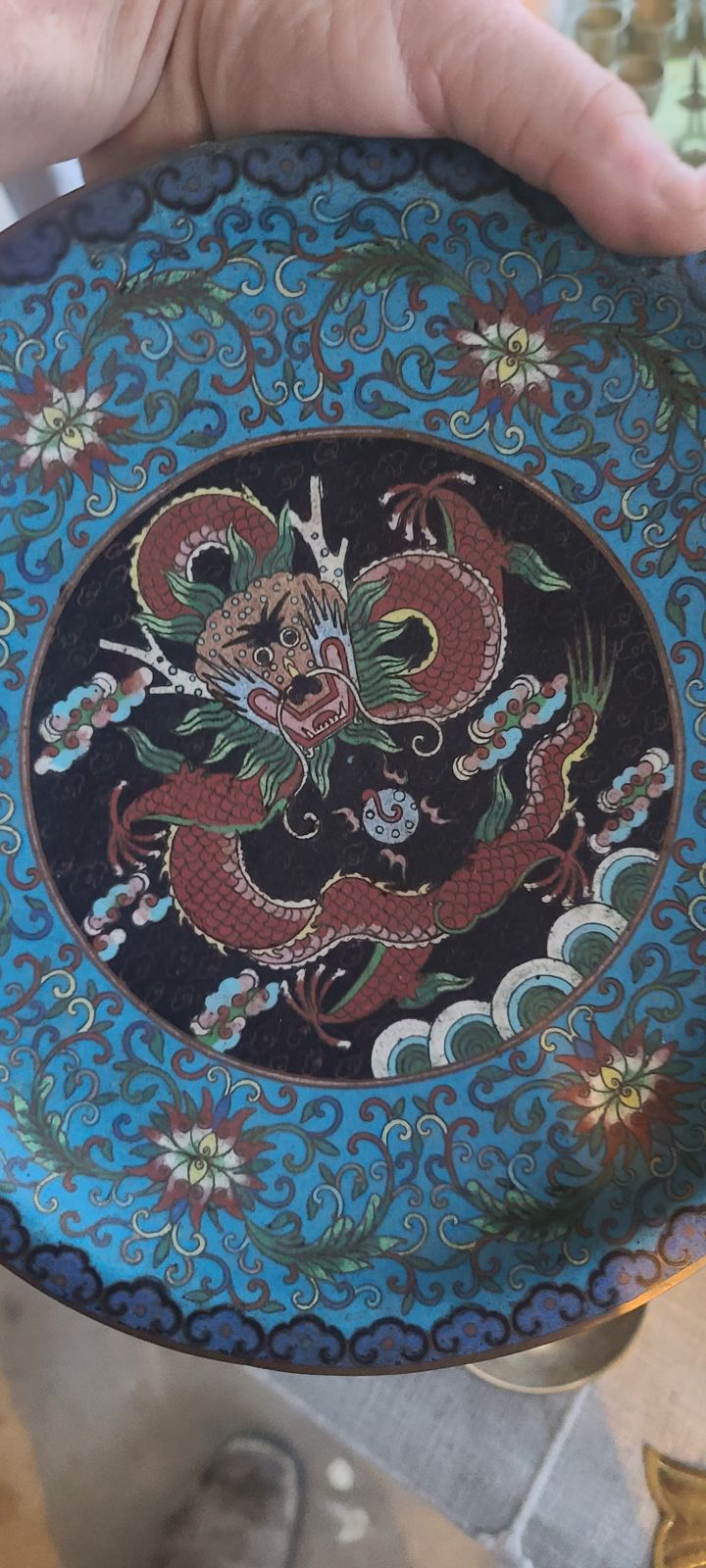
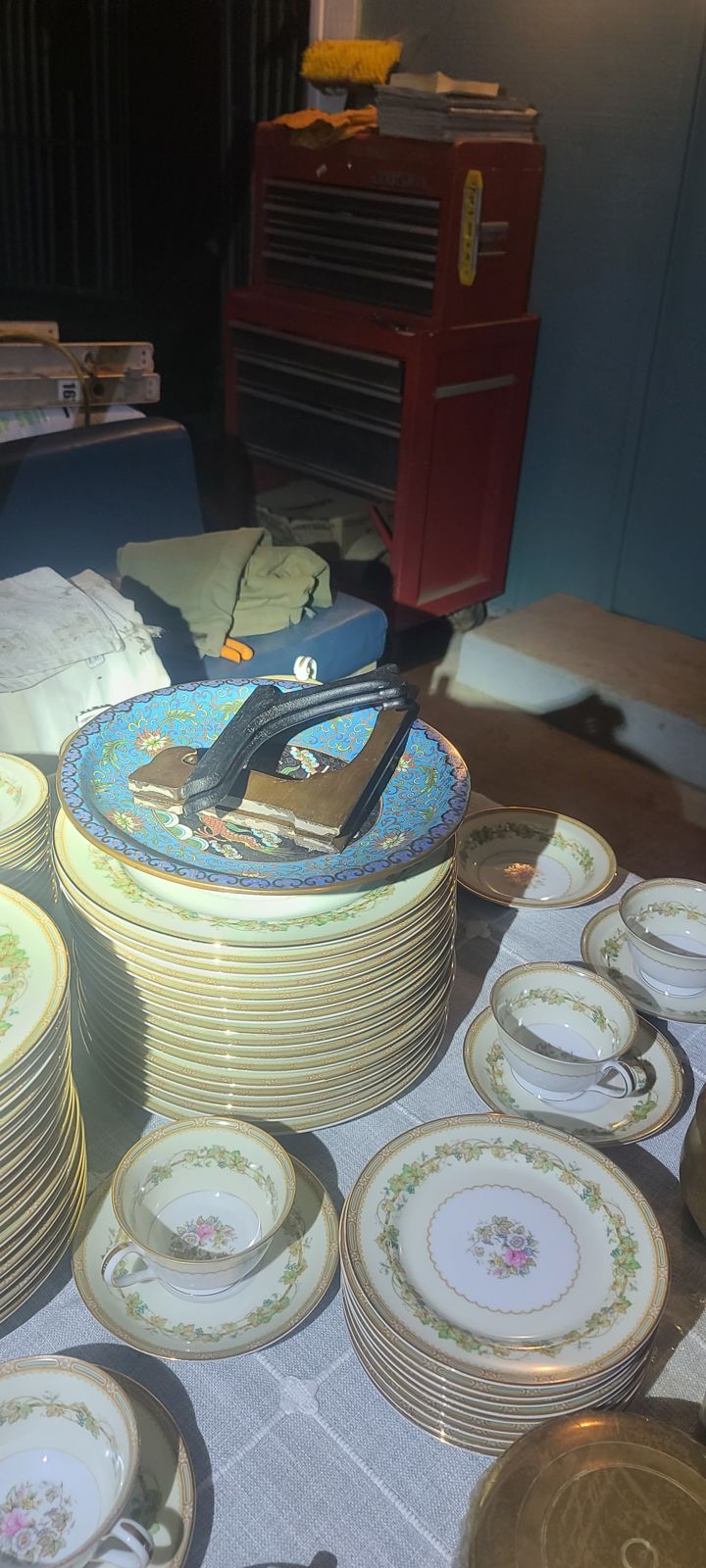
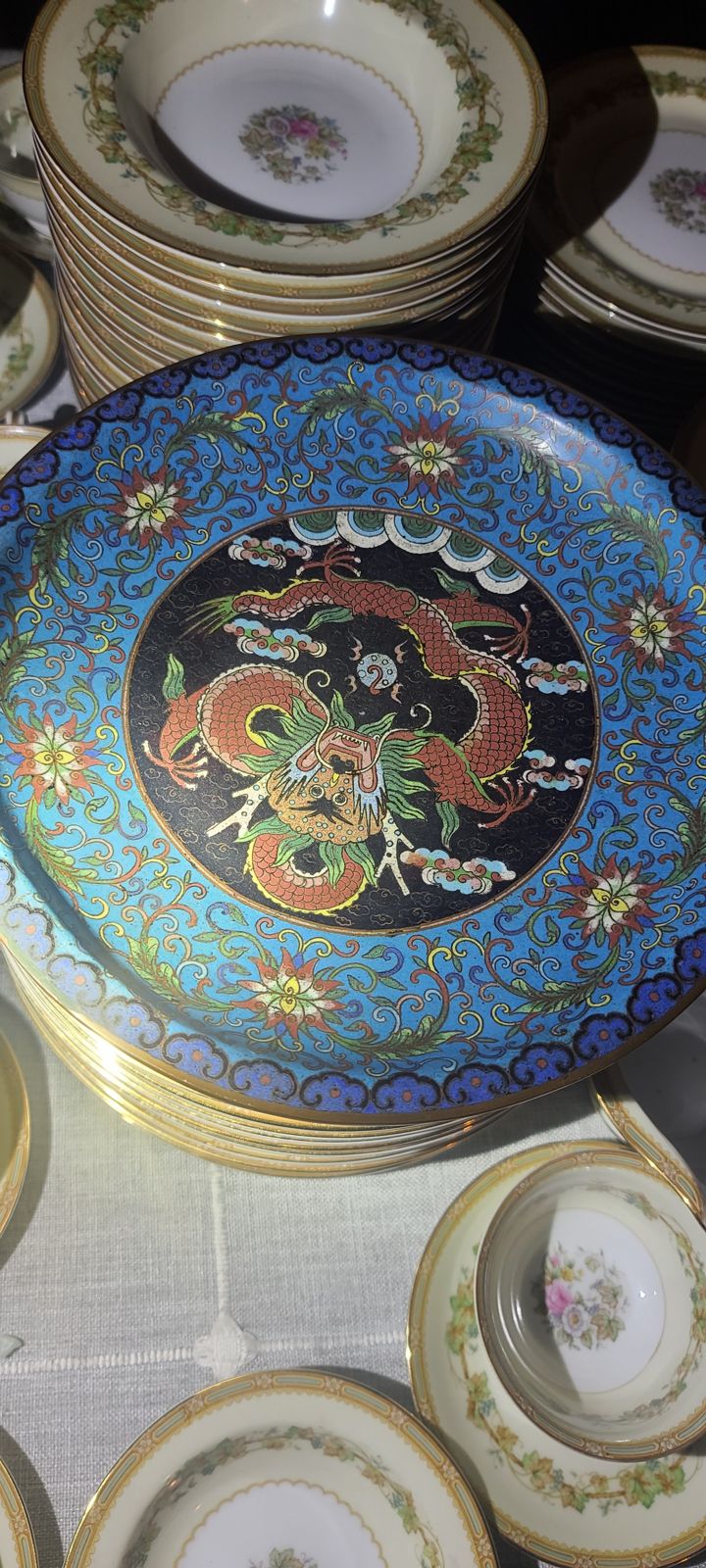
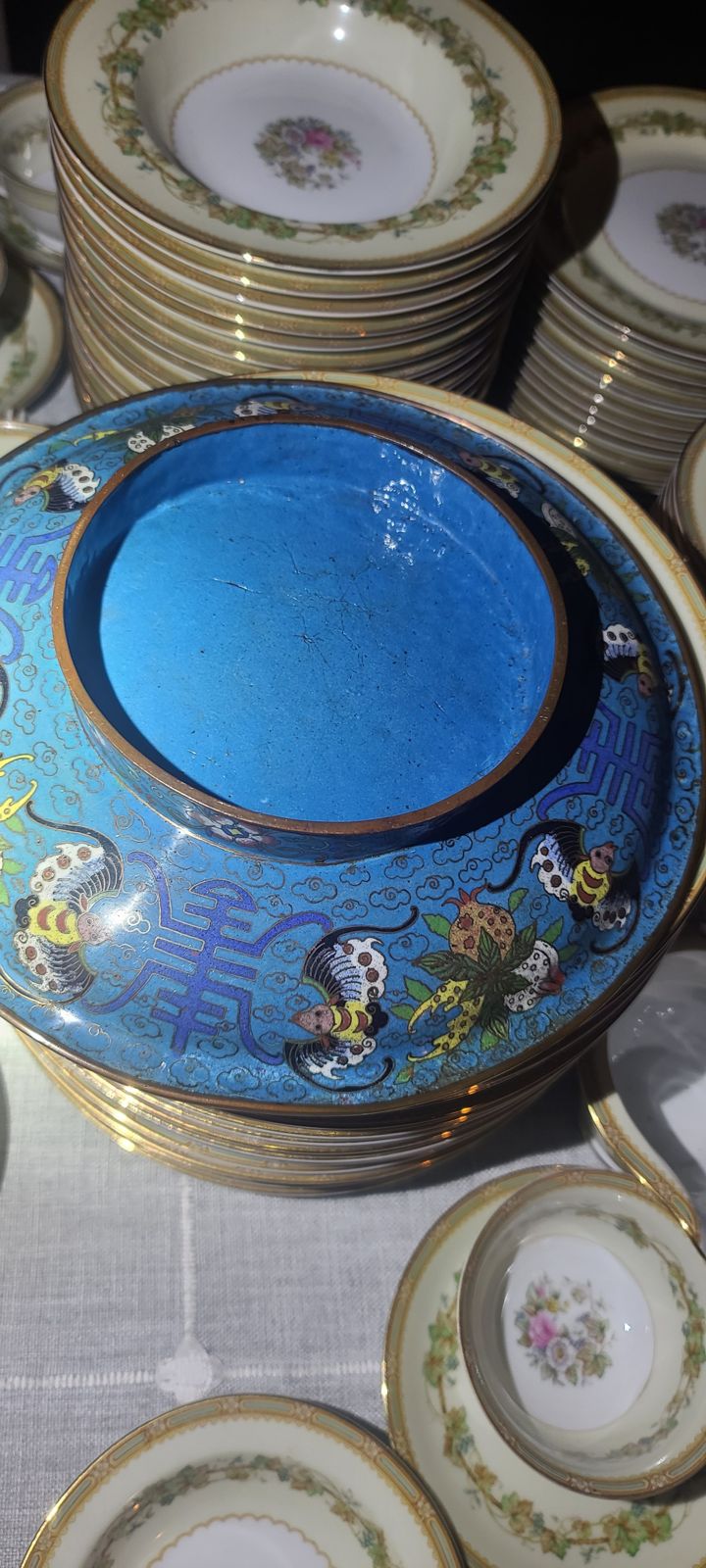
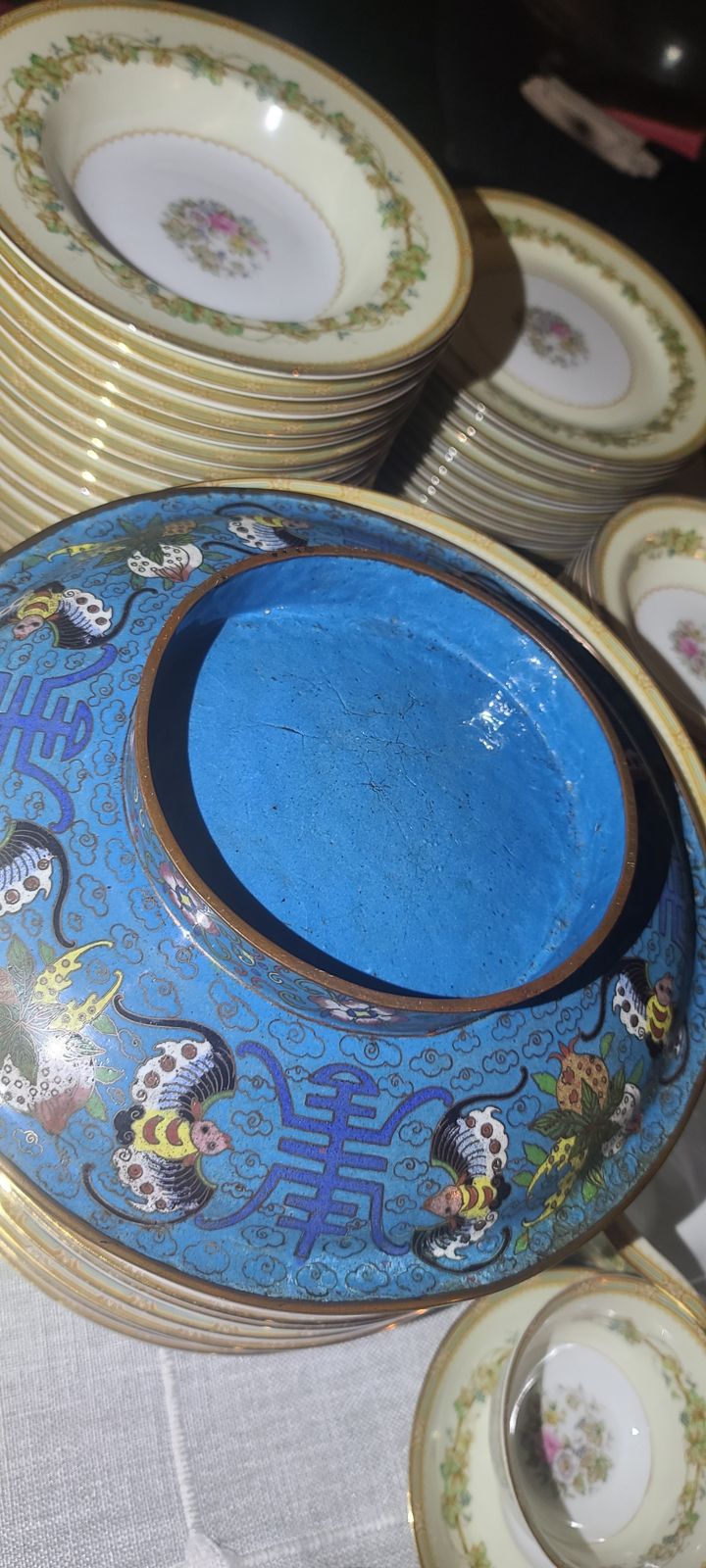
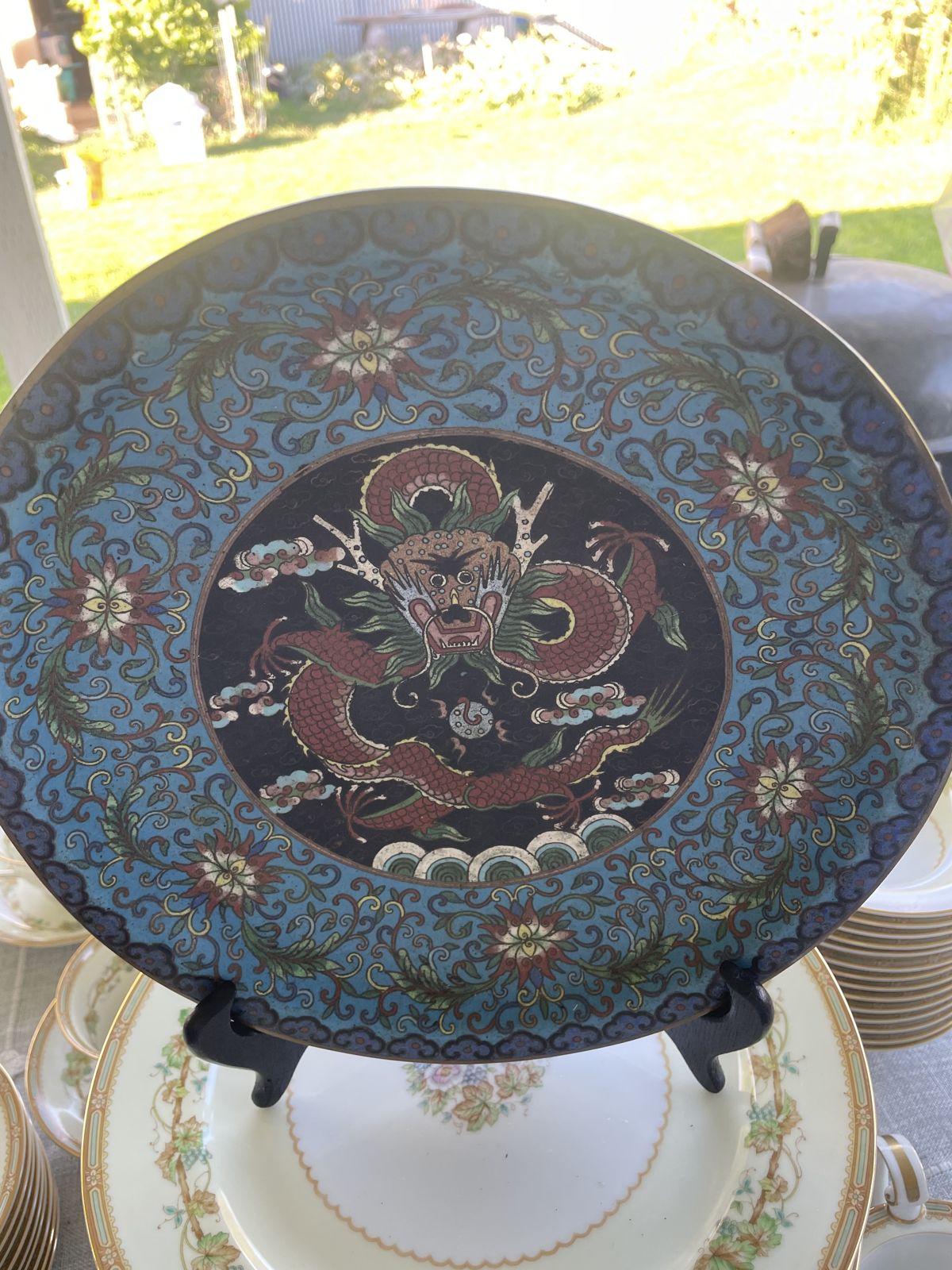
We first catalogued these as two pieces, a dragon charger and a shou bowl. The owner confirms they are the top and bottom of one object. That makes it a large round cloisonné covered box (he, 盒), one of the classic forms of Beijing cloisonné, used to hold sweets, seals, ink cakes or gifts and displayed with its lid on.

The lid (P03, P27, P40, shown face-up on a plate stand) carries a black-ground roundel at the centre. In it a red, frontal "face-on" dragon with five claws coils around a flaming pearl among multicoloured clouds above stylised breaking waves. Around it, the turquoise field is covered with "Indian lotus" scroll, large stylised lotus heads on curling tendrils, with a dark-blue ruyi-cloud border at the edge. The five-clawed dragon was formally the emperor's beast; on export work after 1900 it is simply the grandest decorative choice. The pearl it chases is read as wisdom, the moon or perfection.

The base (P28, P29) has a turquoise cloud-scroll ground with large dark-blue seal-script shou (壽, longevity) characters. These alternate with butterflies and with sprays of auspicious fruit, pomegranate (many sons) and Buddha's-hand citron (blessing), which with the peach make up the "Three Abundances" (sanduo 三多). The butterfly is a pun as well: hu-die (蝴蝶) sounds like die (耋), a great age. Its interior is enamelled plain turquoise and shows crazing and a crack line. That is what the "blue interior" photographs show.

Dragon above and longevity below make this a birthday or presentation piece, a wish for long life under heaven's favour. The wire-work is fine, the enamel fill even and the pitting mild, which points to the earlier part of the range (about 1900–1930) rather than 1970s PRC export.

Other things it could be

  • Large covered bowl or tureen rather than a box (depends on the depth of the base)
  • Japanese Meiji export cloisonné in Chinese taste (less likely given the lotus-scroll and shou vocabulary)
  • Later PRC copy (the crazing and wear argue for age)

What points that way

  • The dragon lid and shou base share the same turquoise ground, wire style and gilt rims
  • Both were photographed on the same stack of plates in the same session
  • Lid: frontal five-clawed dragon with pearl, clouds and waves, Indian-lotus border
  • Base: seal-script shou characters with butterflies and the Three Abundances; plain enamelled interior

Check in person

  • Fit the lid on the base. A snug fit confirms they are original to each other
  • Look inside the lid and under the base for a mark: 'China', or a workshop such as 老天利 Lao Tian Li or 德興成 De Xing Cheng, would add value
  • Check whether the crack inside the base goes through to the outside
  • Measure the diameter and the overall height with the lid on
  • Check the rims for dents and the enamel for chips

Source frames: P02, P24, P26, P31, P39

Lot 5Confident

Cobalt cloisonné baluster vase with peony sprays

Origin
China (Beijing)
Period
Republic to mid-20th century, c.1920–1960
Material
Cloisonné enamel on copper, brass rim and foot
Quantity
1 (possibly 2 — see note)

Fair market value$75 – $225

Single Republic-era cobalt cloisonné vases make $60–200 at auction. A true pair would bring about 2.5 times a single.

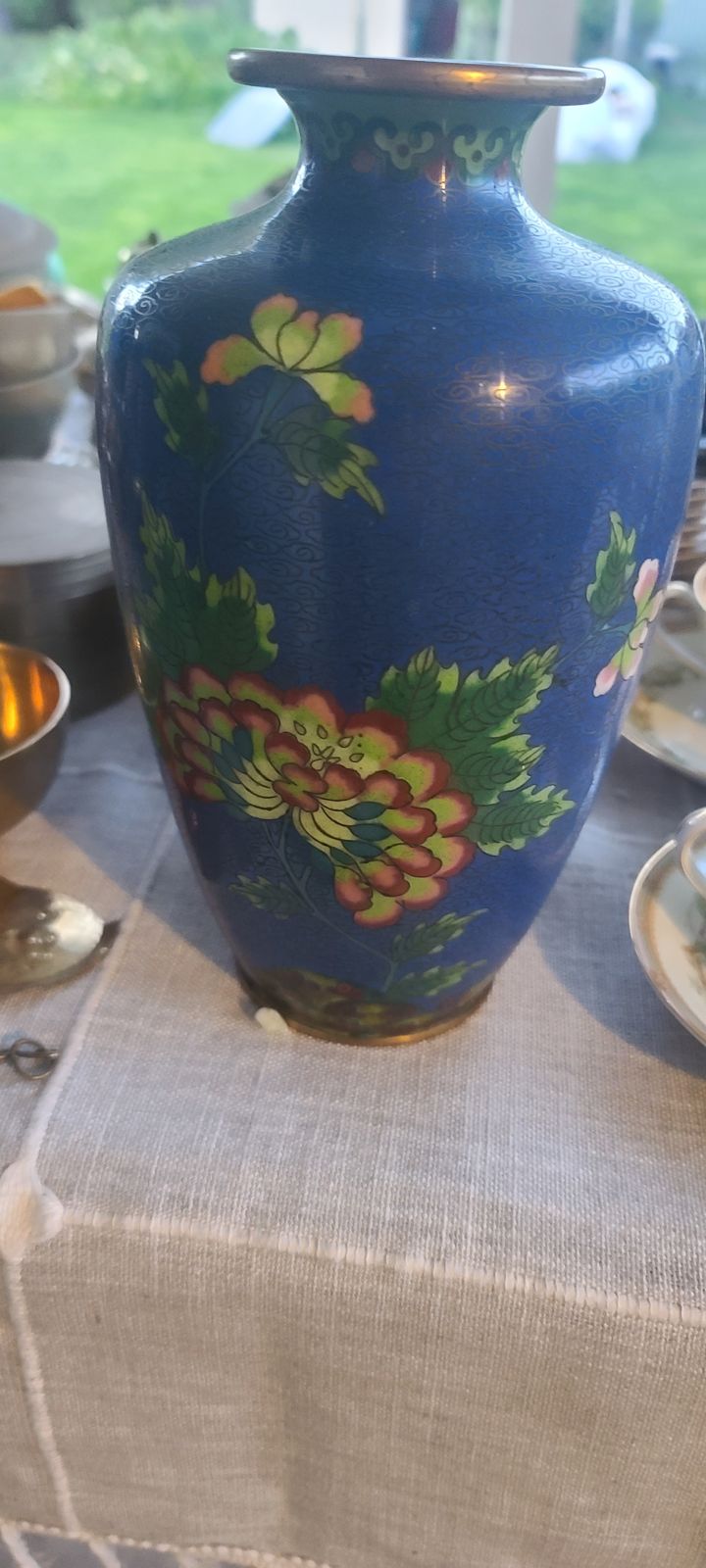
This is a shouldered baluster vase with a waisted neck and flared brass lip. The deep cobalt ground is entirely filled with tiny wire cloud scrolls, a filler that keeps the enamel from cracking during firing and gives the surface its shimmer. On the front is a large peony in pink, red and yellow among green leaves. A smaller spray of pink blossoms is on the reverse, and a green ruyi-lappet collar circles the neck.

The peony is the "king of flowers" in China and stands for wealth and honour (fugui 富貴). The bright "Republic" palette, the cloud-wire ground and the clean finishing are typical of Beijing export workshops of the 1920s–50s; the same vases were made in enormous numbers into the 1980s.

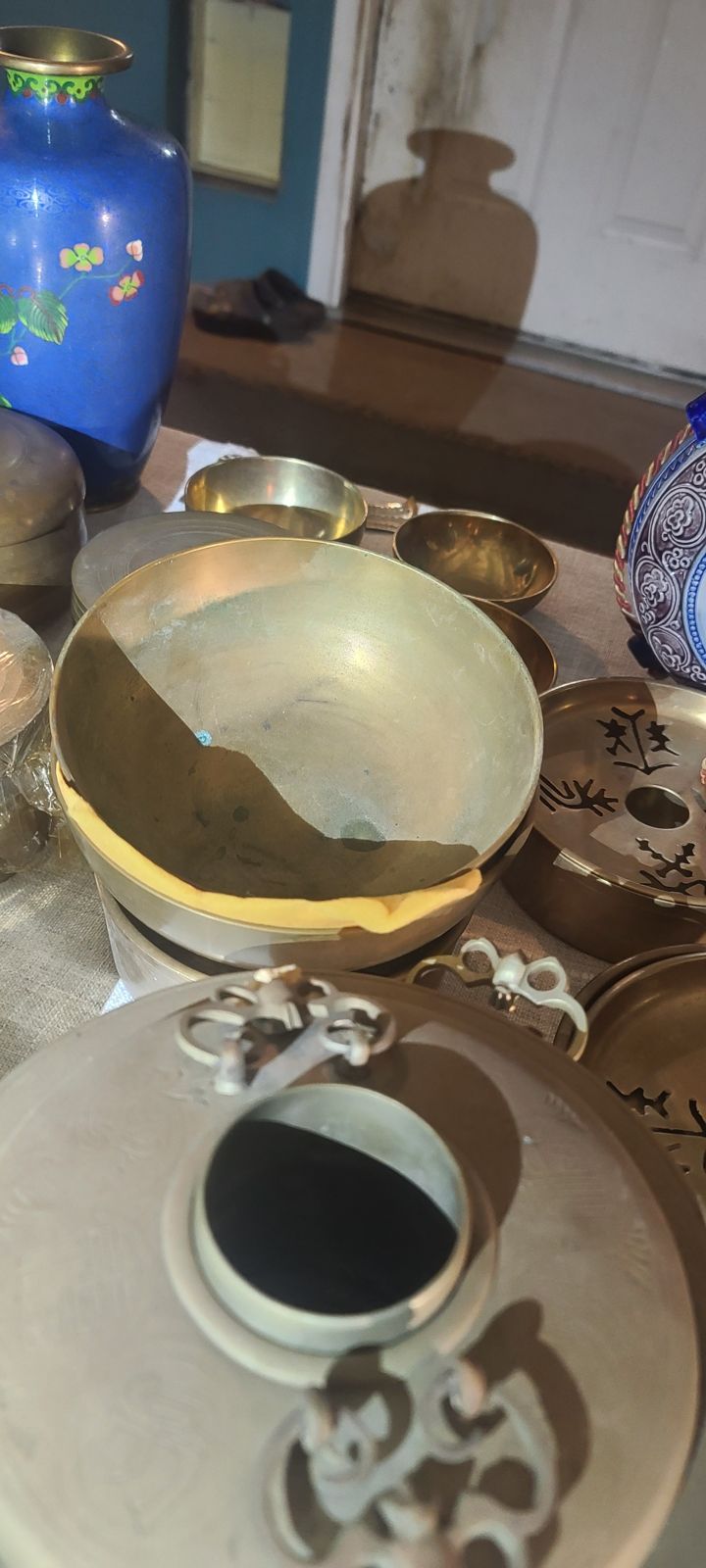
One open question: P24, taken in a different room, shows a blue vase with only the small pink spray and the same green collar. It is most likely this vase's reverse. Its neck looks a touch taller, though, so it is worth checking the boxes for a second vase before pricing.

Other things it could be

  • 1960s–80s PRC export vase (often with a foil 'Made in China' label)
  • Japanese late-Meiji cloisonné (less likely; Japanese work typically has finer wire and plainer grounds)

What points that way

  • Cobalt ground filled with cloud-scroll wire
  • Bright peony palette and green lappet collar
  • Gilt-brass lip and foot

Check in person

  • Look under the foot for a 'China' stamp or foil label
  • Check the shoulder for dents and filled or repainted enamel (dull, soft-looking patches)
  • Search the boxes for a matching second vase (see P24)

Section III

Korean & Asian brass

This is the large table of yellow metal. Most of it is Korean, the kind of household and gift brass that came home with American servicemen and families from about 1955 to 1985. Korea has a deep tradition of copper-alloy tableware called yugi (鍮器). Its finest grade, bangjja, is a hand-forged bronze of about 78% copper and 22% tin that rings like a bell when you tap it. The town of Anseong was so famous for made-to-order yugi that "Anseong-machum" (made to order, Anseong style) became a Korean idiom for something that fits perfectly. During the Japanese occupation much of Korea's yugi was requisitioned and melted down for the war effort. The post-war revival was mostly spun and cast brass, and that is what nearly all of this group appears to be.

The centrepieces are two sinseollo (신선로), Korea's royal-court hot pot. A chimney full of live charcoal rises through a ring-shaped moat of broth and delicacies, and the dish is cooked at the table. Around them are rice bowls, a wedding bowl, drinking cups, ashtrays, trivets and ornaments. Individually these are modest pieces. As a group they make an attractive, saleable lot, and it is worth tapping every bowl in case some of them are true bangjja.

Source frames: P17, P21, P23, P24, P31, P37, P46, P63

Lot 6Confident

Pair of brass sinseollo — Korean royal-court charcoal hot pots

Origin
South Korea
Period
c.1955–1985
Material
Brass (cast and spun), engraved
Quantity
2 complete-looking pots

Fair market value$90 – $220

Vintage Korean brass sinseollo are offered at $50–175 each on eBay; complete pots in good condition realistically sell for $45–110.

The sinseollo (신선로, 神仙爐, "brazier of the immortals") is the showpiece of Korean royal-court cuisine. A central chimney holds live charcoal and rises through a ring-shaped moat. Thin slices of beef, pan-fried fish and vegetable jeon, mushrooms, gingko nuts, pine nuts and egg-garnish strips are arranged in concentric colour rings in the moat, and hot broth is poured over at the table. The legend has it named for a Joseon-era scholar who withdrew to the mountains to live like an immortal and cooked his meals in a pot of his own design.

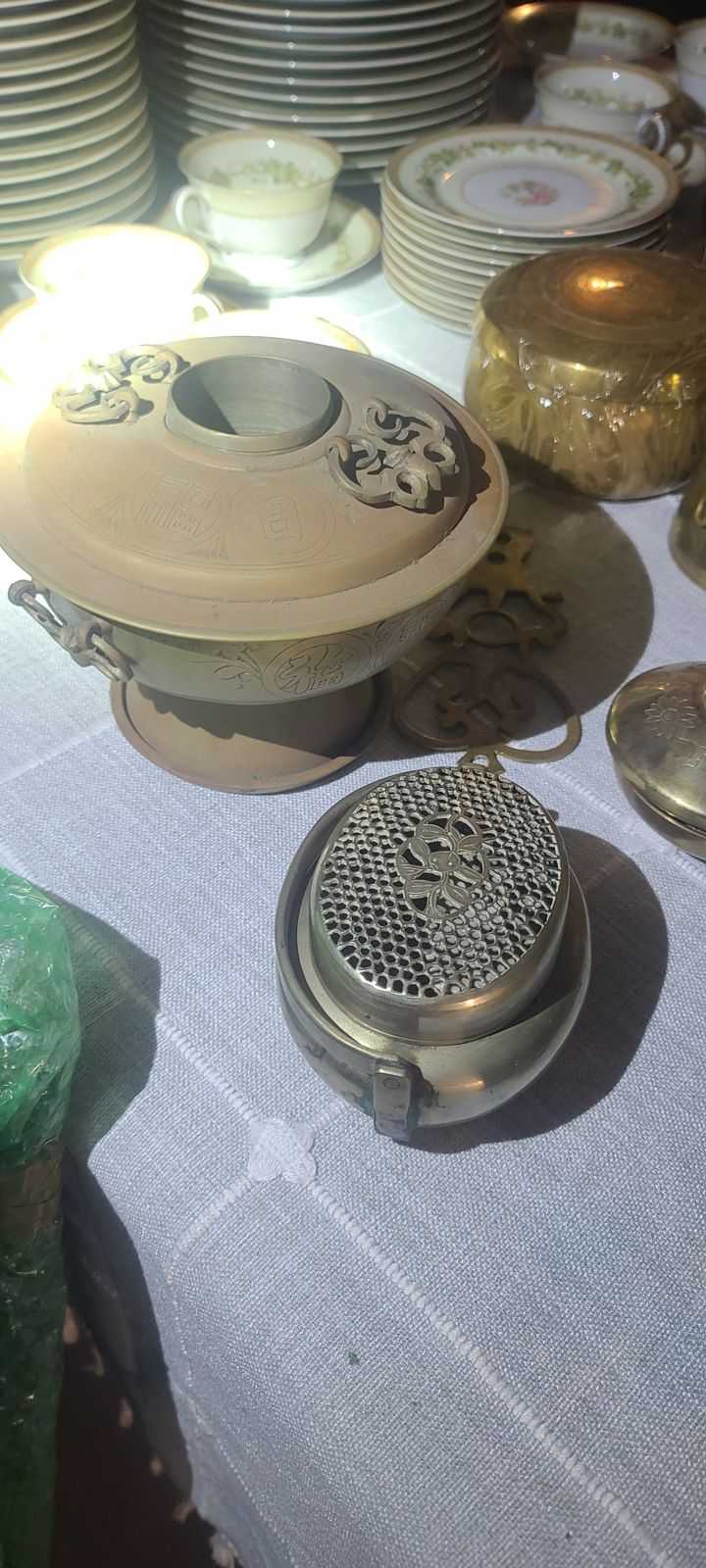
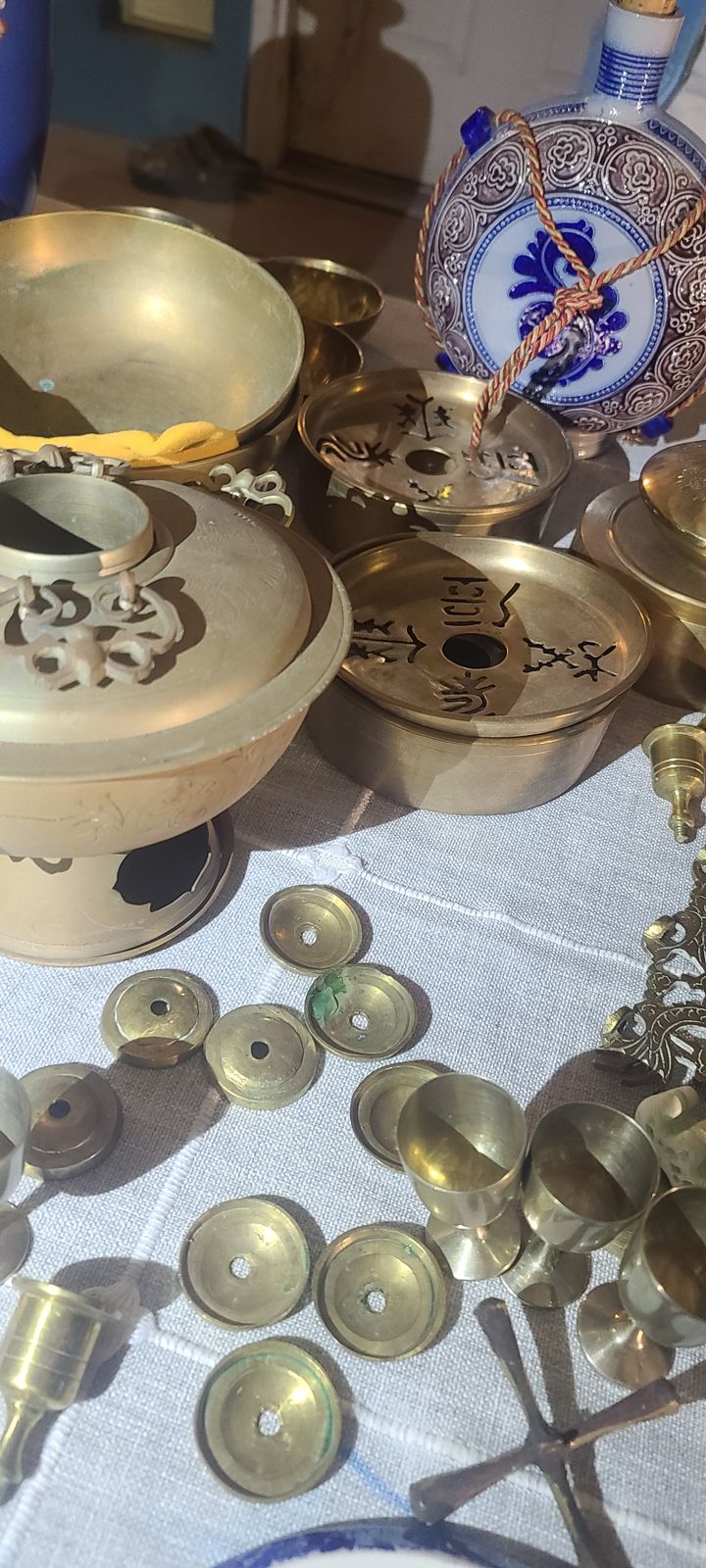
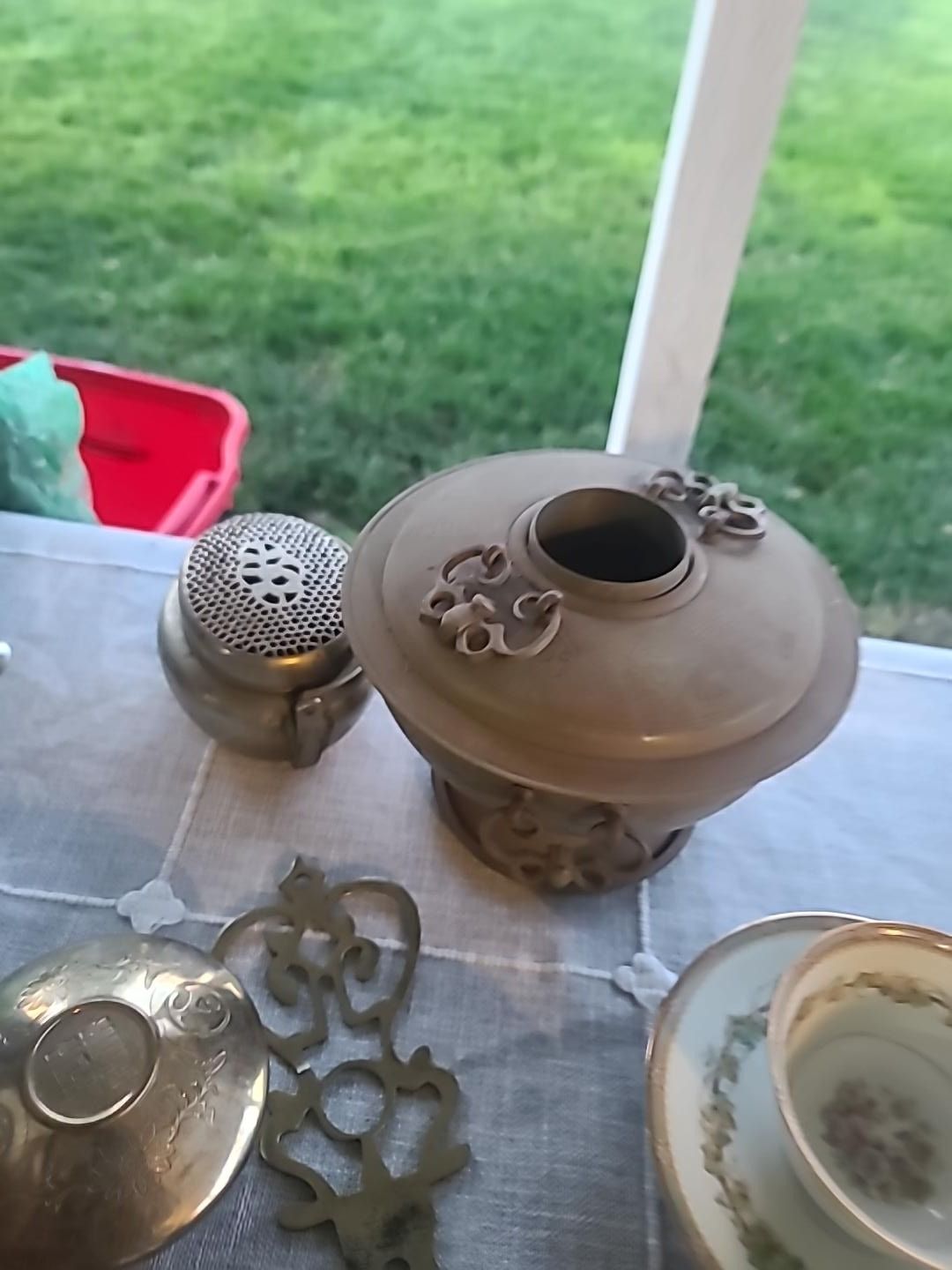
Two pots appear in the photographs; P31 and P42 each show both at once. Pot A has a lid engraved with 福 (fortune) and 壽 (longevity) medallions in roundels, cut-out cloud-scroll lid handles, drop-ring handles on the bowl and a dished foot. Pot B has a pierced, openwork scroll fire-box base. Both have the tarnished, slightly greyish look of post-war Korean brass. They were made in large numbers for Korean households and as gifts for American service families. A full sinseollo assembly is a lid with chimney collar, a moat bowl, a chimney, and a pedestal fire-box with a drip tray.

Other things it could be

  • Chinese huoguo (火鍋) hot pot: usually taller, with a spouted chimney and often pewter or copper
  • Japanese shabu-shabu pot made for the Korean export market

What points that way

  • Central chimney rising through a ring-shaped moat
  • Cut-out cloud-scroll lid handles; 福/壽 roundels
  • Pedestal fire-box base with draught openings

Check in person

  • Check that each pot is complete (lid, moat bowl, chimney, base, drip tray)
  • Look under the fire-box for a 'KOREA' stamp or maker's mark
  • Soot inside means it was used. That's fine, but clean it gently
  • Heavier cast pots are worth more than thin spun ones

Source frames: P21, P22, P36, P46

Lot 7Probable

Oval hand warmer (shǒulú 手爐) with honeycomb-pierced lid

Origin
China (or Hong Kong / Taiwan)
Period
c.1920–1970, possibly earlier
Material
White brass or nickel-plated brass
Quantity
1

Fair market value$60 – $150

Chinese brass hand warmers with pierced lids are offered at $130–170. Marked or clearly pre-1920 examples bring considerably more at Asian-art sales.

This is a palm-sized oval container with a domed lid pierced all over in a honeycomb mesh, around a central openwork flower medallion. A hinged bail handle is mounted on lugs at the sides. It was first read as a Korean brazier, but the form is the classic Chinese hand warmer, shǒulú (手爐).

From the Ming dynasty onward, scholars and ladies carried these in a sleeve or on the lap in unheated winter rooms. They were filled with smouldering charcoal dust or rice husks banked in ash, so the mesh let warmth out without exposing the embers. Fine Ming and Qing examples by named makers (Zhang Mingqi 張鳴岐 is the most famous) are serious collector's items. This one's bright, silvery colour suggests baitong (白銅, "white copper", a nickel-rich alloy) or nickel plating. The clean, machine-even mesh points to the 20th century.

Other things it could be

  • Incense burner (the same form doubles as one)
  • Korean or Japanese souvenir copy of the Chinese form
  • If hand-pierced and marked, a late-Qing piece worth several hundred dollars

What points that way

  • Oval body and domed honeycomb-mesh lid
  • Hinged bail on side lugs, for carrying while hot
  • Silvery white-metal colour

Check in person

  • Look under the base for a cast or engraved maker's seal
  • Look closely at the mesh: uneven hand-cut holes are older and better; uniform stamping is later
  • Check for soot inside and wear on the plating
  • Magnet test (paktong and brass are non-magnetic)

Source frames: P15, P22, P37, P45, P48

Lot 8Probable

Yugi brass rice bowls, including a lidded "double happiness" wedding bowl

Origin
South Korea
Period
c.1960–1980
Material
Brass (test for high-tin bangjja bronze)
Quantity
~6–8 bowls and lids

Fair market value$80 – $200

Korean brass lidded rice bowls are offered at $26–88 on Etsy. A plain brass bowl typically sells for $15–40, and true bangjja for $60–150 each.

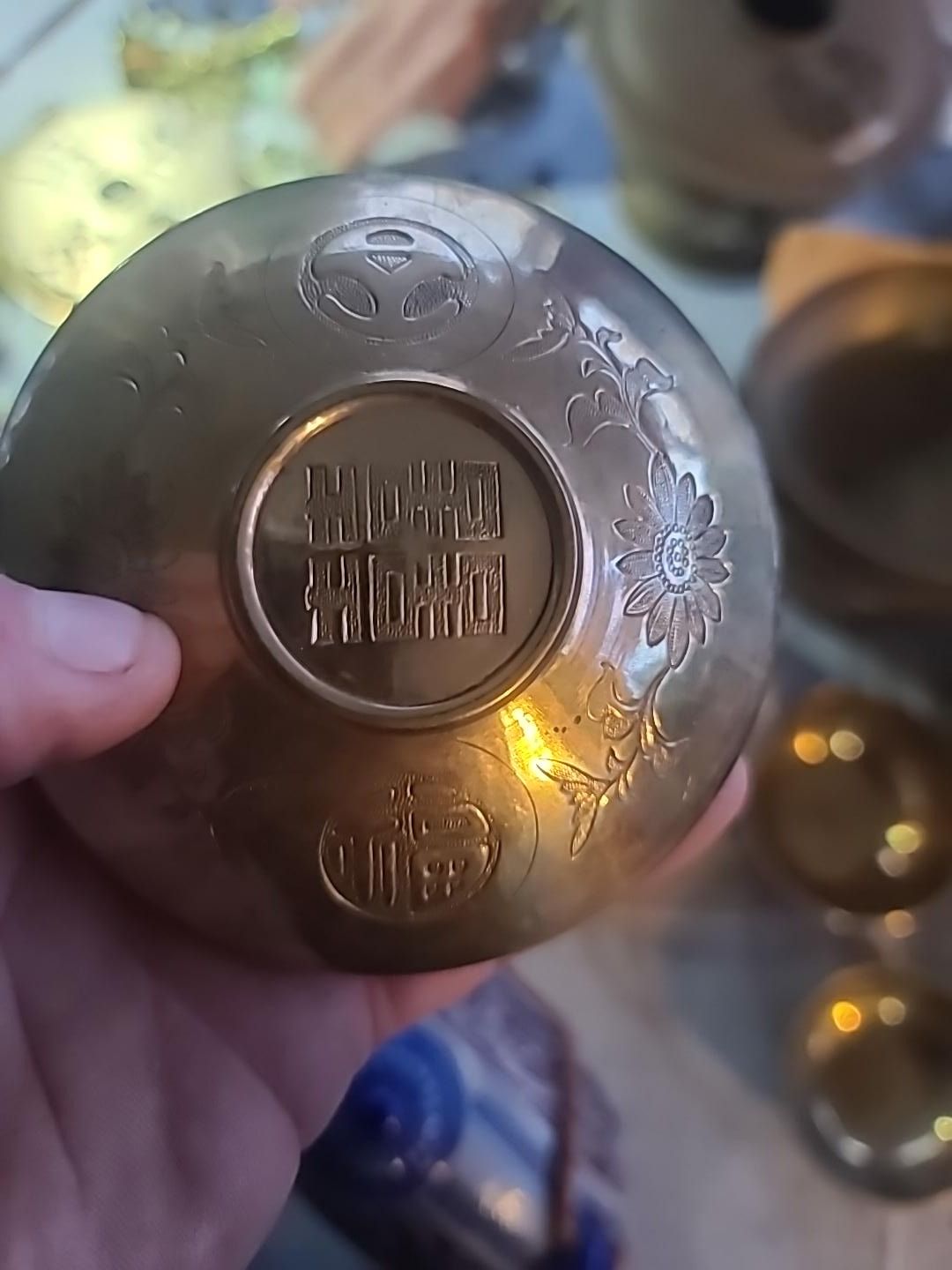
This is a group of round brass rice and soup bowls (bari or jubal, 주발), some stacked with fitted lids. The interesting one is in P48 and P22: a lidded bowl whose foot holds a stamped square seal of two stacked pairs of the character 喜 (joy). That is effectively the double-happiness 囍 sign of a wedding. Around the sides are roundels with 福 (fortune) and a three-comma whirl crest like the sam-taegeuk, plus an engraved chrysanthemum spray. In Korea a covered rice bowl was a classic wedding gift; the bride brought her own set of yugi to her new household.

The question for this group is the alloy. The thick, deep-gold walls suggest ordinary turned brass. Genuine bangjja yugi, hand-forged high-tin bronze, looks paler and greyer-gold, shows faint hammer facets, and rings like a temple bell for several seconds when tapped. It is in demand again in Korea, partly because of its reputation for detecting spoiled food and resisting bacteria, and good pieces command real money.

Other things it could be

  • Chinese brass rice bowls (the 囍 motif is shared across East Asia)
  • Some bowls may be true bangjja: tap test needed

What points that way

  • Doubled 喜 seal stamped in the foot of the lidded bowl
  • 福 roundel, three-comma crest and engraved chrysanthemum
  • Nested bowls with fitted lids, the Korean bari/jubal form

Check in person

  • Tap test every bowl: a long, clear bell tone means bangjja and is worth pulling out and pricing separately
  • Count lids against bowls; matched lidded pairs sell best
  • Look for maker stamps (Anseong 안성 or Napcheong 납청 makers would add value)

Source frames: P16, P23, P37, P45

Lot 9Speculative

Four lidded brass boxes with lids pierced in archaic-style characters (probably covered ashtrays)

Origin
South Korea (or Taiwan)
Period
c.1960–1985
Material
Brass
Quantity
4 pierced-lid boxes + ~3 plain lidded boxes

Fair market value$60 – $140

Vintage Korean brass ashtrays are offered at about $15–30 each. The plain lidded boxes add $10–20 each.

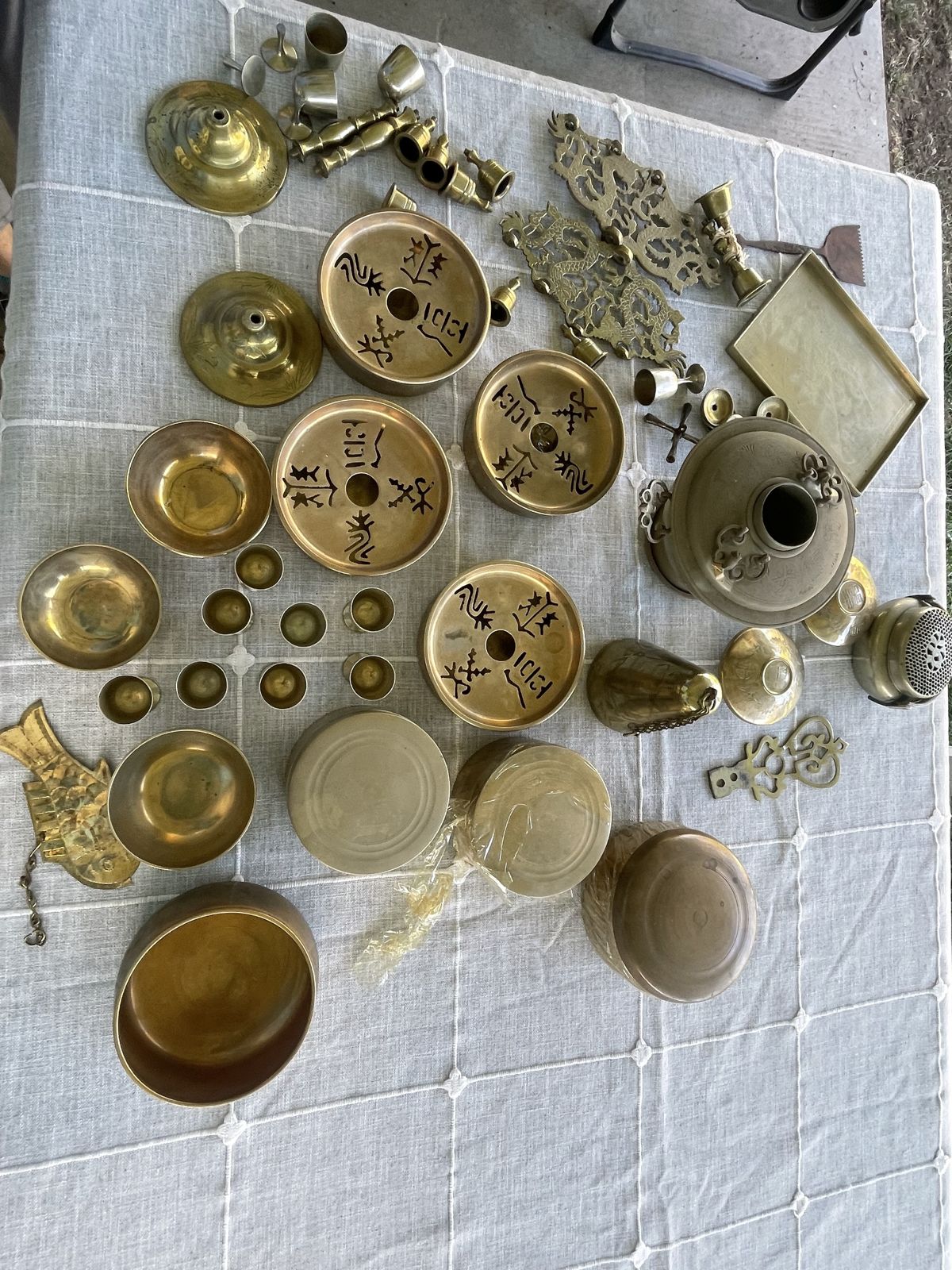
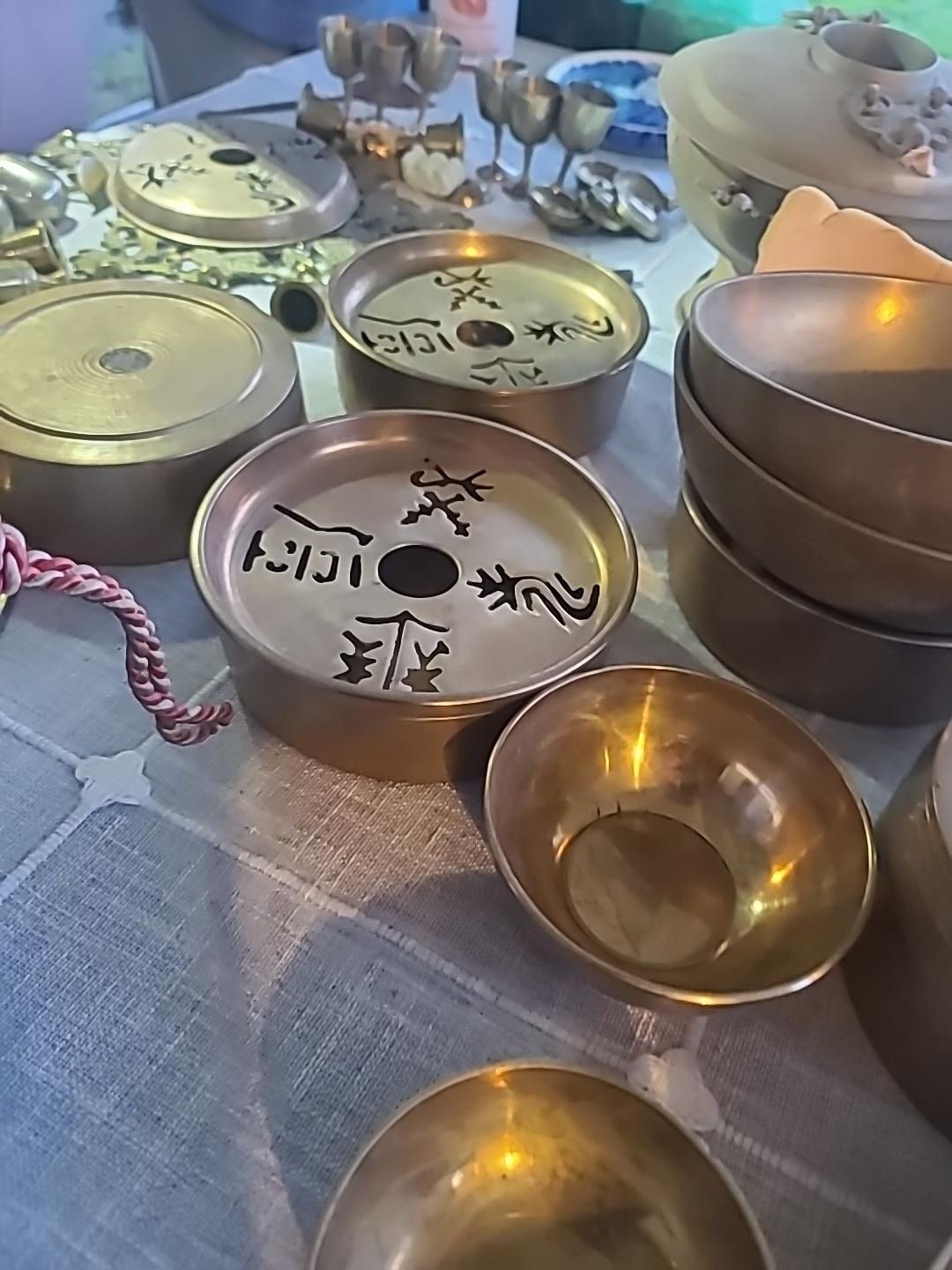
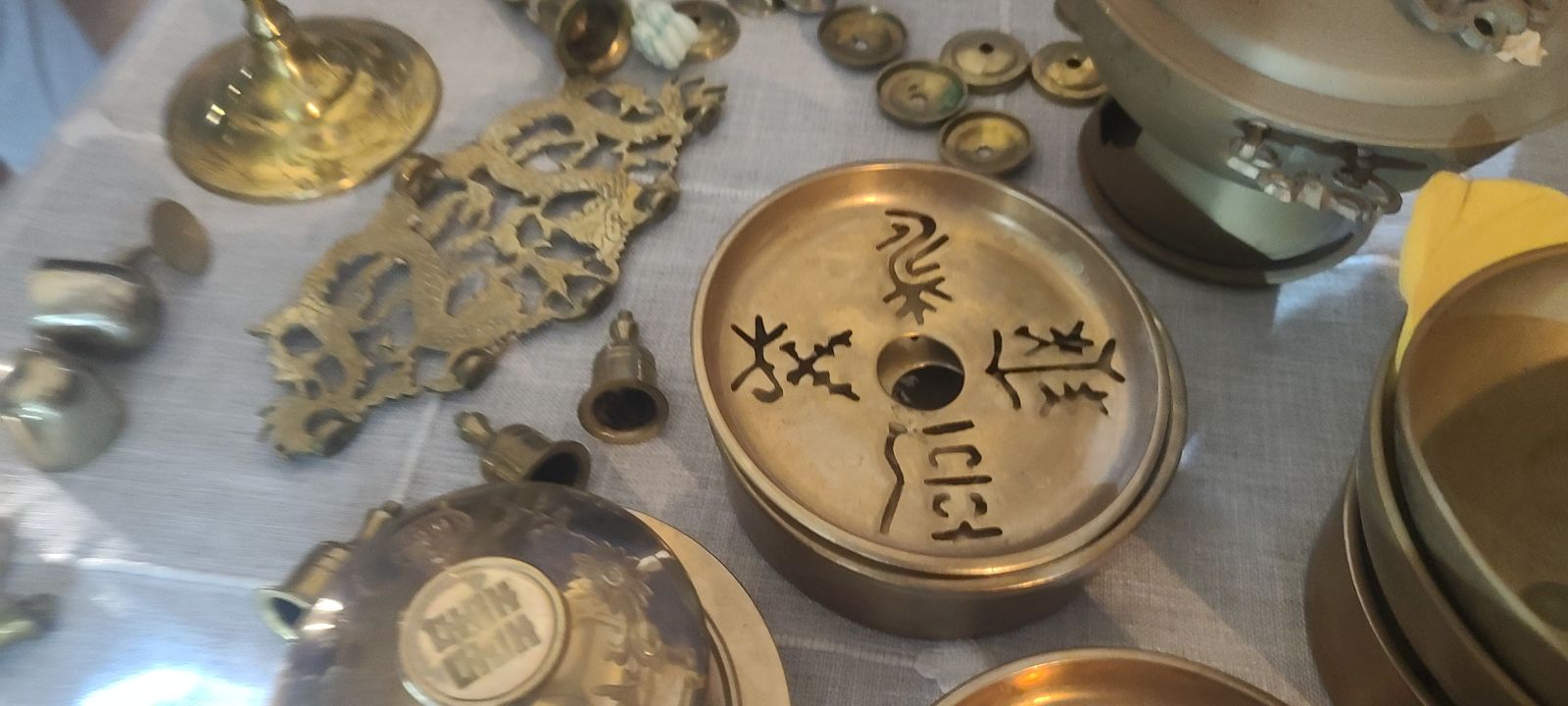
These are four matching round brass boxes. Each lid is a sunken plate with a central hole and four large characters cut through in an "archaic" brush-script style, one in each quarter. They are the most puzzling objects in the group.

We first hoped the four characters would read 福壽康寧 (fortune, longevity, health, peace), the most common four-character blessing. Several of the forms don't match standard seal script, though. One looks like "ICI" with a hook, and others like branching trees. They are probably decorative pseudo-archaic characters in the "oracle-bone" manner, a fashionable motif on 1960s–70s Korean and Taiwanese export brass.

As for function, ash and a stubbed cigarette drop through the centre hole and the cut-outs, and the lid hides them from view. A covered ashtray was a staple Korean gift of that period and is the most likely reading. Three plain boxes with flat lids, a small central boss and turned rings appear nearby. They may be the same vessels with solid lids, or plain covered boxes (hap, 盒).

Other things it could be

  • Incense or pot-pourri boxes
  • Covers or stands belonging to the sinseollo
  • Rice or food warmers

What points that way

  • Recessed lid with a centre hole and pierced decoration
  • Four identical boxes, so a set
  • Same tarnished post-war brass as the hot pots

Check in person

  • Look inside for ash or burn residue and a removable liner
  • Photograph each lid straight down so someone who reads Chinese or Korean can attempt the characters
  • Check whether the plain-lid boxes share the same diameter (mates?)

Source frames: P22, P23, P37, P45

Lot 10Probable

Brass drinking set: nine small cups, stemmed goblets, footed bowls and drip pans

Origin
Korea / India
Period
c.1960–1980
Material
Brass
Quantity
9 small cups, ~6–8 goblets, 2–3 footed bowls, ~11 small discs

Fair market value$40 – $100

Per-piece values: small cups $3–6, goblets $5–10. Sold as a group they are worth more than piece by piece.

Laid out on the cloth in P37 are nine identical tiny round cups, about the size of a soju or sake cup. Sets of brass drinking cups were a standard part of the Korean household brass set and of the boxed gift sets sold in Seoul's Itaewon and at US PX stores. With them are six to eight stemmed brass goblets (P22, P23, P45). These are a generic export form made in Korea and in vast numbers in India, used as wine or liqueur cups, or in Korean ancestral rites (jesa) as offering cups. A couple of small footed bowls complete it.

About eleven small brass discs with centre holes (P16, P23) are probably bobèches, the drip pans that sit on candlesticks, and likely belong with the candlesticks in the next lot.

Other things it could be

  • Goblets may be Indian export brass
  • Small cups may be Chinese wine cups
  • Footed bowls may be jegi (Korean ritual offering vessels)

What points that way

  • A matched set of nine identical small cups
  • Simple turned stemmed goblets

Check in person

  • Look under the feet for 'KOREA' or 'INDIA' stamps
  • Check whether the goblets match in height and profile
  • Fit the small discs onto the candlesticks

Source frames: P16, P37, P46

Lot 11Confident

Pair of openwork cast-brass dragon plaques / trivets and a small scroll ornament

Origin
China, Taiwan or Korea
Period
c.1950–1985
Material
Cast brass
Quantity
2 dragon plaques + 1 ornament

Fair market value$30 – $60

Vintage brass Chinese dragon trivets sell for about $12–25 each; a pair was recently offered at $34.

These are two long pierced castings, each showing a coiled dragon chasing a flaming pearl among cloud scrolls, with knob feet or lugs on the back. This is the standard "dragon trivet" or wall plaque, made by the hundreds of thousands for export from Hong Kong, Taiwan and Korea between the 1950s and 1980s. They were set under hot dishes or hung in pairs on a wall. They are attractive and very decorative, but not rare.

The small separate openwork piece (P37 lower right, P46) has a ruyi-cloud outline and a hanging loop. It may be a key-hanger plaque or a drawer escutcheon, or possibly a detached handle from one of the hot pots. Try it against the sinseollo lids.

Other things it could be

  • Door knocker back-plates
  • Brass wall-hanging pair (if there are no feet)

What points that way

  • Dragon with pearl and clouds in pierced cast brass
  • A matched pair

Check in person

  • Feet on the back mean a trivet; a hanging loop means a plaque
  • Test the small ornament against the hot-pot lid handles

Source frames: P22, P37

Lot 12Speculative

Brass bells, tall chained cone, candlesticks and two domed engraved bases

Origin
Korea / India
Period
c.1960–1985
Material
Brass
Quantity
~10 pieces

Fair market value$35 – $80

Generic brass of this kind sells for $5–20 a piece; the tall cone is the best piece in the group.

This is the miscellany. The most striking piece is a tall tapered brass cone with incised bands, hanging from a chain (P22). It is probably a hanging bell with a chain-held striker, though it could also be a hanging incense cone or a very large candle snuffer. Around it are three or four small cast bells with knob finials, a pair of short candlesticks, and two broad, domed bases engraved with flowers (P37 top left). The domed pieces are probably the bases of candlesticks or oil lamps whose columns have gone astray, and they may take the drip pans from the previous lot.

All of this is generic Asian export brass of the mid-20th century. Korea and India both made it, and none of it is diagnostic of either.

Other things it could be

  • Cone could be a wind chime or temple-style hanging bell
  • Domed bases could be from hookahs or lamps

What points that way

  • Machine-turned, polished brass
  • No visible marks in the photographs

Check in person

  • Look inside the cone for a clapper
  • Try the domed bases with the candle sockets and the drip pans
  • Look for INDIA or KOREA stamps

Source frames: P32, P33, P34, P35

Lot 13Probable

Copper cake server with crane handle, and an engraved brass tray

Origin
South Korea
Period
c.1960–1980
Material
Copper (server); brass (tray)
Quantity
2

Fair market value$20 – $45

Souvenir copper and brass servers sell for $12–25, and small engraved trays for $10–20.

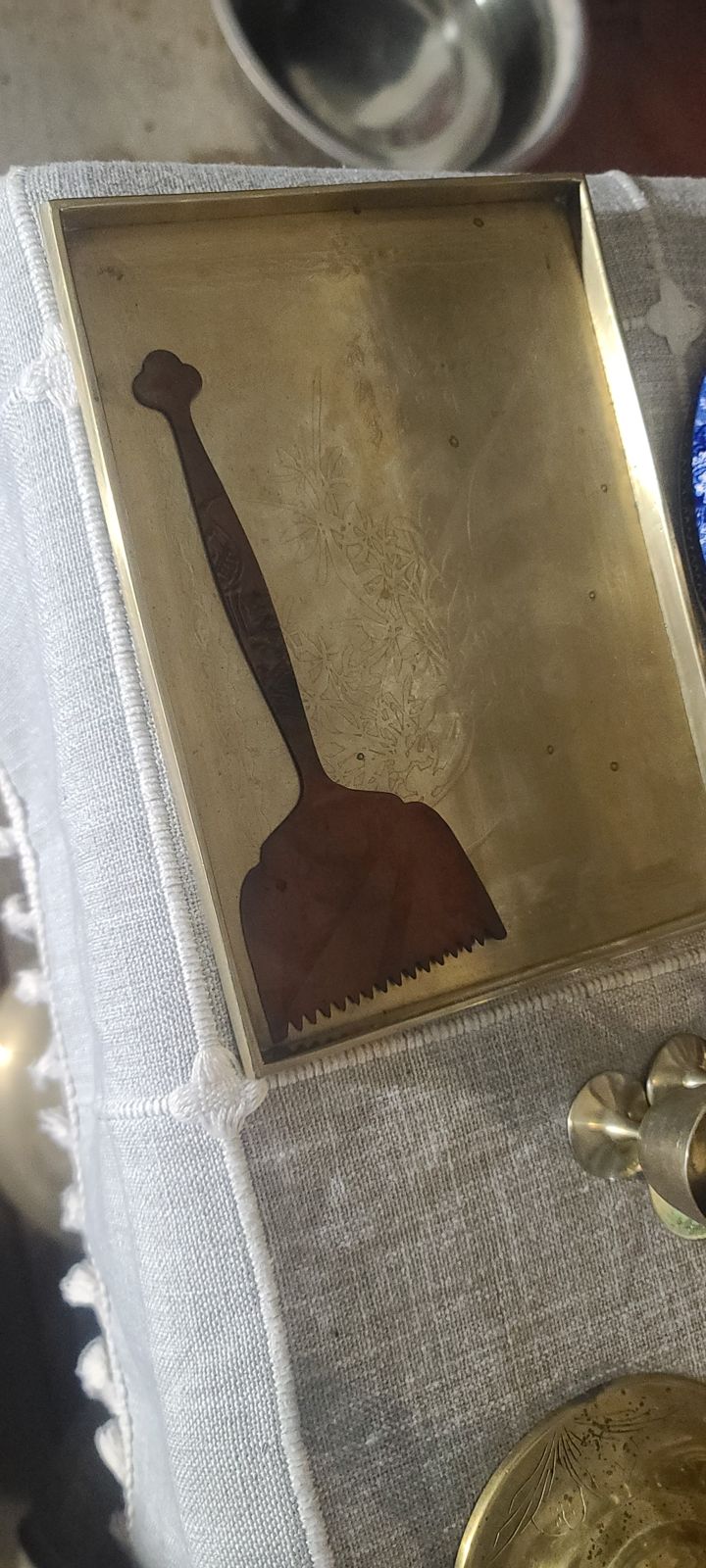
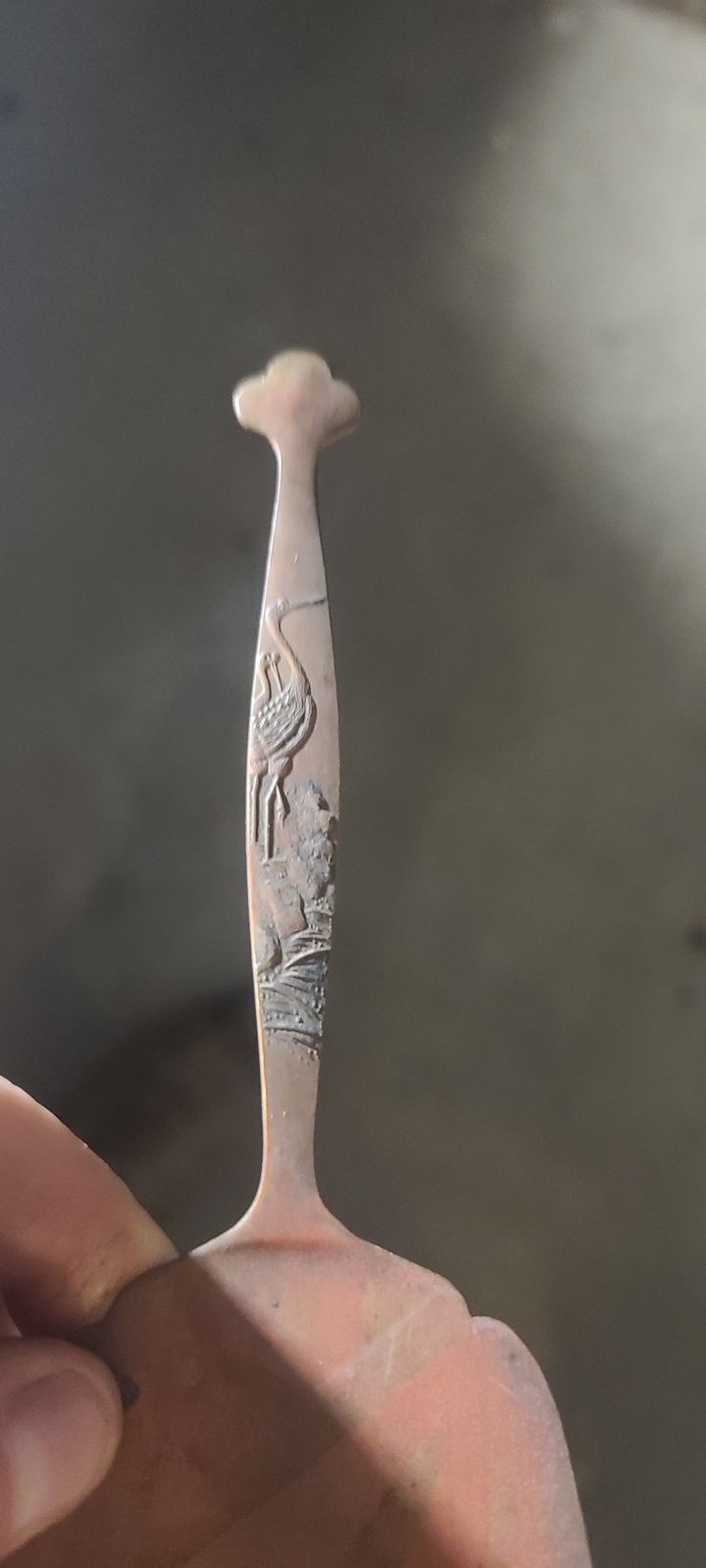
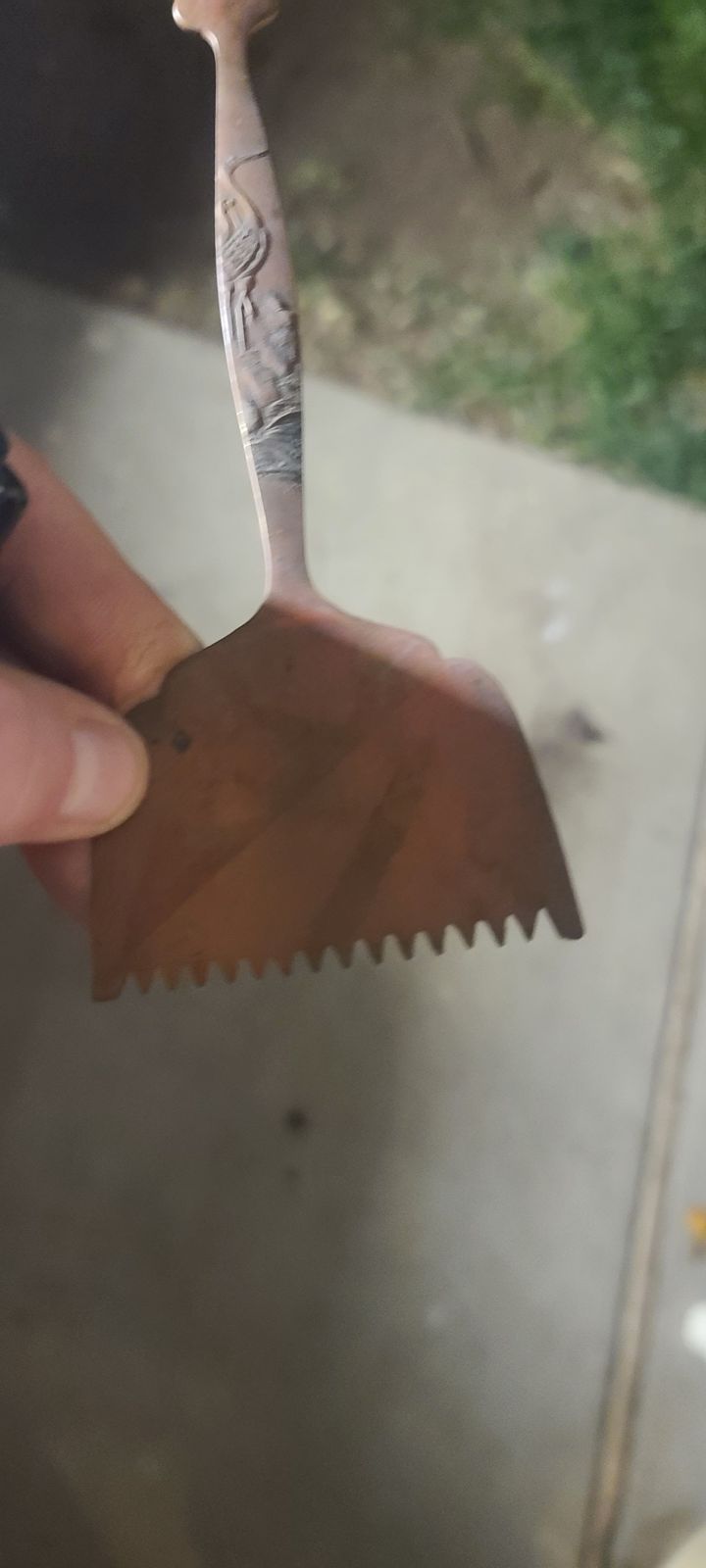
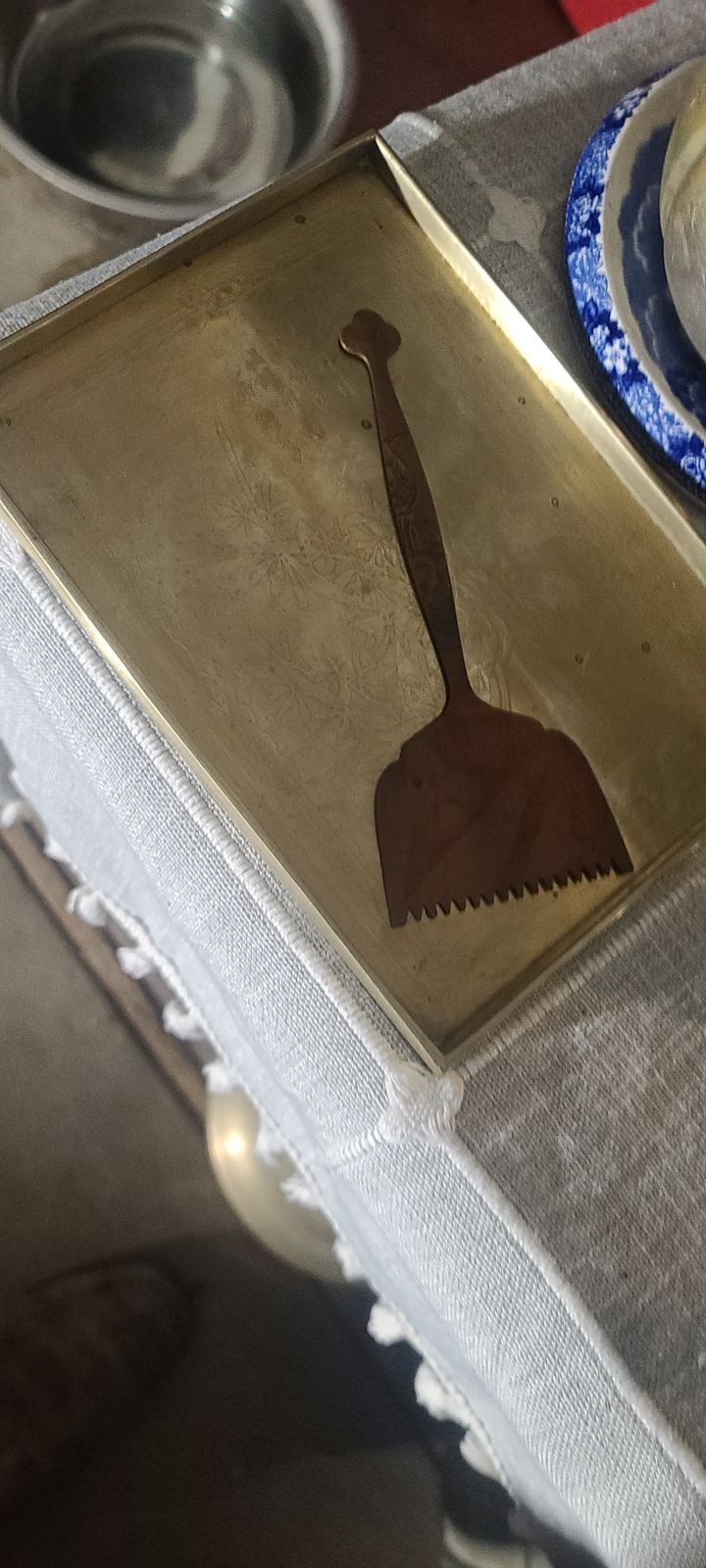
This is a copper server with a serrated cutting edge. It is a rice-cake (tteok) or cake server, though Americans used them as pie servers. The slender handle ends in a lobed cloud-head finial (yeouimeori, 여의머리). On the handle is a relief crane standing among rocks and reeds. The crane is one of Korea's "ten symbols of longevity" (sipjangsaeng, 十長生), with the sun, mountains, water, rocks, clouds, pine, the herb of immortality, turtles and deer. They run through Korean decorative art from royal screens to gift spoons.

With it is a thin rectangular brass tray with folded edges and a lightly engraved field of bamboo or foliage. Server and tray were very likely bought together as a boxed set.

Other things it could be

  • Japanese export copper server (cranes are equally Japanese)

What points that way

  • Ruyi cloud-head finial and crane-among-reeds relief
  • Copper blade with serrated edge

Check in person

  • Look for a 'KOREA' stamp on the back of the blade
  • Check whether the tray engraving matches the server

Source frames: P31, P37, P39

Lot 14Probable

Stamped brass fish wall hanging with chain

Origin
South Korea
Period
c.1960–1980
Material
Sheet brass
Quantity
1

Fair market value$10 – $30

Korean brass fish wall hangings are offered at $10–25 each; pairs are listed on Chairish.

This is a flat sheet-brass fish with embossed scales and fins and a hanging chain, seen in several photographs at the edge of the table. In Korea and China the fish is an emblem of abundance, because 魚 (yu, fish) sounds like 餘 (yu, surplus). It is also an emblem of vigilance, because fish never close their eyes. That is why traditional Korean chest locks were cast in the shape of a fish: so the household's valuables would be watched over day and night. This piece is a mid-century wall hanging or key hanger in that spirit, not a lock.

Other things it could be

  • Door chime
  • Part of a larger set of hanging fish (look for others)

What points that way

  • Embossed sheet-brass fish with chain
  • Matches Korean gift brass of the period

Check in person

  • Look for a 'KOREA' stamp and hooks at the chain end
  • Check the boxes for a second fish (they were often sold in pairs)

Section IV

Other metal & stoneware

These pieces were mixed in with the brass but are not Asian, or not decorative: a West German stoneware hunting flask, a pair of very heavy round black bases, and a small stamped hardware plate.

Source frames: P51, P52

Lot 15Speculative

Heavy round bronze pedestal bases, black patina, threaded centre socket

Origin
Probably USA (commercial / architectural bronze)
Period
Mid-20th century
Material
Cast bronze, dark black-brown patina or finish
Quantity
1–2 (count in person)

Fair market value$150 – $500

Two ways to price it, and the higher wins. As scrap, bronze yards were paying about $3.10–$4.15/lb in late September 2026, so a 30–50 lb base is worth roughly $90–200 in metal alone. As vintage hardware, bronze stanchions and pedestal bases bring several hundred dollars a pair to restaurant, theatre and loft buyers. The range covers one or two bases. Don't scrap them until the decorative market has been tried.

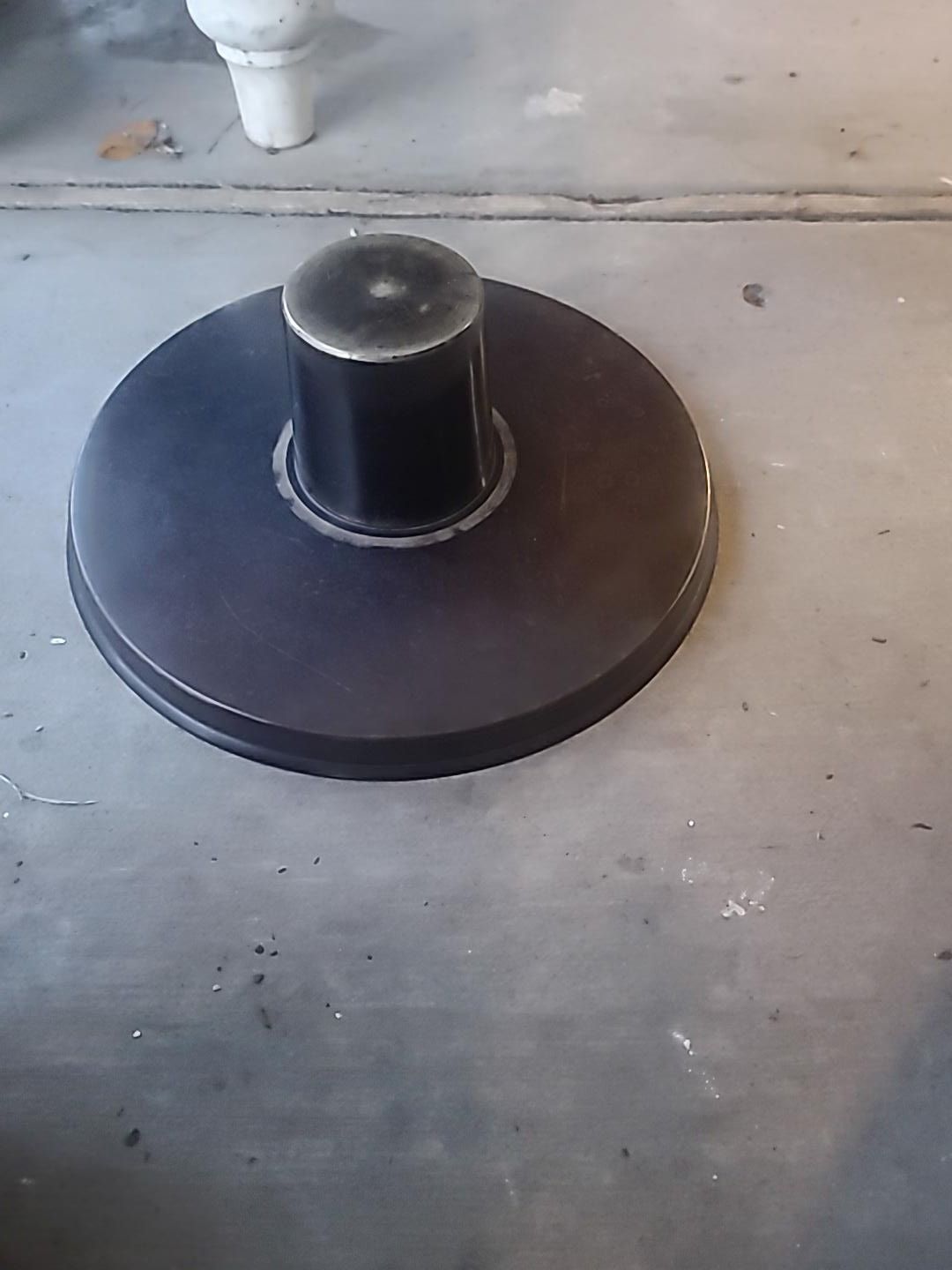
The owner confirms there is no cast iron in this lot, so these heavy black discs are bronze with a dark patinated or lacquered finish. That is a sensible industrial choice: bronze doesn't rust, and it was the metal of choice for quality hotel, bank, theatre and marine fittings.

P51 shows a broad dished disc, perhaps 16–20 in across, with a stepped rim and a short capped cylindrical hub standing up in the centre. P52 shows the underside, or a second base: a raised rim and a large central bore with machined threads, roughly 2–3 in across. A thread that size takes a pipe or post, not a lamp rod.

Our best guess is that these are the weighted feet of bronze rope stanchions. These are the posts that held velvet ropes in bank lobbies, theatres, hotels and museums from the 1920s to the 1960s. The posts screw into a heavy dished base exactly like this one, and bronze examples were finished in dark "statuary bronze". The capped hub in P51 would then be the stub of the post, or a socket cover.

Other strong candidates include a commercial pedestal-table or bar-stool foot (bronze for upscale bars and soda fountains), a flagpole or banner stand base, the foot of a floor lamp or torchère, and a marine fitting such as a mast or davit step. Given the Asian bronze in the same estate, another possibility is the stand of a large Japanese bronze lantern or statue. Japanese pedestals, though, are usually more ornamental than these plain machined discs.

Other things it could be

  • Rope-stanchion or queue-post base (best guess)
  • Pedestal-table, bar-stool or soda-fountain foot
  • Flagpole, banner or sign stand base
  • Floor lamp or torchère base
  • Marine fitting: mast step, davit or stanchion base
  • Stand for a large bronze statue or lantern

What points that way

  • Very heavy for its size
  • Large machined pipe thread in the centre
  • Dished, stepped-rim profile typical of stanchion and pedestal bases
  • Dark statuary-bronze finish

Check in person

  • Weigh each base: the weight sets the scrap floor
  • Scratch an unseen spot: red-gold under the black confirms bronze and shows how thick the finish is
  • Measure the diameter and the thread diameter, and count the threads per inch, to match it to a post or column
  • Look underneath for a foundry or maker's name (Lawrence, Tensator, Visible and Chicago Rope are classic stanchion makers)
  • Search the boxes for matching posts, finials or brass ropes, which would multiply the value

Comparables

ComparablePriceVenue
Current bronze scrap price (US yard average)~$3.08/lbiScrap App · 22 Sep 2026
Rockaway Recycling scrap metal prices (red brass / bronze)see tableRockaway Recycling · 29 Sep 2026
Vintage theatre and bank velvet rope stanchions, pair, with original rope$652 soldScott Landon Antiques
Brass stanchions (vintage, market listings)$825–4,599 asking1stDibs
Statuary bronze luxury rope stanchion, dome base (new, for form)new retailCrowd Control Depot

Source frames: P15, P23, P41, P42, P44, P47

Lot 16Probable

West German salt-glazed stoneware pilgrim flask: stag and hound

Origin
Höhr-Grenzhausen, Westerwald, West Germany
Period
c.1955–1980
Material
Salt-glazed stoneware, cobalt and manganese, enamel medallion, cork stopper
Quantity
1

Fair market value$40 – $100

Merkelbach and other Westerwald hunting-motif decanters are typically offered at $35–100.

This is a round, flat pilgrim or "moon" flask in grey salt-glazed stoneware. It has a cobalt-ringed neck and a blue cork-lined stopper. Four square blue lugs are threaded with red and gold cord for carrying, and the body is covered in impressed rosette roundels picked out in manganese purple. Inset in the centre is a cobalt medallion with a red leaping stag pursued by a yellow hound.

The base (P41) is impressed with a two-line mark. The second line clearly reads HÖHR-GRENZHAUSEN, the twin towns at the heart of the Westerwald "Kannenbäckerland" (jug-bakers' country), which has made blue-and-grey salt-glazed stoneware since the 1500s. The first line is weakly struck. It reads either as MERKEL[BACH], for Reinhold Merkelbach of Grenzhausen, a well-documented maker of hand-decorated stoneware with hunting stags and hounds, or as KUNSTWERK[STÄTTE], a generic "art workshop" mark used by several firms. Either way it is a mid-century decanter of the kind sold to tourists and to American soldiers stationed in Germany, and probably travelled home the same way as the Korean brass.

Other things it could be

  • S.P. Gerz, Marzi & Remy, Wilhelm Kamp or Gerzit (other Höhr-Grenzhausen makers)

What points that way

  • Impressed HÖHR-GRENZHAUSEN base mark
  • Salt-glaze with cobalt and manganese, typical of the Westerwald
  • Stag-and-hound hunting medallion

Check in person

  • Read the first line of the mark under raking light, or take a pencil rubbing
  • Look for 'W. Germany' or a paper label
  • Check the lugs for chips and the cork for crumbling

Source frames: P01

Lot 17Speculative

Small white hardware plate stamped "PERMATIC / PAT. PEND."

Origin
USA (guess)
Period
c.1940–1970
Material
Enamelled steel, ceramic or plastic (unknown)
Quantity
1

Fair market value$0 – $10

No market of its own; sell it with whatever it belongs to.

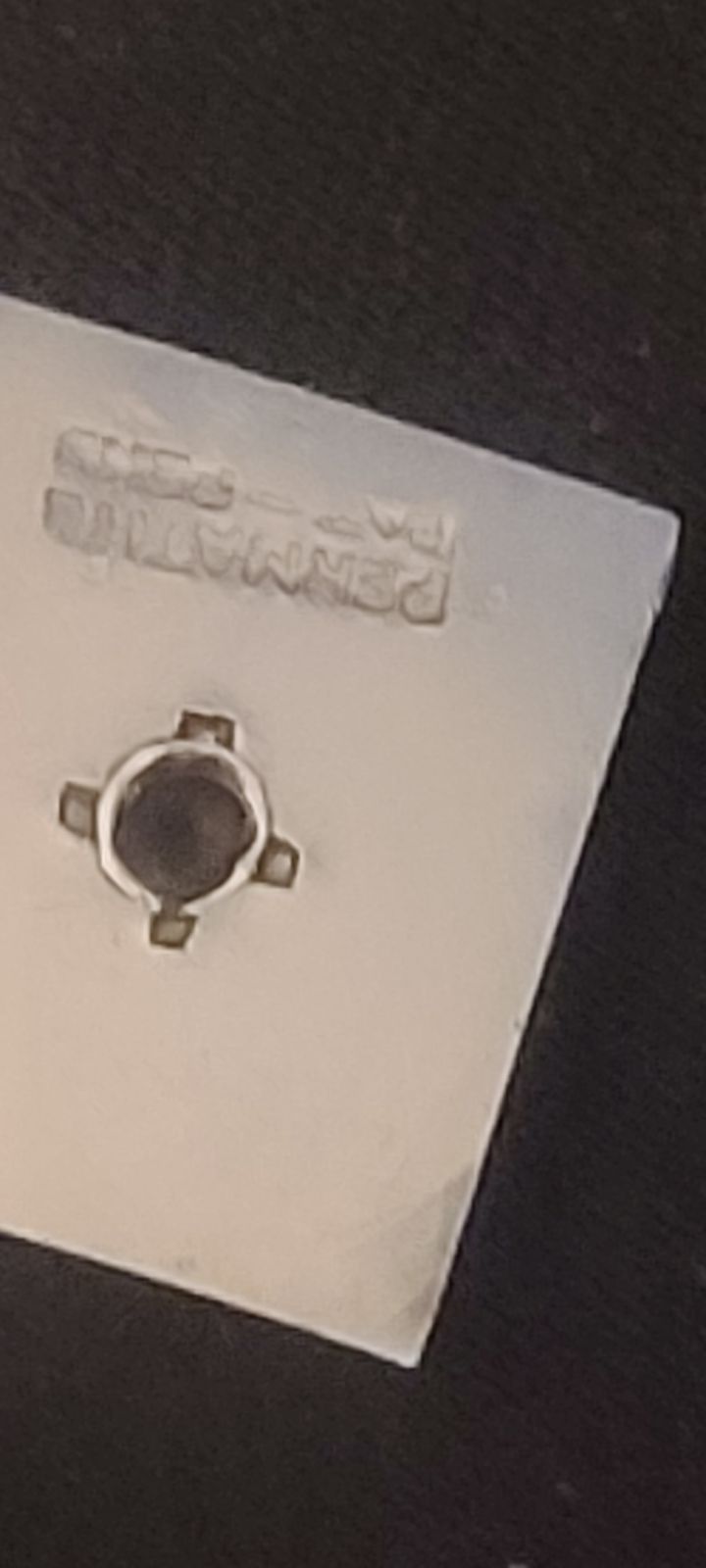
This is a small square white plate. Rotated, its stamp reads PERMATIC over PAT. PEND. (patent pending). In the centre is a round socket with four square bayonet notches, a twist-lock fitting that takes a part with four lugs. It was photographed the day before everything else, against a dark cloth, which suggests someone thought it belonged to something.

We couldn't trace a "Permatic" brand. "Pat. Pend." with no number usually marks a short-lived mid-century product. Best guess: the mounting plate for a fixture, lamp holder, shelf bracket or furniture leg. It's worth trying against the black bases (previous lot), any lamp parts or stands, and the hot-pot fire-boxes before it is thrown away.

Other things it could be

  • Mount for a light fixture or lamp holder
  • Mounting plate for a removable furniture leg
  • Part of a display stand

What points that way

  • Stamped PERMATIC / PAT. PEND.
  • Four-notch bayonet socket

Check in person

  • Magnet test and weigh it
  • Look for further text on the back
  • Try it against fittings elsewhere in the estate

Section V

China & silver

These came from the noritake/ and flatware/ subfolders of the Drive collection and from the table around the brass. They are included so the whole lot is accounted for. A large Noritake service makes a sizeable backdrop in many of the brass photographs.

Source frames: P25, P27, P28, P30, P57, P58, P59, P60, P61, P62, P63, P64

Lot 18Confident

Noritake "Concord" (pattern 4915) dinner service, probably service for 12 or more

Origin
Nagoya, Japan
Period
c.1949–1951
Material
Porcelain, enamel and gilt decoration
Quantity
Estimated 100–130 pieces (count in person)

Fair market value$400 – $800

Whole-set realistic resale. A 76-piece Concord group is asking $560 unsold, and comparable Noritake services for 12 have recently sold for about $300. Selling piece by piece through replacement buyers could reach $1,200–2,000 but would take months.

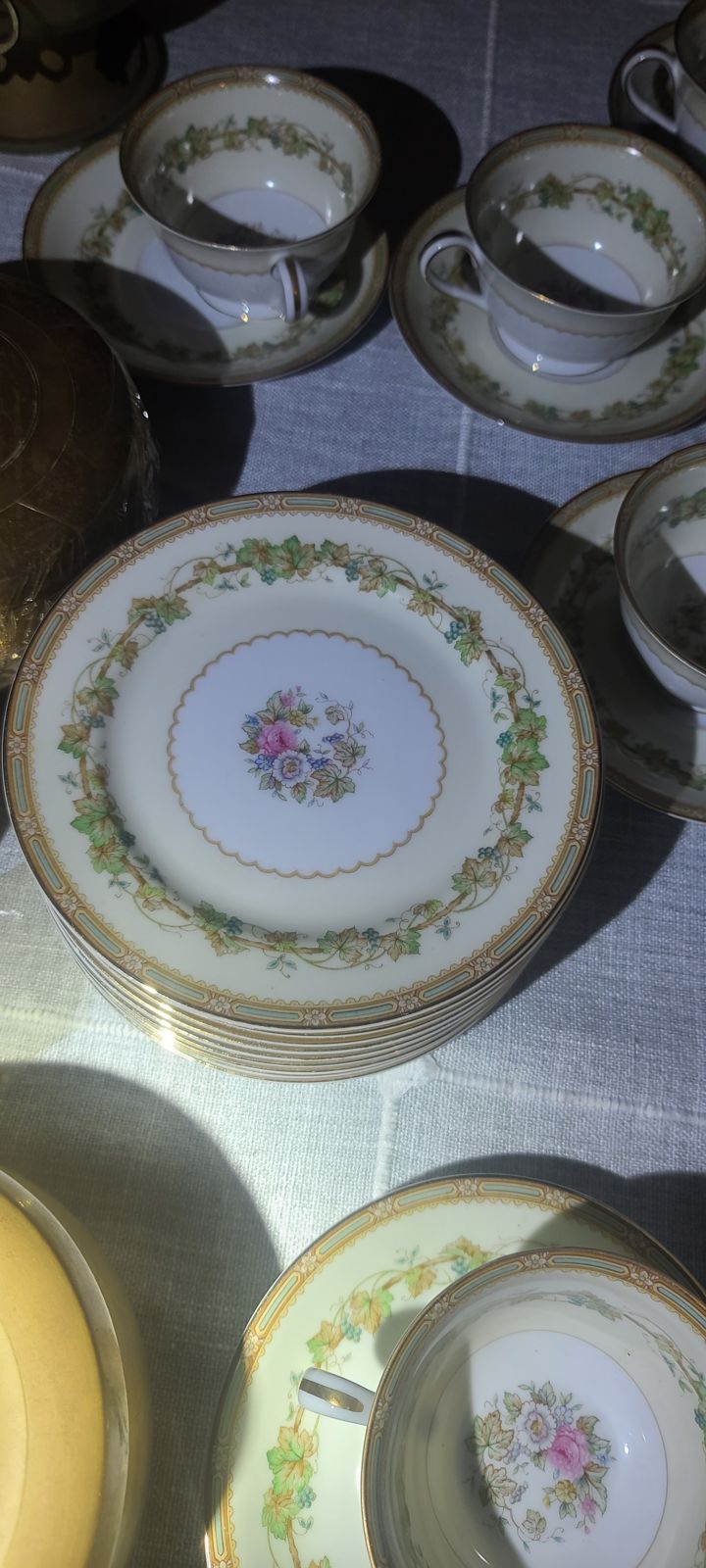
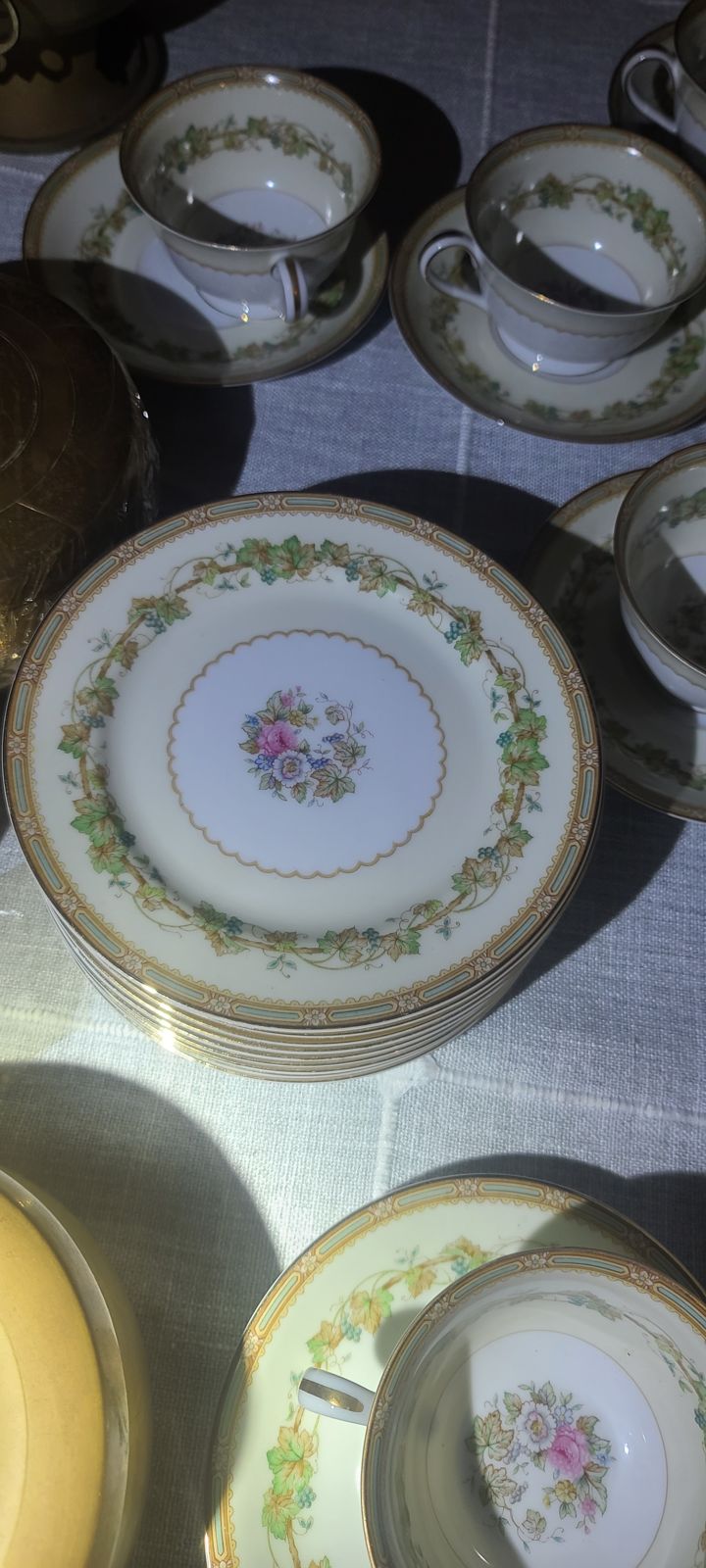
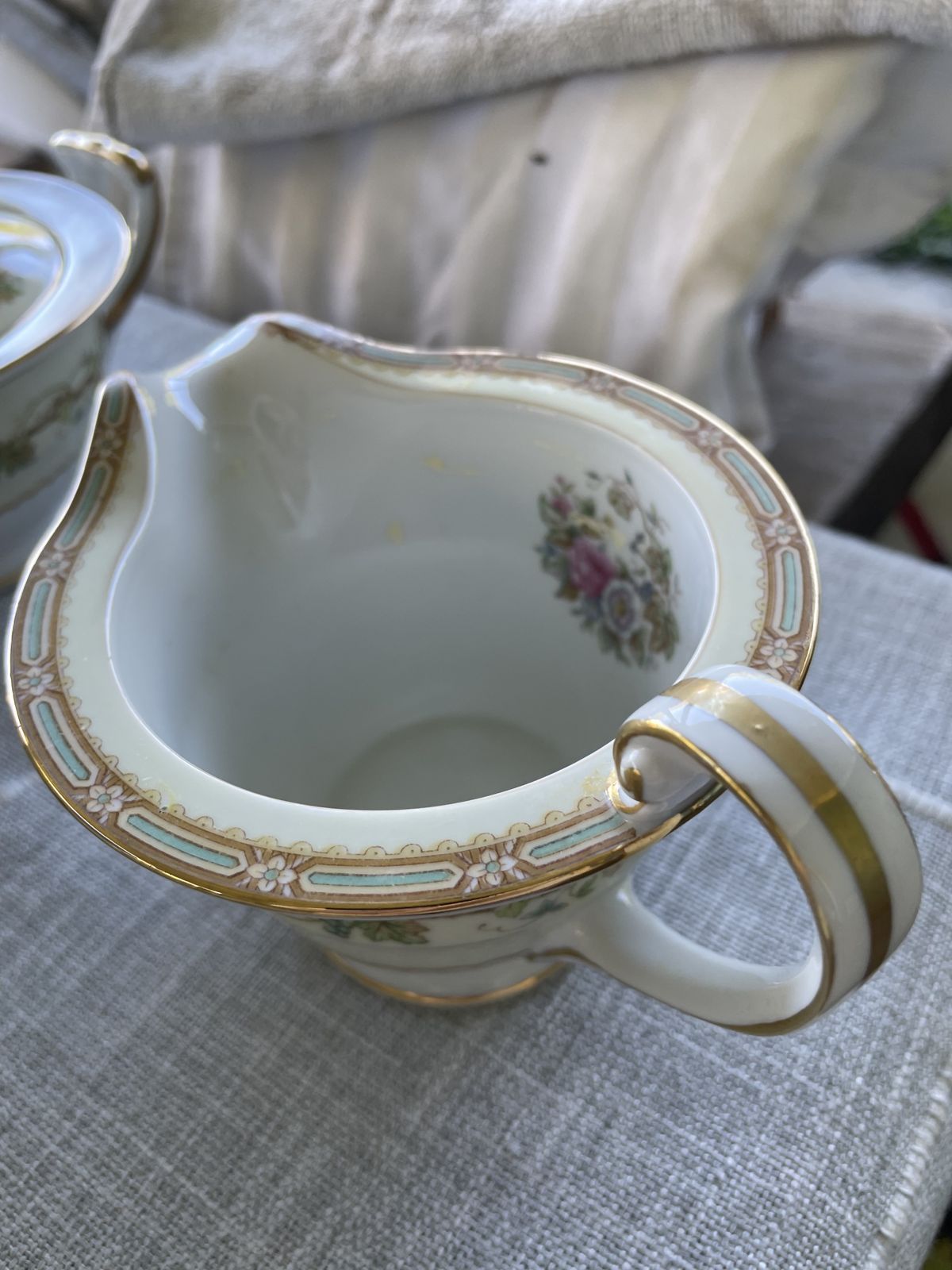
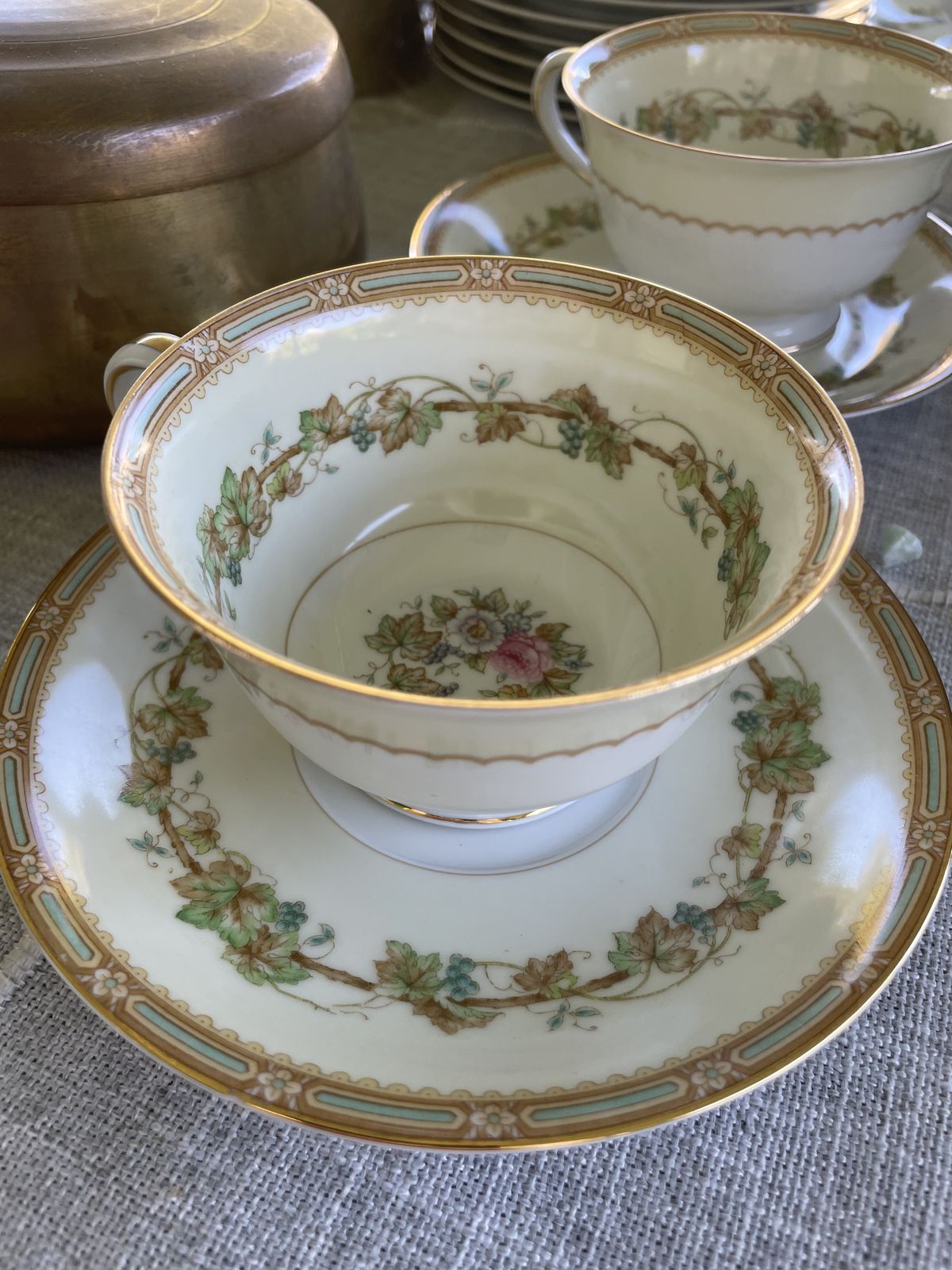
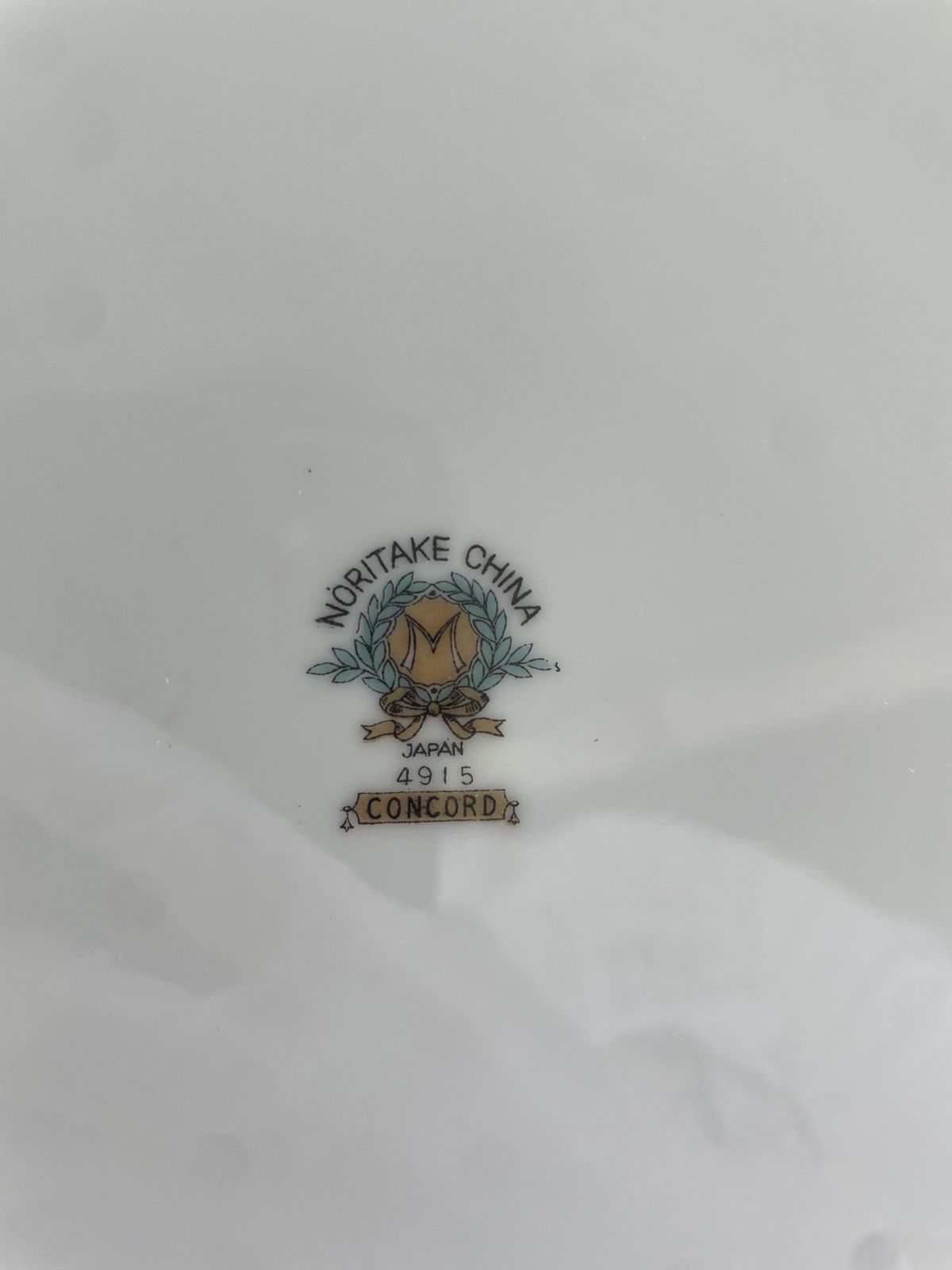
This is the large ivory-and-gold service that fills the background of half the brass photographs. The backstamp (P61) is unambiguous: NORITAKE CHINA, a gold M inside a green laurel wreath tied with a ribbon, then JAPAN / 4915 / CONCORD. The decoration is an ivory rim band with a trailing wreath of green and russet grape leaves and blue-black grapes, a pale blue-green panelled border, a scalloped gold ring around the well, and a centre bouquet of pink roses and blue and white flowers. It is finished in gold.

Noritake made Concord in about 1948–51. That was the first years after the war, when the Nagoya factory was rebuilding its American export trade. The wreathed-M mark marked JAPAN rather than OCCUPIED JAPAN places this set at about 1949–1953, which agrees with the pattern dates.

From the stacks in P25 and P27–P30 we count, roughly, 18–24 dinner plates, 15–18 rimmed soups, 10–15 salad or bread plates, 10–12 cups and saucers, fruit or sauce dishes, and a creamer and sugar. That is a full service for twelve with extras. Large intact mid-century Noritake services are common, so the market is buyer-friendly. Condition and completeness matter more than anything else. Note that Concord 4915 is often confused online with a different, later blue Noritake 'Concord' pattern (6207).

Other things it could be

  • None as to identity: the backstamp is definitive

What points that way

  • Backstamp NORITAKE CHINA, wreathed M, JAPAN, 4915, CONCORD
  • Grape-leaf wreath, blue-green panel border, rose centre

Check in person

  • Count every piece by form; listings sell by the count
  • Hold each plate to the light and look for chips, hairlines, and worn gold on rims (the creamer in P59 shows some gold wear)
  • Gold trim means no dishwasher and no microwave. Say so in any listing
  • Serving pieces (platters, covered vegetable dishes, gravy boat) add the most value if they exist

Source frames: P53, P65

Lot 19Probable

Sango "Nancy" fine china

Origin
Japan (Sango)
Period
c.1960s–1970s
Material
Porcelain, gilt trim
Quantity
Unknown (only backstamps photographed)

Fair market value$40 – $150

$2–8 per piece realised. Asking prices for small groups run $15–40 with few sales, so the range assumes a modest set of roughly 20–60 pieces.

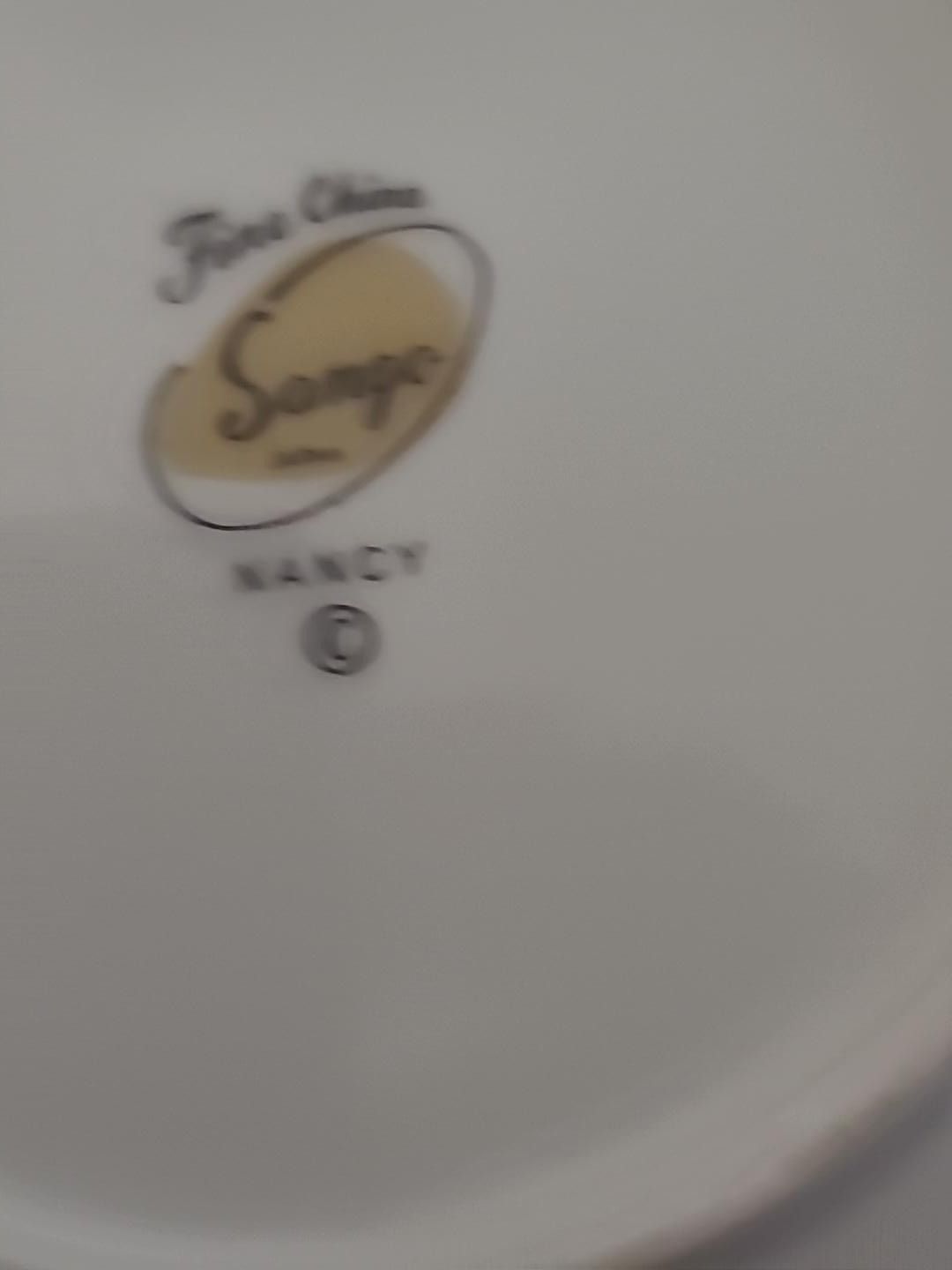
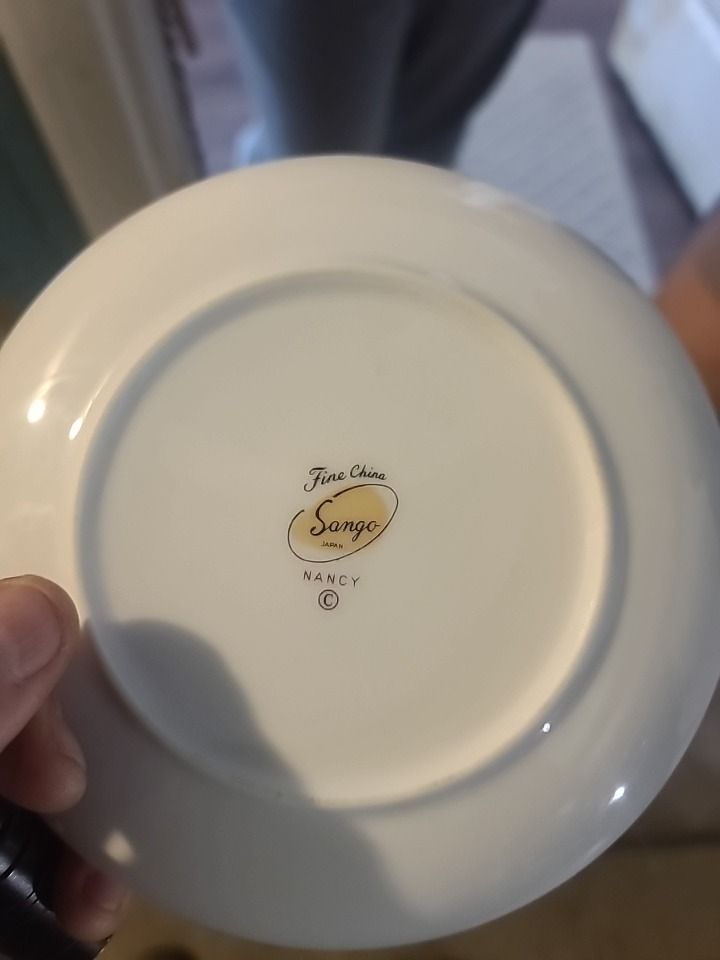
Two photographs show only the backstamp: 'Fine China' over a gold oval with Sango in script, JAPAN, then NANCY and a copyright sign. Sango was a Japanese export brand sold through American department stores. 'Nancy' is a pink rose and rosebud pattern with grey-green leaves and gold trim. The © style of the mark places it in the 1960s–70s. It's an attractive but mass-market service with weak resale demand, and it reads as everyday china next to the Noritake.

Other things it could be

  • None: the backstamp identifies it

What points that way

  • Backstamp: Fine China / Sango / JAPAN / NANCY ©

Check in person

  • Photograph the front of a plate and count the pieces
  • Check the gold trim for wear

Comparables

ComparablePriceVenue
Vtg Sango Nancy 4 salad plates and 6 coupe soup bowls$40 askingeBay · Sep 2026
Vtg MCM Sango Japan fine china Nancy set of 4 berry bowls$15 askingeBay · Sep 2026
Sango Japan fine china Nancy platter$20 askingeBay · Sep 2026
Discontinued Sango Nancy fine china (piece-price survey)B&B $5–8, C/S $11–15MicrowaveCookingForOne

Source frames: P06, P07, P54, P55, P56

Lot 20Confident

Westmorland sterling flatware: "George & Martha Washington" pattern

Origin
Westmorland Sterling, Wallingford, Connecticut, USA
Period
Pattern introduced 1940
Material
Sterling silver (.925); hollow-handle knife with stainless blade
Quantity
At least a dinner fork and a hollow-handle knife photographed. Count the full drawer

Fair market value$110 – $160

Priced for the two pieces actually photographed: dinner fork about $75–100 (single forks sold for $95 in Sep 2026) and hollow-handle knife about $16–45. Every additional solid piece adds roughly $40–100. A 60-piece service sold for $4,000 on 21 Sep 2026.

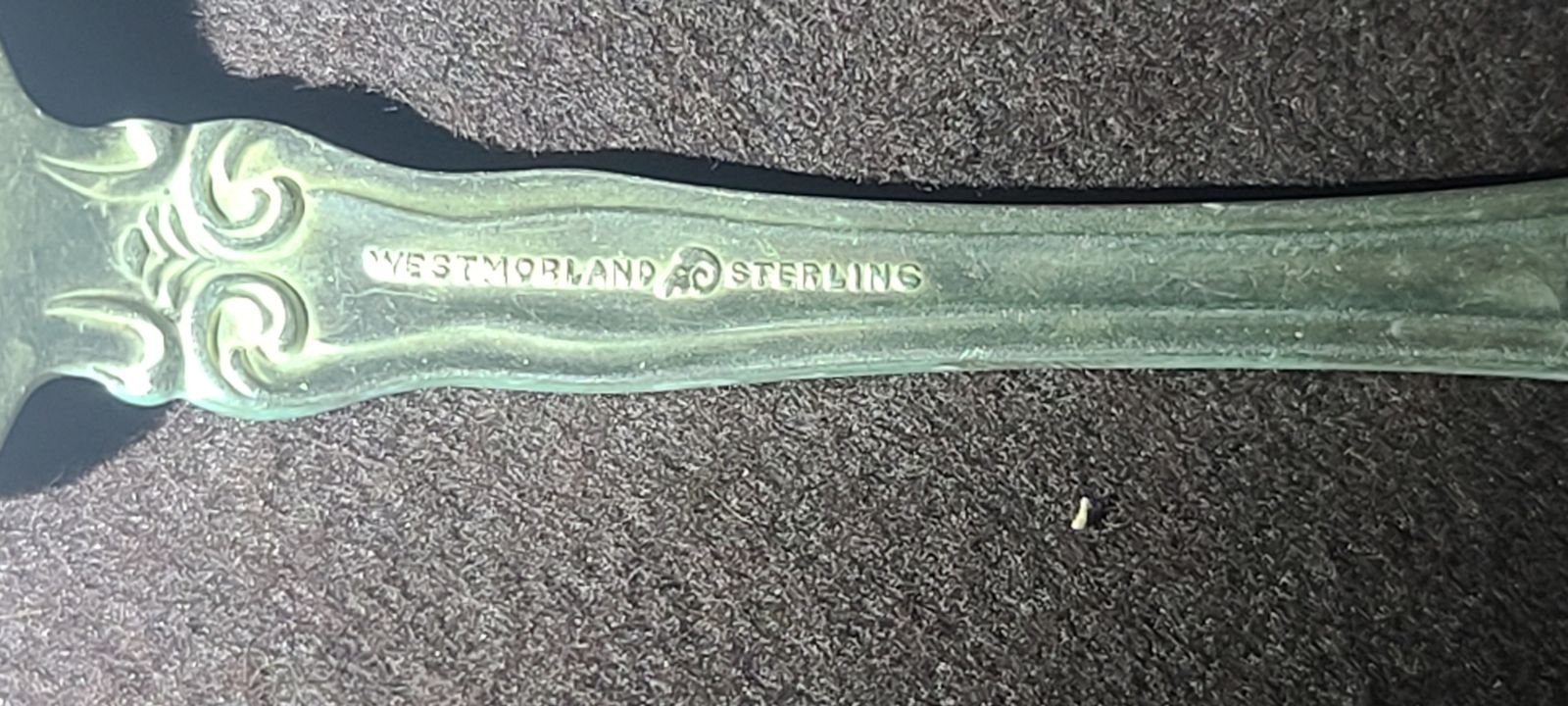
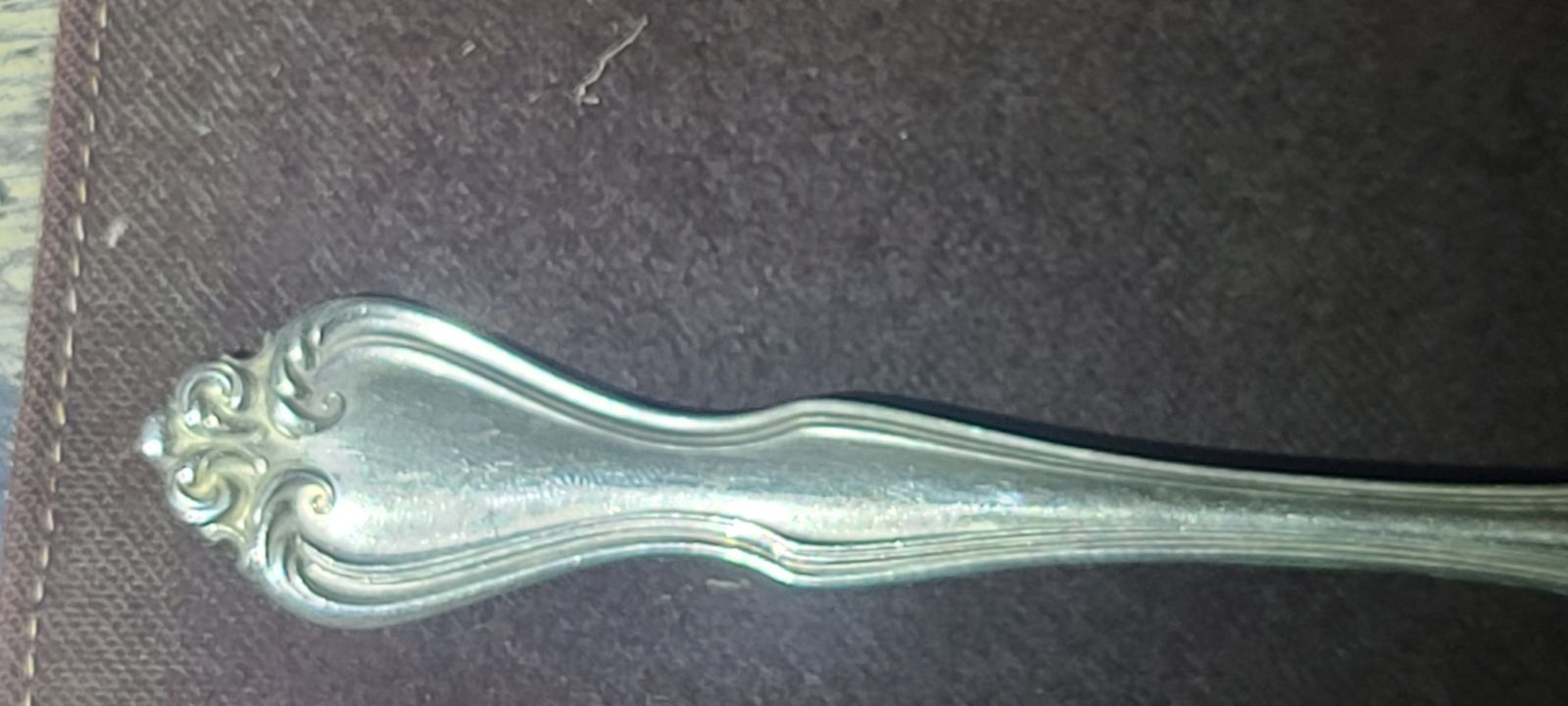
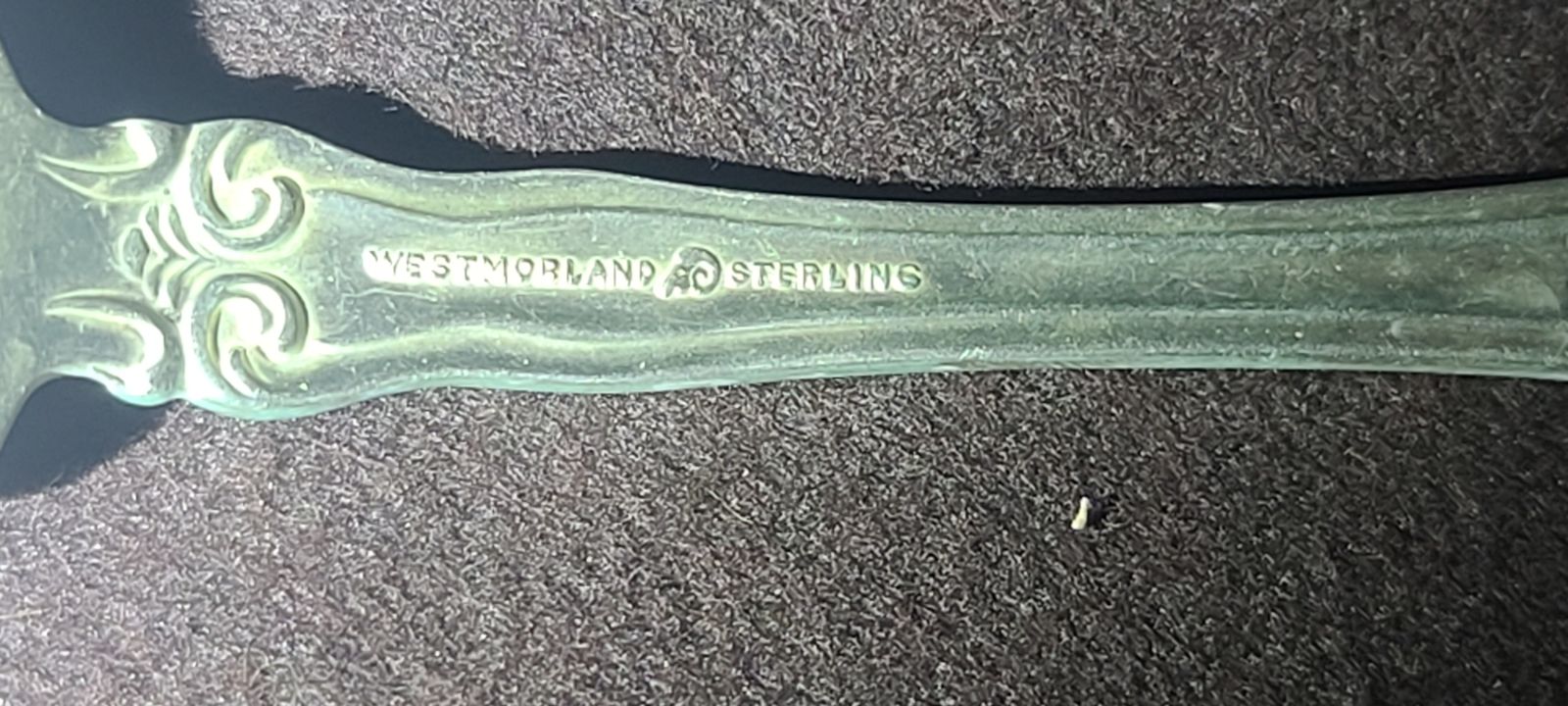
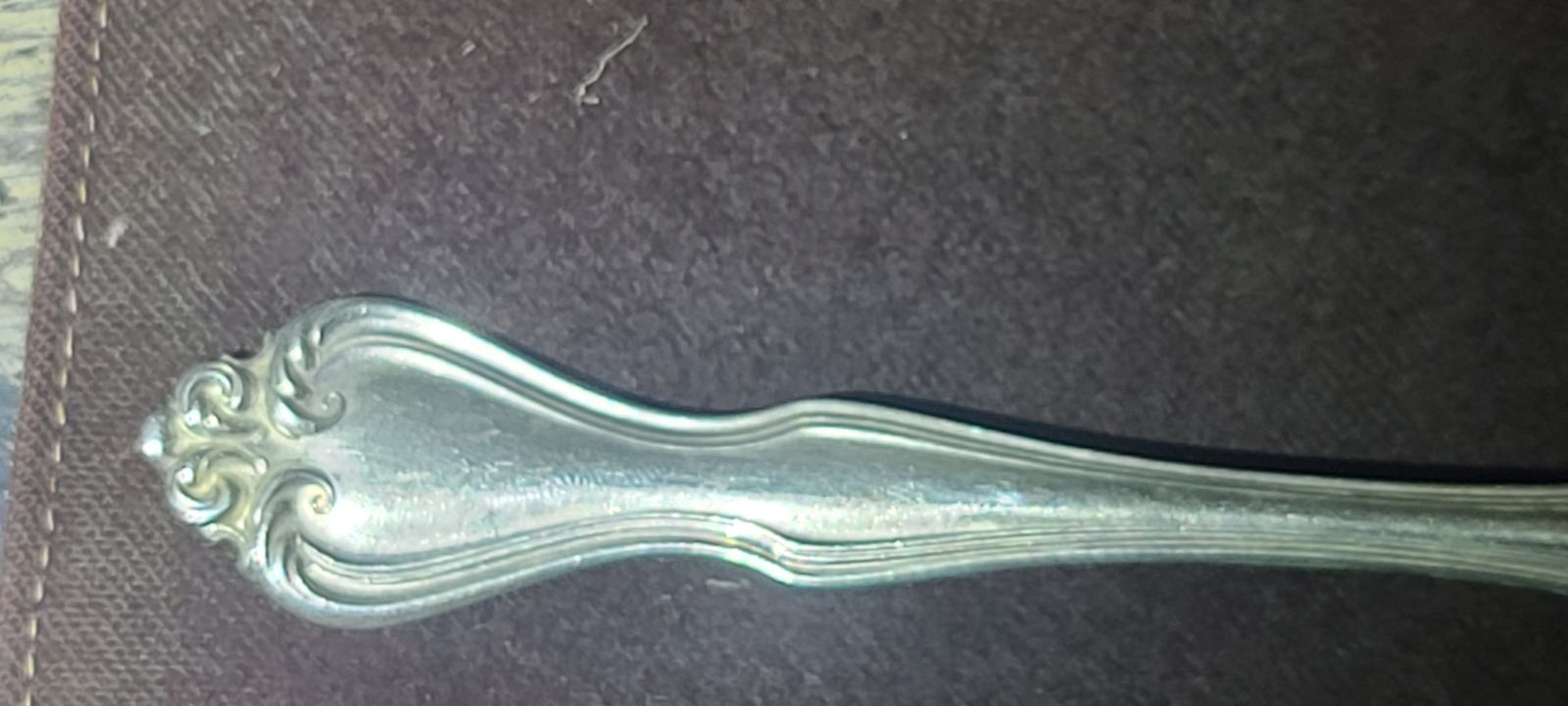
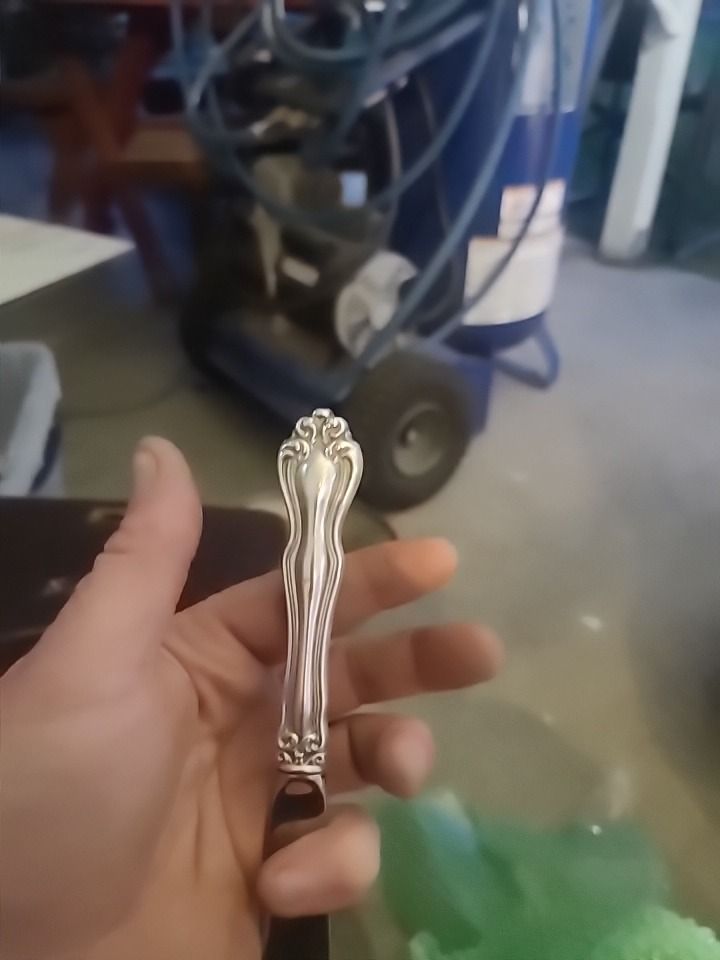
The fork back is stamped WESTMORLAND [logo] STERLING (P06/P54). The handle has a symmetrical C-scroll tip, a repeated scroll at the shoulder and several parallel grooves down the stem. That matches Westmorland's 'George & Martha Washington' pattern of 1940, one of the most popular American sterling patterns of the mid-century bridal-registry era. P56 is a hollow-handle knife: a thin sterling shell filled with cement around a stainless blade.

For once, sterling is worth more as flatware than as metal. With silver at about $61 per troy ounce (30 September 2026), a solid dinner fork of about 45–49 g holds about $80–90 of melt value, and a pattern buyer pays about the same or more. A hollow-handle knife holds only 10–15 g of recoverable silver and should always be sold as a pattern piece, never scrapped.

Other things it could be

  • None as to maker. Pattern match is by handle design and should be confirmed against Replacements' pattern photograph

What points that way

  • Stamped WESTMORLAND STERLING with the maker's logo
  • C-scroll tip and grooved stem of George & Martha

Check in person

  • Count every piece by form (dinner fork, salad fork, teaspoon, soup spoon, knife, serving pieces)
  • Weigh the solid pieces in grams to set the melt floor (about $1.50–1.80/g)
  • Look for monograms, which reduce pattern value
  • Keep the knives together; they sell in sets of 4–8